
Utah News Dispatch
Utah school board won’t sign anti-DEI resolution, letter pushing to end U.S. Education Department

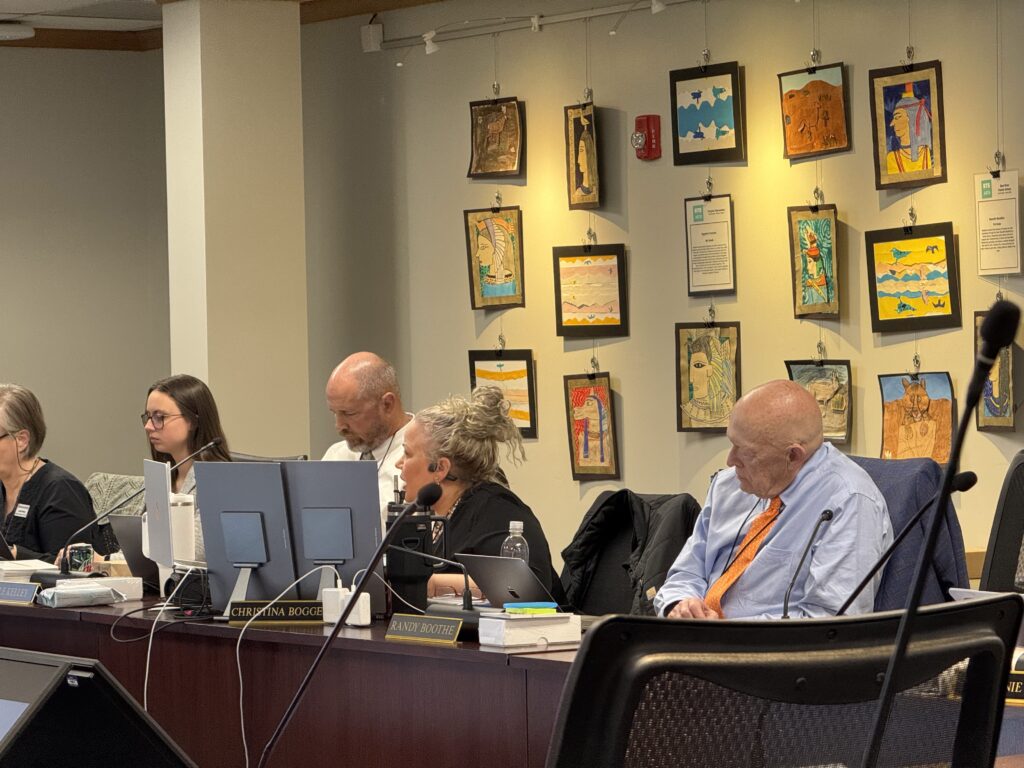

Utah State Board of Education discuss an anti-DEI resolution on April 3, 2025 (Alixel Cabrera/Utah News Dispatch)
A Utah State Board of Education resolution banning diversity, equity and inclusion from public schools failed with a 4-10 vote on Thursday.
Much of the discussion around the resolution centered on whether to delay a vote on the controversial proposal made by board member Christina Boggess. There were questions about specific examples of Utah schools not complying with a 2024 law restricting DEI efforts in all public institutions, and also whether a rule, and not a resolution, would be a more appropriate path to eliminate DEI programs.
LeAnn Wood, a board member who supported postponing the discussion indefinitely, said she worried about the hundreds of calls and emails she received from constituents in her district about the resolution. That much angst, she said, indicates something is not right.
SUBSCRIBE: GET THE MORNING HEADLINES DELIVERED TO YOUR INBOX
“I don’t think a resolution is the answer. If we need to define what compliance looks like, then we need to do that,” she said. “We need to do our job. We do not need a political statement of what we think should be happening.”
Boggess, however, pushed back against an indefinite postponement.
“I think we’re giving the proverbial middle finger to the Legislature,” Boggess said. “I think we’re giving the proverbial middle finger to our federal agencies who have spoken very boldly on these issues and have asked us to address them.”
Utah State Board of Education to consider resolution tying DEI programs to communist goals
The draft, which had been controversial among Utahns for tying DEI programs to communist goals, was updated to eliminate references to communism and to make distinctions for special education programs, among other provisions. But, ultimately, like all of the proposed actions to postpone the discussion, the resolution failed.
A couple of members from Latinos in Action, a nonprofit that offers a year-long elective course aimed to bridging opportunity and graduation gaps for Latino students, spoke against the resolution during the meeting’s public comment section.
Christian Hernandez, a social studies teacher, highlighted how immigrants have vastly contributed to innovation in the country and why programs like Latinos in Action are necessary to provide leadership tools and academic support for students who may feel overlooked.
“The notion that programs like (Latinos in Action) are Soviet style is divisive and misleading,” Hernandez said. “Programs like this embody the very spirit of America, and how we can become leaders promoting progress and opportunity.”

Under Utah’s anti-DEI law, affinity and cultural groups in public institutions are still permitted as long as they don’t exclude anyone based on their race, color, ethnicity, sex, sexual orientation, national origin, religion or gender identity. However, according to Hernandez, the program would have to be eliminated if the resolution passed.
However, Boggess pointed to an addition to the draft made by Utah’s congressional delegation, she said: “Without a firm directive to comply with the Executive Order, the State of Utah stands to lose Federal Funding for education,” the newest version of the resolution states.
And, she said the resolution had to be considered seriously, since she’s personally aware of over 100 complaints of DEI violations in Utah schools made in a U.S. Department of Education online portal.
Board members also raised other concerns about the resolution.
“This appears to be a rule dressed as a resolution,” said member Joseph Kerry, questioning whether approving it would go against the board’s policies.
It would actually violate two of their policies, a member of the board’s legal counsel said — backing a resolution that mandates something to happen as if it were a rule, and the board’s policy on policies, which dictates that all board policies are binding.
Should the U.S. Department of Education be dismantled?
The majority of the board also voted against signing a letter of intent addressed to President Donald Trump, Secretary of Education Linda McMahon and the Utah congressional delegation to allow the state to manage federal dollars for education purposes.
“I think there’s nothing wrong with us saying, ‘if you’re going this direction, we’ve got the qualifications to do this,’” member Jennie Earl said. “I think this also lets the legislature know we can do this.”
But, that proposal also failed despite some attempts to make it shorter and “less disparaging” to federally-managed programs, according to board member Carol Lear.
But, still, after the Utah Legislature rejected to fund some items the board deemed important for Utah students, many of the members said they don’t trust the state to protect some programs that are managed at the federal level.
Lear cited programs like Utah Fits All, the school voucher program that the state’s largest teacher union is challenging in court for its constitutionality, and a 2025 bill that — before it was vetoed — would have rerouted property tax revenue for schools into the state general fund.
She also fears for programs like the McKinney-Vento Homeless Assistance Act, which provides students experiencing homelessness with equal access to public education.
“That’s not going to be a popular use of funds for either the state or for individual LEAs, so I am one very grateful person that those children are served directly by federal regulations,” Lear said.
Other members, like Boggess, said that while they believe government is best when it is closer to the people, they still were skeptical about the move, especially because it would imply that the U.S. Department of Health and Human Services would take over Department of Education tasks
“It presents this conundrum wherein we advocate for the abolition of an agency which only redirects to an agency that is not an expert in education,” Boggess said.