Utah News Dispatch
Utah officials unveil site for 1,300-bed homeless campus after long, secretive search


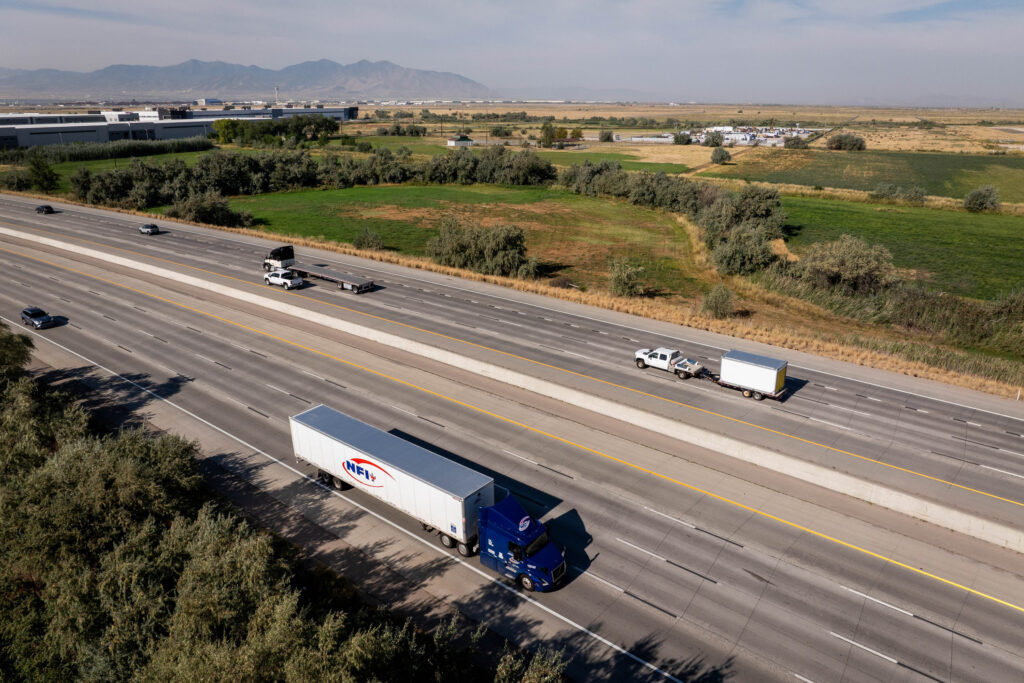


The site of a future homeless services campus at 2520 N. 2200 West in Salt Lake City is pictured with I-215 in the foreground on Wednesday, Sept. 3, 2025. (Photo by Spenser Heaps for Utah News Dispatch)
This breaking story has been updated.
After months of a tight-lipped search, state officials have announced the piece of property they’ve zeroed in on for a new 1,300-bed “transformative” homeless campus.
The Utah Office of Homeless Services and the Utah Homeless Services Board announced early Wednesday morning that state leaders have signed a contractual agreement for the state to acquire a 15.85-acre property that’s currently owned by Salt Lake City.
That property, located at 2520 N. 2200 West, Salt Lake City, is an open field located directly west of I-215 and roughly a mile south from North Salt Lake’s city boundaries, in Salt Lake City’s Northpointe area.
Just south of the property is a warehouse park, and to its north is a small agricultural neighborhood. Directly to the east, across I-215, is a horse boarding facility, Hunter Stable & Arena. It’s also located relatively near the Jordan River OHV State Recreation Area.
Wednesday’s announcement is a major development for the Utah Office of Homeless Services and the Utah Homeless Board in their efforts to increase the state’s emergency homeless shelter capacity while also envisioning not just a shelter, but a “campus” to help people turn their lives around and move out of homelessness.
A ‘turning point’
“This is more than a campus, it’s a turning point for Utah of reimagining hope,” Wayne Niederhauser, the state’s homeless coordinator, said in a prepared statement. “It will further fulfill the identified need to provide additional beds and treatment in Utah’s homeless response while providing individuals served by the campus a transformative path from crisis to stability and, ultimately, thriving.”
The new homeless campus is envisioned to be a “comprehensive hub where individuals experiencing homelessness can access the support and treatment they need to move from homelessness to stability and long-term self-reliance,” the Utah Office of Homeless Services said in Wednesday morning’s announcement.
It’s envisioned to be a place where people experiencing homelessness can go for all of their services in one place.
“Designed to complement the existing homeless resource centers, shelters and service providers throughout Utah, the transformative campus is a place where those experiencing homelessness find help for recovery, employment, criminal justice assistance, and housing, accessible in a single location,” the office continued.
Concluding a long, secretive search
Throughout their search, state officials have declined to publicly share what properties they’ve been considering, citing real estate acquisition privacy considerations.
Niederhauser — a former Utah Senate president who also has worked as a real estate broker — told Utah News Dispatch in an interview on Wednesday that he started working on the concept of a homeless “campus” just months after Gov. Spencer Cox first appointed him as state homeless coordinator more than four years ago.
The goal, he said, was not only to expand Utah’s homeless shelter capacity, but also create a long-term solution as the state faces population growth pressures.
“I started looking at possibilities where we could expand, and I wanted to have property so that we had a place (for) a 50- to 100-year solution for the Salt Lake (County) area and region,” Niederhauser said. “I knew early on that we were going to need to have a location that we could rely upon and expand as populations grow, as we deal with this very difficult problem for many years to come. I just didn’t want the state to be having to look at different places every five or 10 years. We wanted a long term solution.”
It wasn’t until last fall that the concept was formalized when the Utah Homeless Services Board voted to set a deadline of Oct. 1, 2025, for the campus to be built. But Niederhauser told Utah News Dispatch last month that that deadline likely won’t be met, since the search has proven difficult and taken longer than previously expected. Now, the first phase of the development isn’t expected to be finished until sometime in 2027.


Niederhauser said he looked at roughly 50 pieces of property before settling on the Northpointe parcel as the best choice.
“This one’s a little closer to the city than a lot of the other ones I looked at,” he said. “There isn’t a perfect property … There are some potential challenges with this, but it presented a lot less challenges than all the other properties.”
Niederhauser acknowledged that transportation to the fairly remote area “is going to be an issue.”
“But we’ve got a solution for that, and that’s having a shuttle system,” he said, adding that “it will cost money,” but state officials plan to expand the existing shuttle system that transports people to and from the existing homeless resource centers in Salt Lake City and South Salt Lake.
“We’ve also been in talks with (Utah Transit Authority),” he added. “I think there’s some long-term desire to have even some bussing into that area.”
Niederhauser said it’s an “undeveloped” area that’s started to see some commercial development, but there’s also a small agricultural neighborhood to the north.
“The impacts are higher in residential areas. Not that businesses are not impacted, they will be to some degree. But we plan on having a very robust public safety and security situation so that the impacts are minimized,” Niederhauser said.
Utah homeless board OKs search for up to 1,200-bed ‘centralized campus.’ What now?
Room for expansion
Though the parcel is 15.85 acres, Niederhauser has previously said state officials would prefer about 30 acres of contiguous land for the campus. However, there’s at least two other undeveloped properties bordering the Salt Lake City-owned parcel that together would bring the total footprint up to roughly 40 acres. One is a 11.4-acre property owned by the Rose Park Stake of The Church of Jesus Christ of Latter-day Saints, according to Salt Lake County Assessor records.
Niederhauser said “eventually” state officials would like to expand the acreage, “and looks like there’s some possibilities of that.” He said state officials have “had conversations” with the church about that 11.4-acre adjoining parcel, but nothing has been finalized.
“We know that this first phase is where we need a lot of shelter and services. We know there will need to be some expansion in the future. The church has expressed some interest, so we’ve had conversations, but the timing of that is yet to be determined,” he said.
What will the cost of the property be?
Niederhauser said the contract that’s been signed allows for the state to either purchase the land or trade other open space in exchange. He said state and city leaders have not yet decided which of those options will be used to finalize the acquisition, pending an appraisal process.
“The city and the state did appraisals and there’s some space in between them, so we’re going to join together in another appraisal to settle on a price,” Niederhauser said.
SUBSCRIBE: GET THE MORNING HEADLINES DELIVERED TO YOUR INBOX
He added that the various appraisals have valued the land at between $5.7 million and $8.8 million, so the final value will be “somewhere in between there.”
Niederhauser’s office has about $24 million on hand to purchase the land and start building the campus — but the entire project is expected to cost much more.
Annual operations are expected to be “north of $30 million,” Niederhauser said, and the cost to build infrastructure is an estimated $75 million, excluding the land purchase.
However, there’s a big hurdle that Niederhauser will need to overcome to get the project over the finish line. He’ll have to convince the Utah Legislature to help pay for it.
“That’s going to be a heavy lift,” he acknowledged. “It’s not going to be an easy course to travel. But we’ll be engaging with the Legislature. We’ll be engaging with other potential funders now as we start to plan more details so we can build a capital stack and operating revenue with the different partners that the state will need to make it happen.”
Earlier this year, as Niederhauser worked with Salt Lake City officials to find a parcel, the Utah Legislature passed a bill granting the state eminent domain powers to help acquire a city-owned parcel if need be.
For this particular property, Niederhauser said the state ended up not needing to use those eminent domain powers.
‘A critical step,’ SLC Mayor Mendenhall says
Leading up to Wednesday’s announcement, Salt Lake City Mayor Erin Mendenhall — who is also a member of the Utah Homeless Services Board — has been urging the state to act quickly.
On Aug. 13, the day a state report was released showing an 18% rise in Utah homelessness, Mendenhall said that number should be heard as a “battle cry” for Utah lawmakers to do more to address homelessness.
18% rise in Utah homelessness should be ‘battle cry’ for lawmakers to do more, SLC mayor says
The mayor also warned there’s “inadequate funding to build and non-existent funding to operate a new campus shelter.” She urged lawmakers to appropriate more during their 2026 general session in January.
Still, the mayor applauded the site announcement as a step forward.
“Our state has long needed more shelter beds and services, and this campus represents a critical step forward in supporting the most vulnerable people in our communities,” Mendenhall said in a prepared statement.
“By providing consistent shelter and wraparound services in one location, this facility could also help Salt Lake City first responders by reducing the number of emergency calls, freeing up law enforcement to focus on public safety, and better connecting people to the help they need,” she added.
North Salt Lake mayor ‘isn’t surprised’ but concerned about impacts
North Salt Lake Mayor Brian Horrocks told Utah News Dispatch on Wednesday morning that he’s “not surprised” state officials chose that property. He said there have been rumblings that state leaders were looking in that area as they’ve been talking with neighbors leading up to the selection.
“We’re disappointed. Mostly disappointed in the process, very secretive,” Horrocks said, adding that “they told us they would keep us in the loop and they haven’t.”
The mayor added that North Salt Lake city leaders are “looking at options.”


“We can’t control what they do in another city … but what we can control we’ll try to control,” Horrocks said.
Asked what that could entail, he said, “for example we control the bridge across the Jordan River.”
Pressed further, Horrocks said, “I don’t know, I saw a barge hit a bridge in Baltimore, and that was pretty effective.”
Asked if he meant city leaders are considering destroying that bridge or blockading access from the area into North Salt Lake, Horrocks said, “I don’t know what our options are.”
“I’m looking at it from a point of view that we do not necessarily need to provide access to that part of Salt Lake County, and vice versa,” he said. “They’re free to do whatever they want on their side of the river, and we’re free to do whatever we want on our side of the river.”
Horrocks said he understands homelessness is a tough issue, but he has a city to represent, and he’s most concerned with protecting North Salt Lake from its impacts.
“We’ll do what we can do to protect our community and our neighborhood, and they’ll do what they do,” he said.
To the mayor’s comments Niederhauser said state leaders “are focused on the campus and getting something operational.”
“We’re focused on making it a place where there’s very little impact to the community so we won’t need to block bridges and other accesses because, you know, it’s a safe place for everybody,” Niederhauser said.
To the mayor’s complaints about the secretive process, Niederhauser said “it’s very difficult to find a property and get it under contract.”
“I’ve done this for 30 years as a real estate developer. We, first of all, secure the land, and then we go through community meetings … and then you go to the city at that point and you start to work through the process,” he said. “But I wouldn’t even begin to do that without having a piece of property under contract. That’s the first step. And then you engage in some community meetings.”
West-side concerns
In response to the site selection, Sen. Luz Escamilla, D-Salt Lake city, and Rep. Sandra Hollins, D-Salt Lake City, issued a statement expressing concern about the placing the campus on the city’s west side, and that they’re concerned “that this decision was made without any significant input from the public.”
“As leaders and champions on issues of homelessness, we know how critical it is for our unhoused neighbors to have access to safe shelter and the services they need to regain stability,” they said. “This campus is an important step in addressing the state’s homelessness crisis, but it must move forward in partnership with the people who will live alongside it.”
Escamilla and Hollins added that “our community has always been committed to helping those in need; it is central to who we are, and we are proud of this.”

“At the same time, this neighborhood has historically carried a disproportionate share of the state’s social and environmental burdens,” they said. “The relocation of the state correctional facility here is one example. Now, with the addition of a 1,300-bed homeless services campus, the West Side is once again being asked to carry a disproportionate share of the state’s response to homelessness.”
They urged state and Salt Lake City leaders to “move forward with care and foresight, guided by a clear and comprehensive plan that addresses transportation, public safety, and the well-being of both campus residents and the surrounding neighborhood.”
“If done thoughtfully, this project can meet urgent needs while respecting and strengthening the community that hosts it.”
What’s next
Niederhauser said the Office of Homeless Services plans to hold a series of public meetings to discuss the project’s planning in coming weeks and months. His office encouraged anyone wanting to receive updates on the campus to sign up at www.homelesscampus.utah.gov.
According to state officials, a feasibility study on the property has been completed and environmental studies are ongoing.
“The next steps are to secure funding partnerships, continue to engage with community stakeholders, service providers, and state leaders to bring the campus to actualization,” the Utah Homeless Services Office said. “It is anticipated that the initial operations of the campus will begin in 2027.
Randy Shumway, chair of the Utah Homeless Services Board, applauded the campus vision during a time when Utah’s homeless population has been increasing.
“Despite tremendous effort, resources, and goodwill across the state, homelessness in Utah has continued to worsen — for both those experiencing it and for our communities,” Shumway said. “The proposed Utah campus will take a human-first approach that provides healing and stability while embedding accountability at every stage.”
According to Wednesday’s announcement, state officials envision the homeless campus as a “‘hub and spoke’ system, where individuals can Step In to access core services at a centralized hub, and once stabilized and ready to Step Up, they can Step Out to be connected efficiently to additional specialized resources across the community — the spokes.”
“This model reduces barriers to service access, increases operational efficiency, and strengthens the broader network of support,” the office said. “By expanding capacity and improving the overall system’s accessibility, the campus would enhance the sustainability and effectiveness of the region’s homelessness response.”
Last fall, a delegation of Utah leaders — including Niederhauser, other Homeless Services Board members, officials from Salt Lake County and Salt Lake City and others — traveled to San Antonio, Texas, where they visited Haven for Hope, a nationally recognized nonprofit, which is described as “more than a shelter,” and a “transformational campus” on its website. They envision Utah’s campus will be modeled similarly.
Shumway said the campus, “by pairing compassionate support and medical care with clear expectations and opportunities for growth,” it’s envisioned to help people “reclaim their inherent dignity, achieve self-reliance, and live drug-free, crime-free, and contributing lives.”