
Utah News Dispatch
Utah may be home to a nuclear innovation campus, Department of Energy announced

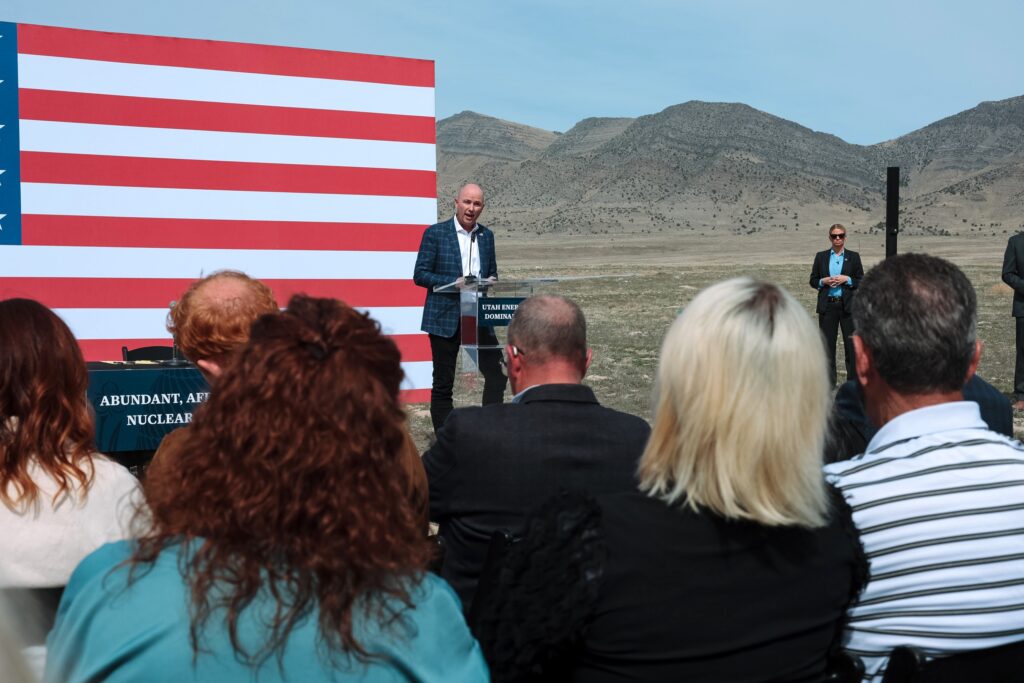

Utah Gov. Spencer Cox announces Utah will be applying with the U.S. Department of Energy to host a “nuclear lifecycle innovation campus” in a remote area in northwest Tooele County during a news conference there on March 27, 2026. (Photo Courtesy of the Utah Governor’s Office)
A campus to develop nuclear technologies may be coming to Utah, as the U.S. Department of Energy shortens its list of potential hosts for new “nuclear lifecycle innovation campuses,” the federal agency announced Tuesday.
Apart from Utah, other four states — Tennessee, Oklahoma, Louisiana and Idaho — are in the running to build campuses that, according to the Department of Energy, “could support activities across the full nuclear fuel lifecycle, including fuel fabrication, enrichment, reprocessing used nuclear fuel, and disposition of waste.”
Utah has campaigned hard for a campus, with Gov. Spencer Cox inviting reporters to a remote site in northwest Tooele County in late March to show a portion of the state’s vision for it, arguing then that the facility would help “build the safest, most complete nuclear energy ecosystem in the country.”
SUBSCRIBE: GET THE MORNING HEADLINES DELIVERED TO YOUR INBOX.
“Today’s agreement with the U.S. Department of @ENERGY is an important step in a competitive process exploring the potential for a Nuclear Lifecycle Innovation Campus in Utah,” Cox said in a social media post on Tuesday. “We’re grateful for @SecretaryWright‘s leadership and look forward to continuing the conversation about how Utah can help strengthen America’s energy security and nuclear supply chain.”
Utah to apply with feds for a nuclear campus in remote Tooele County
The Utah campus is not a done deal yet. The Department of Energy did not provide a specific timeline for when the agreements with states will be final.
During that March event, Utah leaders were still fine tuning the details of their application, but shared they were contemplating using a wide swath of “thousands” of acres in Tooele County for the campus.
Cox said then that the site was “uniquely suited” for the project.
“The geology, the arid climate, existing infrastructure, distance from major population centers, and some of the very best people on planet Earth, make it one of the most practical locations for this kind of work,” he said.
However, environmental advocates from HEAL Utah worry the project may bring high-level radioactive waste to the state. According to Utah’s proposal, the state “is prepared to support DOE in advancing a safe, secure, and compliant approach to managing the first-ever long-term storage solution for (high-level waste) and (used nuclear fuel).”
“I can’t in good conscience say that we won this bid because it really feels like losing,” Lexi Tuddenham, executive director of HEAL Utah, said on Tuesday.
“The Utah office that led this said that they wanted and were willing to take both temporary and permanent high-level waste storage. So that means that it will be shipped from around the country. It will be shipped and buried here in our land forever,” Tuddenham said. “And those issues have not been dealt with, nor have they been truly rolled out in a way that involves people who will be dealing with those health effects potentially for generations.”
In support of the campus, the Utah Legislature also passed a law this year authorizing the state’s Office of Energy Development “to pursue development of a Nuclear Lifecycle Innovation Campus” to prepare for the competitive process the Department of Energy issued.
According the bill text, the scope of the campus may include “facilities for fuel fabrication, uranium conversion and enrichment, and the reprocessing of used nuclear fuel,” as well as the deployment of advanced modular reactors and micro-reactors and the “development of secure, long-term pathways for used nuclear material consistent with national security and environmental safety standards.”
The Utah campus, if materialized, may also host other nuclear-adjacent products, like isotopes, heat, or nuclear supply chain manufacturing.
Utah Republican Sen. John Curtis also celebrated the news of Utah’s selection, arguing that it represents “another vote of confidence in our state’s future.”
“This is an incredible opportunity to strengthen American energy dominance, bolster our domestic nuclear supply chain, and create new high-paying jobs right here in Utah,” Curtis said in a statement.
U.S. Secretary of Energy Chris Wright signed memorandums of understanding with all five shortlisted states to continue to explore pathways to build the campuses, the Department of Energy said in a news release. The proposed projects have the potential to generate about $10 billion in state and local taxes and to create nearly 25,000 jobs, the agency said.
“These campuses will be massive generators of economic growth, create thousands of high-paying jobs, and be crucial to unleashing America’s nuclear renaissance,” Wright said in a statement.