
Utah News Dispatch
Utah Legislature picks congressional map supported by Republican party


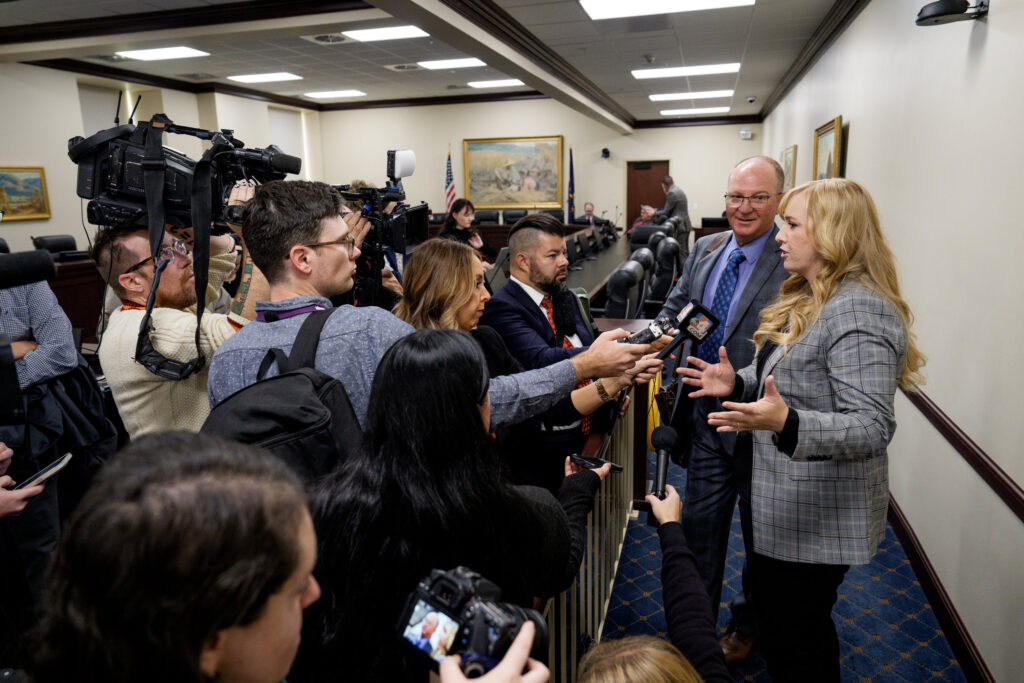


Sen. Scott Sandall, R-Tremonton, and Rep. Candice Pierucci, R-Riverton, talk to reporters after a meeting of the Utah Legislative Redistricting Committee during a special legislative session at the Capitol in Salt Lake City on Monday, Oct. 6, 2025. (Photo by Spenser Heaps for Utah News Dispatch)
The Republican-controlled Utah Legislature voted during a special session Monday to pick map C — a congressional map that the Utah GOP last week encouraged Republicans to support — as their preferred choice to send to a judge for consideration in the state’s court-ordered redistricting process.
Republican legislative leaders insisted that they picked map C not because GOP leaders flagged it as their preferred choice, but because they argued it was the best map that represented both urban and rural voters while splitting the fewest number of cities and counties.
Democrats, however, argued that map C was the worst choice — particularly when paired with a bill the Legislature also voted to approve and Gov. Spencer Cox signed later on Monday that requires the state’s next congressional maps (including the one ultimately picked by 3rd District Judge Dianna Gibson) to pass three statistical tests meant to bar the maps from favoring one party over another.


Two of those statistical tests, Democrats argued, won’t work fairly in a “lopsided” state like Utah where active registered Republicans (921,531) outnumber Democrats (239,389) statewide by more than 680,000 voters. Republicans, on the other hand, argued in favor of codifying the three tests to clarify “vague” language in Proposition 4, the 2018 voter-approved ballot initiative that sought to create an independent redistricting process.
Meanwhile, plaintiffs in the redistricting lawsuit — which successfully challenged the state’s 2021 congressional map and led to Utah’s court-ordered redistricting — announced Monday evening that they submitted two maps for Gibson to consider.
Gibson is expected to ultimately pick a replacement map — either the Legislature’s preferred map or one proposed by the plaintiffs’ — by her deadline of Nov. 10 in order for it to be put in place in time for the 2026 elections.
In an earlier ruling that Republican lawmakers continued to protest throughout Monday’s special session, Gibson determined the state’s 2021 congressional map was the product of an unconstitutional process. She ruled the Legislature overstepped when it repealed and replaced a voter-approved ballot initiative known as Proposition 4 that sought to create an independent redistricting process.
Elizabeth Rasmussen, executive director of Better Boundaries — the group that successfully pursued Proposition 4 in 2018 — issued a statement after Monday’s vote expressing disappointment in the Legislature for “missing an opportunity to rebuild trust with voters.”
“When politicians control redistricting, there is always an incentive to protect power,” she said. “That is why Utah voters passed Proposition 4 to create fair standards and measures that could evolve as data and technology changed.”
Map C, Rasmussen said, “demonstrates how the core principles of Proposition 4 are being sidestepped.”
“Proposition 4 called for fairness measured by the best available tools and data, transparency in how maps are drawn, and accountability to voters rather than political interests,” she said. “Those principles have been replaced with a narrow set of tests that define fairness in limited terms and make it easier for lawmakers to say a map is technically fair even when broader evidence shows it’s not. The tactics have changed, but the result is the same — a map that serves those in power instead of the voters they represent.”

Will lawmakers try to impeach the judge if she doesn’t pick their map?
Republican legislators have repeatedly said they’ll continue to contest Gibson’s ruling voiding the 2021 congressional map, if necessary all the way to the U.S. Supreme Court. In the meantime, some heated comments — especially from two senators on the Senate floor — indicated legislators are entertaining the idea of pursuing articles of impeachment against Gibson if she doesn’t pick their preferred map.
Sen. Dan McCay, R-Riverton, characterized Gibson’s court-ordered redistricting process as a “joke” and a “farce.” And Sen. Brady Brammer, R-Pleasant Grove, argued that the Utah Constitution says “the only way a map can be accepted is by approval by the Legislature.”
“It is our duty as a Legislature to approve a map, otherwise there is no other means by which a map may be used, even if parties ask for it,” Brammer said. “It would be a malfeasance in office — a malfeasance in office — for a court to attempt to accept a map that has not been approved by the Legislature, or for a lieutenant governor to certify and use a map that has not been approved by the Legislature.”


Under Utah law, elected officials and judges can only be impeached for “high crimes and misdemeanors or malfeasance in office.” Any impeachment proceedings would also be required to start in the House.
Pressed during a media availability after the vote on whether lawmakers plan to pursue impeachment, Brammer didn’t give definitive answers to reporters, but left the door open to that possibility.
“Whether malfeasance in office rises to the level of impeachment, that’s always a matter of debate,” Brammer said. “But it would not be within either the statutory or constitutional framework if a court or anyone else other than the Legislature were to attempt to adopt a map.”
House Speaker Mike Schultz, R-Hooper, would not say whether the House would be open to considering articles of impeachment against Gibson, saying, “I’m not going to get into what the House is going to do in a theoretical (situation).” However, he also said the Legislature will “do all we can to protect the power given to it in the Constitution.”
“Nowhere in the Constitution does it allow for a judge to be able to pick a map,” he said. “And we will adamantly defend that, to whatever means necessary.”
Banging his fist on the table, Schultz said “we are skating on some thin lines as far as constitutional balances.”
Debate over map C
Map C would mix rural and urban parts of Utah, split three cities (Millcreek, North Salt Lake and Pleasant Grove) and split three counties (Davis, Salt Lake and Utah). The state’s Democratic stronghold and capital city of Salt Lake City would remain whole, while Salt Lake County (the state’s most populated county) would be split once.
Under the 2021 congressional map that’s since been voided by the courts, Salt Lake County was split four times — which led to a lawsuit from nonpartisan groups including the League of Women Voters of Utah, Mormon Women for Ethical Government and a handful of Salt Lake County voters challenging it as “blatant gerrymandering,” along with claims that lawmakers’ unconstitutionally repealed and replaced Proposition 4.
SUBSCRIBE: GET THE MORNING HEADLINES DELIVERED TO YOUR INBOX
Map C would be at least slightly more competitive for Democrats compared to the 2021 map — but would still result in four congressional districts that would lean in favor of the deep red state’s dominant party, the GOP.
However, Democrats including Rep. Doug Owens, D-Millcreek, continued to argue map C was “still designed to disadvantage one party,” adding that “if the split is such that the minority can never approach a competitive level is just as effective as splitting Democrats into two districts as it is to split them into four. That’s probably what happened here.”
From the other corner, Republicans including Sen. Scott Sandall, R-Tremonton, argued Democrats were focused on advocating for “competitive” districts while Proposition 4’s criteria doesn’t call for that. Rather, he noted that the law prioritizes minimizing city and county splits as among the highest priorities, pointing out that Democrats’ preferred map split 13 cities and four counties.
Schultz also argued that Democrats’ preferred map “didn’t even come close” to adhering to Proposition 4.
“We worked really hard as a legislature and a majority caucus to make sure the maps we put forward through the process met the rules and what Prop 4 meant,” he said. “The Democrats had one outcome, and that was clear. Rep. Owens talked about it, clearly, that he wanted a competitive district. That’s not what Prop 4 says.”

Rep. Candice Pierucci, R-Herriman, also said that Democrats’ preferred map “failed all three” statistical tests legislators codified into law under SB1011.
Owens, however, told reporters that Democrats’ map failing those tests shows how Republican legislators’ codified tests fail to recognize fair maps compared to slanted ones, and “bad maps pass.” He argued that Democrats’ map passed a “neutral ensemble test,” where it’s compared to thousands of maps’ average outcomes and passes if it falls in the middle range of those averages.
“So what we’re saying is if the right tests were applied, our map would have passed with flying colors,” Owens said.
Legislative Redistricting Committee vote to recommend map C
Early Monday morning, the Legislative Redistricting Committee’s only two Democrats — Senate Minority Leader Luz Escamilla, D-Salt Lake City, and Owens — didn’t debate against map C during Monday’s committee hearing and cast their no votes without comment.
As lawmakers fight over dueling redistricting experts, Utahns ask: Why not one of our maps?
Owens told Utah News Dispatch after the meeting that Democrats already made their case against the committee’s slate of five proposed maps and in favor of Democrats’ preferred map during two committee hearings last month.
“There was nothing new to say,” Owens said, though he and Escamilla told reporters they don’t believe map C adheres to Proposition 4’s standards because it was drawn using a statistical method that Democrats say unfairly benefits the dominant party, in this case Republicans.
Owens also said if the Republican Party’s preference of map C was taken into account during the legislative committee’s selection process, “that’s improper for the Legislature to take partisan outcome into consideration.”
Owens, however, added there has been “no evidence” that lawmakers were “swayed” by the party’s preference, “but I think it’s telling that the Republican Party itself publicly was pushing for that map because it was clearly the most damaging to Democrats.”

When asked whether the Republican Party’s support of map C influenced the Legislative Redistricting Committee’s selection, Sandall indicated he wasn’t aware of the party’s preference.
“Did the Republican party do that? Because quite honestly I’ve been shielded by all of that,” Sandall said.
The committee’s House co-chair, Rep. Candice Pierucci, R-Herriman, said it didn’t.
“I mean, we can’t control what happens in public comment, but I haven’t read that email. I’ve been asked that question over the past couple of days, but no,” she said, adding that while the party is “entitled to sharing their opinion, that didn’t come into consideration at all.”

Legislature swiftly passes bill changing Prop 4, adding 3 statistical tests
Ahead of voting on their preferred congressional map, the Utah Legislature also voted to pass a bill, SB1011, that adds new requirements to Proposition 4 and specifies that congressional maps must pass a set of three statistical tests in order to test whether they favor or disfavor any political party.
The bill, sponsored by Sen. Brady Brammer, R-Pleasant Grove, would require maps to pass the partisan bias test, an ensemble analysis, and the mean-median difference test.
Brammer’s bill passed on a 22-7 vote in the Senate and 55-18 in the House, where a handful of Republicans — Reps. Jim Dunnigan, Karianne Lisonbee, Steve Eliason and Ray Ward — joined Democrats in voting against. Sen. Dan Thatcher, who recently unaffiliated from the Republican Party to join the Utah Forward Party, also sided with Democrats opposing it in the Senate.

An earlier version of Brammer’s bill only included the partisan bias test, but on Friday he announced he had changed it to add in the other two tests after Democrats argued against only codifying a single test to measure for partisan symmetry.
Brammer, on the Senate floor, argued that Gibson’s ruling voiding the 2021 congressional map invited legislators to clarify Proposition’s “general” and “nonspecific” language. He noted that with Proposition 4, Utah became the first state to explicitly call for “measures of partisan symmetry” to assess maps, and he argued it’s within lawmakers’ discretion to define how to best do that.
Brammer also said Democrats had advocated for both the ensemble analysis and mean-median difference tests to be considered as alternate tests.
Here’s what Gibson wrote in her ruling:
“Given the general, non-specific nature of the language, the legislature retains discretion in determining what judicial standards are applicable and they retain discretion to determine the ‘best available data and scientific and statistical methods’ to use in evaluating redistricting plans for compliance with state and federal law and the Proposition 4 redistricting standards,” Gibson wrote. “This provision does not impair the legislature’s authority under article IX and does not displace the legislature’s legislative redistricting authority.”
Democrats opposed Brammer’s bill, arguing against changing Proposition 4 so soon after Gibson just restored its language as law. They also argued against including the partisan bias test, with Escamilla calling it the “worst available metric” for a state like Utah.
“What is clear to me … is that altering Prop 4 will be in violation of Prop 4,” Escamilla said. “By codifying any type of test, it’s actually in violation of Prop 4.”
Sen. Lincoln Fillmore, R-South Jordan, argued against keeping Proposition 4’s language “vague,” which he said opens the door to endless legal challenges.
“What a horrible way to write laws — to write laws without defining terms,” Fillmore said, calling that argument “fairly disingenuous.”

Sen. Nate Blouin, D-Millcreek, argued “there really is no need” to pass Brammer’s bill and “restrict this process to a handful of metrics,” adding that he worries it will require tools that inject partisanship into the process.
“We’re not going to get that impartial view we might get if we just kind of left this up to the best available methods,” Blouin said.
On the House floor, House sponsor Rep. Norm Thurston, R-Provo, argued “with these three tests we have covered our bases to make sure that we’re doing the very best that we can, using the very best available statistical models as of today,” to evaluate maps being considered today. He also argued the partisan bias test is the best available method to measure partisan symmetry.

In his arguments against, Owens stressed that the partisan bias test was a bad metric for a “lopsided” state like Utah. “It’s not a good test,” he said. “It yields invalid results. We should not be embodying that into the statute.”
While Owens said it’s “good to have a variety of tests,” he argued the bill is “still too narrow.” He also worried that he didn’t think changing Proposition 4 again would survive a court challenge.
“I simply don’t believe there’s going to be a compelling state purpose to make this change in Prop 4,” he said. “It’s not a good look to the public after all this litigation where we’re supposed to, in good faith, apply Prop 4, to now change Prop 4.”
Owens also argued Gibson, in her ruling, didn’t ask the Legislature to change Proposition 4. Rather, he argued she “asked us to apply it using our best, good faith judgement.”
“I don’t think we need to change Prop 4 in order to meet the requirements of the decision,” he said, while warning that by passing this bill, “We’re clearly headed … to another confrontation with the courts.”
Rep. Melissa Ballard, R-North Salt Lake, argued the only relevant question in the debate over Brammer’s bill was whether the Legislature “has the right and ability” to change the law, including Proposition 4. She voted in favor of the bill.
“Should we be holding ourselves to every single law or every proposition or initiative for 50 years and never change it?” Ballard said. “That’s not what the constitution of Utah or of our United States expects, of any citizen-led initiative or any legislative change that is proposed.”