Utah News Dispatch
Utah lawmakers endorse bill to turn moratorium on transgender care for minors into a full ban

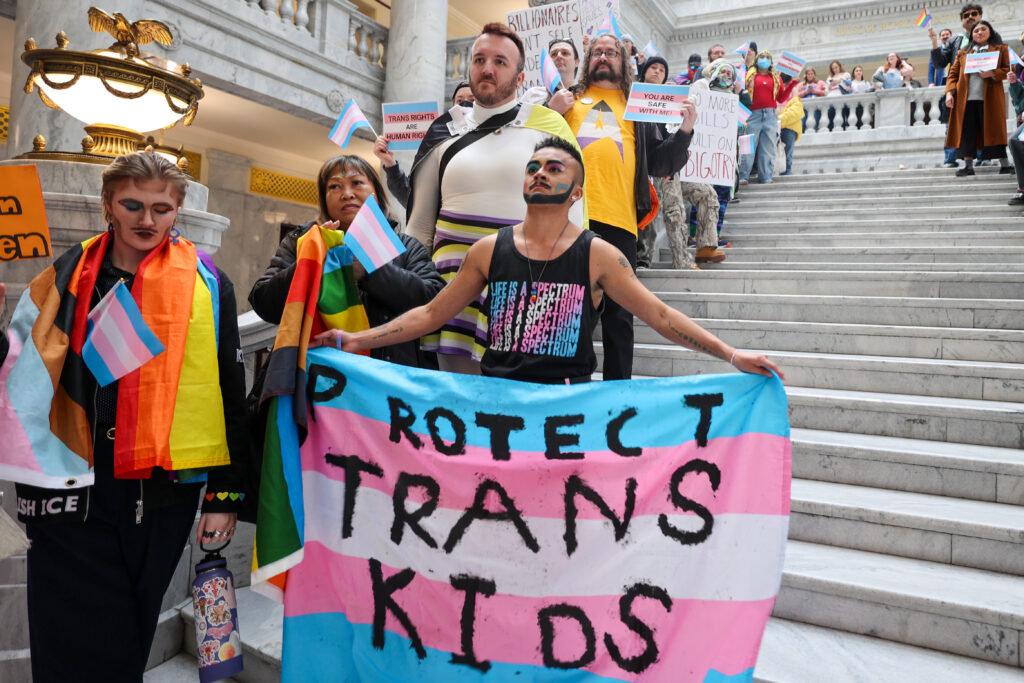

Demonstrators rally in support of transgender Utahns at the Capitol in Salt Lake City on Wednesday, Jan. 21, 2026. (Will Ruzanski/Utah News Dispatch)
A Republican-majority committee of Utah lawmakers voted 11-3 on Tuesday to advance a bill to turn the state’s 2023 moratorium on newly prescribed hormonal transgender treatments for Utahns under the age of 18 into a full ban despite objections from parents saying the gender-affirming care has saved their kids’ lives.
In the same meeting, the House Health and Human Services Committee also advanced two other bills that would restrict public employers — including cities, school districts or other taxpayer-funded employers — from providing insurance to employees that covers gender-affirming treatment for transgender people while also requiring them to cover “detransition” treatments.
All three of those bills now go to the full House for consideration.
The votes came despite hours of testimony from transgender Utahns and parents of transgender kids urging lawmakers not to restrict their ability to access life-saving care for an already vulnerable group of people who are at higher risk of suicide.

“I believe in personal responsibility, parental authority, and limited government. This bill violates all three,” said Catherine Dillon. “Please don’t make our family collateral damage in politics.”
Dillon said she is a mother of a 16-year-old transgender daughter who is currently “grandfathered” in under Utah’s current moratorium on gender-affirming hormonal care because she had already started treatments before lawmakers enacted the 2023 moratorium.
An estimated 135 transgender kids in Utah were undergoing treatment when Utah’s moratorium went into effect. Some have aged out since then, but Dillon said Shipp’s bill would require treatment to end for less than 100, “and my daughter is one of them.”
She held up a photo of her daughter for lawmakers to see.
“She has a bright future and knows exactly who she is. I’m not asking you to understand my daughter’s identity, only to understand that this law won’t change it, and it will harm her,” she said. “This bill does not protect children. … This bill only pushes care underground, out of state and out of reach.”
Turning Utah’s moratorium on transgender care for kids into a ban
If approved by the full Utah Legislature, HB174 would ban health care providers from prescribing hormonal transgender treatments to all minor patients, including requiring current patients to stop their treatment by Jan. 28 next year.
Before the committee voted to favorably recommend the bill and advance it to the full Republican-controlled House, Veronika DaVil, a drag artist who has organized transgender rights rallies on Utah’s Capitol Hill, shouted while storming out of the committee room.
“We have all had people take their lives because of this body,” DaVil yelled. “Do better. Love one another.”

The bill’s sponsor, Rep. Rex Shipp, R-Cedar City, responded “I don’t hate anybody” — a comment that several in the packed committee room laughed and scoffed at while shaking their heads.
“This is about protecting the most vulnerable, which is our children,” Shipp said.
Shipp and the bills’ supporters argued that kids shouldn’t be given hormonal treatments that could result in “irreversible physical harm.” Much of Shipp’s bill presentation focused on discrediting the state’s own academic research on the safety and effectiveness of hormonal gender-affirming treatments for minors.
When Utah lawmakers enacted the moratorium in 2023, they required the Utah Department of Health and Human Services to conduct a “systematic review of the medical evidence” of the use of hormonal treatments for transgender minors under the age of 18 with gender dysphoria.
Anti-transgender bill among ‘most harmful and outrageous’ Utah LGBTQ+ advocates have seen
That systematic review — conducted by the University of Utah College of Pharmacy’s Drug Regimen Review Center and submitted to state officials in August 2024 — cost about $110,000 to analyze more than 277 studies of at least 28,056 pediatric gender dysphoria patients from “all over the world.”
“The conventional wisdom among non-experts has long been that there are limited data on the use of (gender-affirming hormone therapy) in pediatric patients with (gender dysphoria),” the evidence review report says. “However, results from our exhaustive literature searches have led us to the opposite conclusion.”
After “many months” of reviewing available literature, “it was impossible for us to avoid drawing some high-level conclusions,” the report says. “Namely, the consensus of the evidence supports that the treatments are effective in terms of mental health, psychosocial outcomes, and the induction of body changes consistent with the affirmed gender in pediatric (gender dysphoria) patients.”
The review also said evidence supports that “treatments are safe in terms of changes to bone density, cardiovascular risk factors, metabolic changes, and cancer.”
But Shipp called the state’s own review a “flawed report with a lot of bias in it.”
Among those that argued in favor of his bill while expressing “major concerns” with the state’s academic review was Kurt Miceli, a physician and chief medical officer for Do No Harm. The group advocates for “keeping identity politics out of medical education, research and clinical practice,” and opposes “youth-focused gender ideology,” according to its website.

Miceli argued Utah lawmakers should instead look to a review that was issued by the U.S. Department of Health and Human Services in May, which highlights “a growing body of evidence pointing to significant risks including irreversible harms such as infertility — while finding very weak evidence of benefit.”
In a peer review of that report, the American Psychiatric Association said that while the HHS report “purports to be a thorough, evidence-based assessment of gender-affirming care for transgender youth, its underlying methodology lacks sufficient transparency and clarity for its findings to be taken at face value” and its claims “fall short of the standard of methodological rigor that should be considered a prerequisite for policy guidance in clinical care.”
Caught in the middle of the disagreements over the scientific evidence are a small number of Utah kids that haven’t yet aged out of Utah’s moratorium and are currently undergoing treatment.
Heather Kester, of Eagle Mountain, said she’s the mother of a transgender teenager who was also “grandfathered” in to continue treatments after Utah’s moratorium took effect. Kester said her daughter was 13 years old when she “attempted suicide due to gender dysphoria.”
After years of “careful, multidisciplinary care,” including therapy “before even entertaining the idea” of hormone treatments, Kester said her daughter received “life-saving care” and was eventually prescribed hormone therapy and puberty blockers.
“She is currently alive, thriving, happy, back in public school and looking into her future,” she said.
To those who support Shipp’s bill out of concerns of permanent impacts to kids’ bodies from the medications, Kester said: “My child is alive today because of them.”
“And if we have to deal with bone density issues, I will, because she’s alive,” Kester said. “It’s better than having a dead child. And that is a reality that our family has faced.”
Ban backed by House speaker
Shipp’s bill has been prioritized by House Republican leadership and is supported by House Speaker Mike Schultz, R-Hooper. Schultz told Utah News Dispatch in an interview earlier this month that he wants to make the state’s moratorium a permanent ban.
“For a couple of years as this issue first came up I was kind of on the fence because I could see both sides of it,” Schultz said, but now he argued “we’ve got a lot of studies, in particular the ones coming out of Sweden, that show the long-term harms.”

Asked about Utah’s study that showed hormonal treatments for minors are largely safe and effective, Schultz said he was “really disappointed in Utah’s study, to be honest with you.” He argued it didn’t include enough research on long-term harm.
“I don’t need a study to tell me common sense,” he added. “And I firmly believe in that. … Kids shouldn’t be taking hormone blockers, puberty blockers. It shouldn’t happen.”
House Minority Whip Jennifer Dailey-Provost, D-Salt Lake City, was among three Democrats who voted against Shipp’s bill Tuesday. She said she was “emotionally exhausted” by another batch of bills “targeting” transgender people in Utah.
“There seems to be this dogged desire to continue to marginalize one of our most marginalized, at-risk populations,” she said. “To our transgender community, I stand with you. I always will, and I love you. … I’m really, really sorry that we have to constantly drag you up here to bare your souls and tell your stories and ask for compassion when I know that you’re not going to get it.”
Dailey-Provost added that she’s “ashamed when scientists use misdirection and their education to tell a story that they want to be true, whether it is or not.”
She added that “nobody claims that gender-affirming care is without risk.”

“Every medical care that every patient receives has risk,” she said, “but we’re not here denying that to anyone else.”
Before casting her vote in favor of Shipp’s bill, Rep. Cheryl Acton, R-West Jordan, told Utah’s transgender community: “I love you too.”
“I will be voting for this bill because I simultaneously recognize your humanity … at the same time, I have a desire to protect children from irreversible harms. That’s what this bill is about,” she said. “I fully support adults making decisions and living their lives. But when children … are brought into the equation, that’s where I have to decide.”
Banning public-funded insurance coverage for transgender care
After Shipp’s bill passed out of Tuesday’s committee, the next two bills lawmakers advanced to the House floor were both sponsored by Rep. Nicholeen Peck, R-Tooele.
HB193 would ban government entities from using public funds to pay for insurance coverage for transgender employees who receive hormonal treatments or sex characteristic surgical procedures.
“The distinction in this bill is really about if it’s transgender procedure related as opposed just to any type of hormonal (treatment) or any other reason,” Peck said. “The point of this bill really is about the use of taxpayer dollars and prioritizing that.”
Kaz Kanani Howell, of Salt Lake City, urged lawmakers not to support Peck’s bill.
“Denying trans people access to life-saving medicine and health care will not make us less trans or cisgender,” they said. “You would make living a joyful life extremely harder to access. As a trans person of color, as a trans Utahn, as an American, I feel that I have three unalienable rights: life, liberty and the pursuit of happiness.”
SUBSCRIBE: GET THE MORNING HEADLINES DELIVERED TO YOUR INBOX
Before it won approval from the committee, the bill was changed to allow people who are currently receiving hormonal transgender treatment to “complete that course of treatment” beyond the bill’s effective date, on May 6, under their current coverage if their physician determines it is medically necessary.
Additionally, the bill requires governmental employers to provide insurance for people seeking care to “detransition.”
The committee also endorsed Peck’s second bill, HB258, which would also require private insurers to cover “detransition” treatment and procedures if they’ve previously paid for transgender treatments.
Peck argued there’s a “growing” population of transgender people who want to reverse their treatments, and she wants to ensure it’s available for people who want it.
“In short, we’re just trying to make sure that all people are represented by their private insurance companies,” Peck said.
Most arguments against Peck’s bills were directed at her proposal to restrict government entities from covering gender-affirming care for transgender Utahns.
Marina Lowe, legislative counsel for Equality Utah, the state’s largest LGBTQ+ advocacy organization, argued against the bill while noting that Utah lawmakers have spent five years in a row debating legislation aimed at restricting transgender Utahns.
“I just want to remind everyone that transgender Utahns exist,” she said. “They deserve the same rights and dignity that all Americans deserve, and that extends to health care as well.”
Lowe also argued “all Utahns should be worried when the Legislature steps in between that sacred relationship between a doctor and a patient and dictates what sort of medications and procedures” can be administered.
One Republican, Rep. Ray Ward, of Bountiful, joined Democrats in voting against Peck’s HB193. He argued there “are a fairly large number of other cisgender hormone treatments” that are covered.