
Utah News Dispatch
Utah is undermining popular sovereignty through ballot initiative restrictions

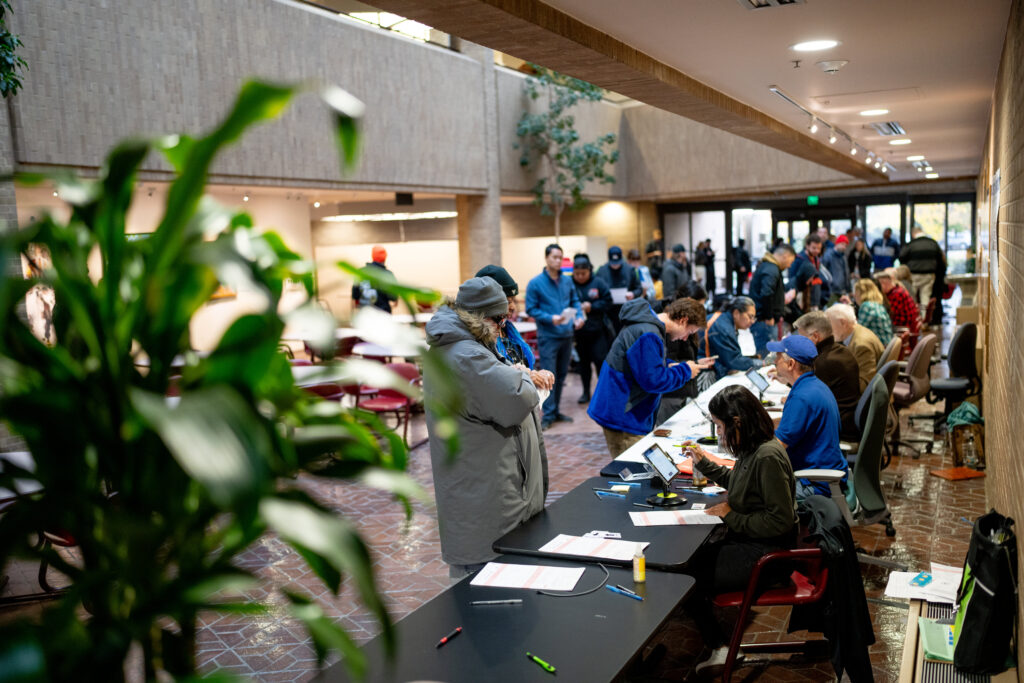

Voters line up at the Salt Lake County Government Center in Salt Lake City on Election Day, Tuesday, Nov. 5, 2024. (Photo by Spenser Heaps for Utah News Dispatch)
The first three words of the United States Constitution are not symbolic. “We the people” is a statement of authority. Government power does not originate with legislatures, courts, or executives. It originates with the people themselves. That principle, known as popular sovereignty, is the foundation of American constitutional government.
Yet in Utah today, that foundation is being quietly weakened.
Three bills currently advancing through the Utah Legislature, HB160, HB167, and HB242, collectively reduce the practical ability of citizens to exercise direct democratic authority. These proposals are often defended using language suggesting that legislative action represents a higher or “super” form of law. That framing misunderstands the constitutional order.
The supreme law of the land is not statute or legislative process. It is the United States Constitution itself, and the authority of that Constitution comes from the people. Popular sovereignty is not subordinate to government. It precedes it.
HB160 directly raises the barrier for citizens to send an initiative to the legislative body through the indirect ballot initiative process. Under current law, an indirect initiative requires signatures equal to 4% of active registered voters statewide and 4% in at least 26 Utah state Senate districts. HB160 doubles both requirements to 8% — the same as what’s required to put a direct initiative on voters’ ballots.
Using Utah’s January 2026 voter registration data, this raises the statewide minimum from roughly 70,000 signatures to more than 140,000. That figure represents only the legal minimum. Any realistic campaign must collect more to account for invalid signatures, clerical rejections, and uneven district participation. In practice, citizen-led efforts would need closer to 175,000 signatures distributed across 26 districts. For most grassroots organizations, that threshold alone is prohibitive.
HB167 compounds this difficulty by rewriting how signatures are gathered, verified, challenged, and retained. It requires public posting of petition signers’ names and signature dates on a government website for at least 90 days. It expands opportunities for signatures to be removed after signing. It adds procedural deadlines, audit requirements, and increased legal exposure for volunteers and organizers.
These changes predictably suppress participation. Citizens are less likely to sign petitions when their names will be publicly displayed for engaging in political activity. Signatures become less reliable when expanded removal mechanisms exist. Volunteers are less willing to help when procedural and legal risk increases. None of this strengthens democracy. It narrows it.
HB242 reinforces this pattern. While it is not a constitutional amendment, it is another statutory change targeting signature gathering and removal for initiatives and referenda. Like HB167, it adds complexity, expands post-signature challenges, and increases uncertainty for citizen efforts attempting to qualify measures for the ballot.
Taken together, these bills operate at every stage of the initiative process. HB160 raises the numerical threshold. HB167 discourages participation and destabilizes signatures. HB242 adds additional procedural hurdles. The combined effect is structural, not incidental.
Supporters of these measures often point to the Supremacy Clause as justification, arguing that legislative authority must prevail. That argument misunderstands the clause. The Supremacy Clause resolves conflicts between state and federal law. It does not elevate government above the people. The Constitution is supreme because the people made it so.
Utah’s own Constitution reflects this structure. Article I, Section 3 states that Utah is inseparable from the Federal Union and that the Constitution of the United States is the supreme law of the land. That supremacy flows upward from the people, not downward from elected officials.
Ballot initiatives exist because representative government is not infallible. They are constitutional safeguards. When lawmakers make those safeguards harder to access and more fragile once invoked, they are not protecting governance. They are insulating themselves from accountability.
Direct democracy rarely disappears in one dramatic moment. It erodes gradually through technical changes that appear reasonable in isolation but devastating in combination. Utahns should recognize what is happening now.
Popular sovereignty is not a threat to government. It is the source of government. Utah can protect election integrity without silencing its citizens. HB160, HB167, and HB242 fail that test. They move us away from “We the people,” not toward it.
Utah can and should do better.