Utah News Dispatch
Utah has more revenue than expected. Lawmakers still want leaner budgets, and a 6th income tax cut

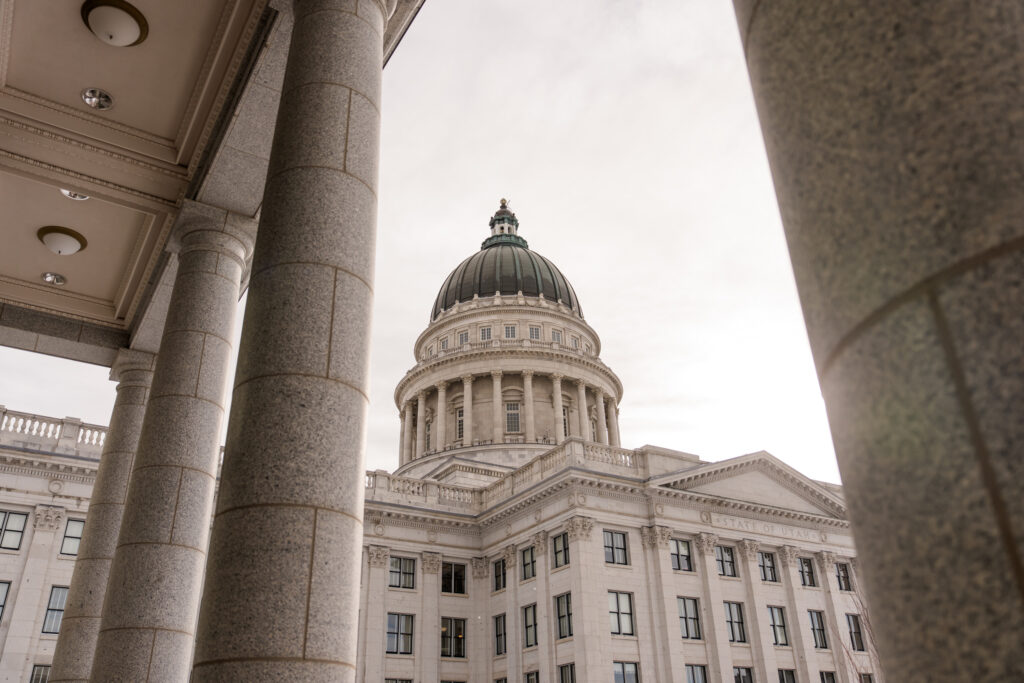

The Capitol in Salt Lake City is pictured on Thursday, Feb. 19, 2026. (Photo by Spenser Heaps for Utah News Dispatch)
Utah lawmakers have more money to spend during their 2026 legislative session than they had originally projected, according to new revenue estimates.
“Suprise, surprise, folks,” Senate Budget Chair Jerry Stevenson said on the Senate floor Friday.
He announced that legislative fiscal analysts now predict the state will have an additional $88 million in ongoing money and $125 million in one-time money in its coffers for the coming fiscal year thanks to Utah’s continued economic growth.
Utah’s Republican legislative leaders said the additional money will soften — but not completely erase — the “need” for budget cuts.
Heading into the Legislature’s 45-day session, lawmakers had asked state agencies to contemplate the possibility of 5% reductions as part of a spending efficiency exercise, tasking them each with generating a list of recommended cuts for lawmakers to consider.
Under Trump tax cuts, Utah won’t collect $500 million in income taxes in 2026, 2027
The new revenue means those cuts likely won’t be as deep, Stevenson said, but lawmakers will likely still enact some.
“We’re going to have to take some of those cuts,” Stevenson said. “To get this job done, we will take many of the reductions that the (appropriations) subcommittees deemed reasonable.”
At the same time, however, GOP legislative leaders are still adamant about cutting the state’s income tax rate for a sixth year in a row — on top of more than $500 million wiped out from the state budget in 2026 and 2027 thanks to federal tax cuts included in the One Big Beautiful Bill Act.
A bill to drop Utah’s income tax rate from 4.5% to 4.45% — with a price tag of about $101 million in ongoing money — has already cleared the Utah Senate and is waiting for a House committee. As lawmakers close in on the final days of their budgeting process, it’s likely that bill, SB60, will start progressing through the House.
Democrats and low-income advocates have argued against yet another income tax rate cut, which would largely benefit the wealthiest earners.
Over the past five years, the Republican-controlled Utah Legislature has already enacted more than $1.4 billion in tax cuts, most of which have been from income tax reductions. According to an analysis by the low-income advocacy group Voices for Utah Children, the bottom 80% of Utah earners saved an average of $353 annually from those tax cuts, while the top 1% of the state’s earners saved $19,290 annually.
If Utah’s income tax rate drops again from 4.5% to 4.45% under SB60, Utah earners in the bottom 20% with salaries of up to $34,600 would see an additional $13 in yearly savings, while the state’s top 1% (those making more than $835,200) would see $1,212 more in annual savings, according Voices for Utah Children.
While Democrats including Senate Minority Leader Luz Escamilla, D-Salt Lake City, have urged lawmakers to take a break from income tax rate cuts “so we can make sure we’re stable,” Republican legislative leaders have said Utah has been enjoying strong revenue growth largely because of tax cuts that energize the economy.
SUBSCRIBE: GET THE MORNING HEADLINES DELIVERED TO YOUR INBOX
Senate President Stuart Adams, R-Layton, told reporters the state has seen about $750 million in new revenue over the past two fiscal years — representing about 4.8% in year-over-year growth.
“That’s growth in revenue,” he said, “and some of that ought to be shared with the taxpayers.”
Stevenson said that shows “we have a healthy economy. And if you look at the tax cut the feds took and what we’ve done, we’ll grow back into that within two years at the rate we’re going.”
Asked why they insist on another income tax rate cut when federal tax cuts already took about $300 million from the state’s budget this year, Adams said those cuts didn’t benefit all Utahns, but mostly corporate earners.
“That tax cut was not a broad base (cut),” Adams said. “It didn’t go to the majority of the people. It was actually a specific tax cut, and we think we need a broad base tax cut.”
Adams also noted that the Utah Legislature, when it set its base budget on the 10th day of the session, already appropriated more than $275 million in new spending. Of that, $225 million was for increases for public education, including a 4.2% increase in the value of the weighted pupil unit, which is the per-pupil rate used to calculate how much money each school should receive.
After committing that funding to the base budget, lawmakers had fully committed all of their new funding — but with Friday’s new revenue estimates, now they have millions more to spend on new requests and tax cuts.

Adams said it’s “pretty amazing” that Utah is positioned to not only increase funding in education but also cut taxes at the same, adding that he doesn’t think “any other state can do that, and it happens because of a strong economy.”
“When you can do two things — when you can fund infrastructure and education and services, plus cut taxes — that’s a pretty amazing budget,” Adams said. “That’s a pretty happy day.”
Escamilla agreed that the new revenue estimates were “really good numbers,” and she’s “optimistic” that some concerning budget cuts, especially in social services, will no longer be necessary.
Escamilla reiterated that Democrats would prefer lawmakers not pursue another income tax rate cut, but nonetheless, “this is great news and we are excited to work with” budget co-chairs on the remaining budgeting process, she said.
In coming days, the powerful budget body known as the Executive Appropriations Committee will consider recommendations from budget subcommittees before finalizing the state’s budget for the coming fiscal year, likely to top well over $30 billion.
In addition to tax cuts, Adams said to expect additional revenue for public education, higher education, and other agencies including social services, though he said social services is “always a budget that’s difficult.”
“We’re going to continue to try to do what Utah does,” Adams said. “Live within our means and try to fund the things we need to and try to give money back to our citizens.”