Utah News Dispatch
Utah Gov. Cox proposes millions for homeless campus while also hoping for federal funds

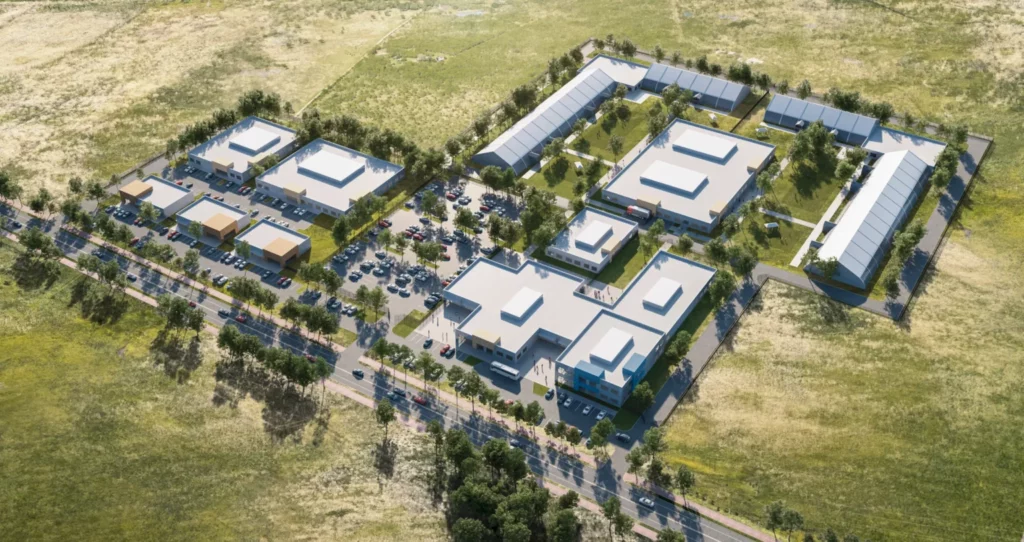

A conceptual rendering depicts what state leaders envision for a new “transformative campus” meant to house and rehabilitate people experiencing homelessness. (Courtesy of the Utah Office of Homeless Services)
As part of his $30.7 billion state budget recommendation unveiled Wednesday morning, Utah Gov. Spencer Cox proposed the Utah Legislature — which controls the purse strings — use $25 million in one-time money and $20 million in ongoing funding for “homelessness and criminal justice high utilizers.”
The governor’s budget recommendation doesn’t explicitly say that money should be used to fund a 1,300-bed homeless campus that the state’s stop homelessness leaders have proposed in northwest Salt Lake City. But the governor recently said that campus — envisioned to help Utah be a “pilot” state to fulfill President Donald Trump’s executive order titled “Ending Crime and Disorder on America’s Streets” — is a top priority for his administration.
The “intent” is to use that funding for the proposed homeless campus, Sophia DiCaro, executive director of the Governor’s Office of Planning and Budget, told reporters in a briefing ahead of Cox’s announcement Wednesday morning. But she also said specifics for that funding and its uses are still being fleshed out.
Utah Gov. Cox says homeless campus — envisioned to fulfill Trump’s order — is a ‘top priority’
“The details are still being developed in terms of what exactly that would look like,” she said. “But the idea is the target market is the population that is tending to be the high utilizers of the criminal justice system.”
Plans for the campus are still taking shape. The Utah Homeless Services Board last week fielded input from homeless service providers, Salt Lake City, Salt Lake County and others within Utah’s homeless services network.
But over the last several months, the state’s top homelessness leaders have proposed including in the campus hundreds of beds for people who are civilly committed — or court ordered into mental health treatment. They have also envisioned an “accountability center” or a “secure residential placement facility” for substance abuse treatment as an alternative to jail, where people who are “sanctioned” to go there would not be able to leave voluntarily.
DiCaro noted that the governor’s newly appointed state homeless coordinator, Rep. Tyler Clancy, R-Provo, is slated to start his new position in March after the state’s current homeless coordinator, former Senate President Wayne Niederhauser, retires in December.
Clancy won’t start in his new role until after the Legislature’s 2026 general session concludes, so “there’s going to be some time needed to develop exactly what” the proposed funding entails, “but the idea is for that to be flexible as that gets developed,” DiCaro said.
“It’s fair to say that the intent is for that (funding) to be used for a campus. It’s what kind of services go into the campus that I’m not able to answer at this time because those kind of details will likely require involvement by the courts, corrections, public safety, as well as the other service providers,” DiCaro said, adding that figuring out those details will require “collaboration and partnership.”
Some homelessness, housing and low-income aid advocates have criticized the proposed campus project and expressed concerns about forcing drug or mental health treatment on people while shifting away from “Housing First” strategies. But Cox has defended it as a way to bring more “accountability” but also more “compassion” into Utah’s homelessness system by not letting people addicted to drugs or those with mental illness to languish on the streets.
Homelessness advocates, environmentalists rally against homeless ‘mega shelter’
“Gov. Cox remains committed to ending the harm and prevalence of homelessness and addressing criminal activity associated with substance use and behavioral health,” the governor’s budget proposal says, adding that the additional funding “will help Utah align” with Trump’s executive order.
Trump’s order encourages cities and states to enforce stricter anti-camping laws, expands power to involuntarily treat and civilly commit people experiencing homelessness, and directs federal officials to end support for “Housing First” strategies, an approach to homelessness that prioritizes providing housing while offering — but not requiring — treatment.
“Legislative adoption of this recommendation will signal Utah’s commitment to doing its part to address a nationwide problem while leveraging matching federal dollars to fund solutions that work,” the governor’s budget recommendation says, while adding that Cox’s administration “recognizes that this will entail a long-term effort.”
The campus — which state officials have estimated will cost at least $75 million to build, plus north of $34 million a year to operate — is a long way from becoming a reality, which largely hinges on funding.
Last year, the Utah Homeless Services Board initially voted to set a deadline of Oct. 1 of this year for it to be built, but after state leaders spent more than a year searching for a property, that deadline was pushed. Now state leaders estimate the first phase of the campus won’t be built until sometime in 2027.
Utah’s Republican-controlled Legislature usually doesn’t finalize the budget until the final days of its general session, which is slated to begin in January and end in early March. Even if lawmakers agree to fund all of Cox’s 2026 and 2027 budget recommendations, the campus would still need tens of millions of dollars more to be fully funded.
SUBSCRIBE: GET THE MORNING HEADLINES DELIVERED TO YOUR INBOX
That’s where the Trump administration may come in.
The governor has said he’s “hopeful” the federal government will “see the wisdom in this, and they expressed interest in helping these types of projects.” But whether the federal government does help fund the campus or related projects remains to be seen.
“There’s going to be some federal grant opportunities that will be connected to (Trump’s executive order),” DiCaro said, pointing to the Continuum of Care Competition and the Youth Homeless Demonstration Program as grants state leaders will “try to compete for.”
“We think we’ll be in a good position in terms of competing for the opportunities there,” she said. “So we definitely want to use this to leverage federal opportunities and large private contributions as well.”