Utah News Dispatch
Utah expands access to cancer screenings for firefighters

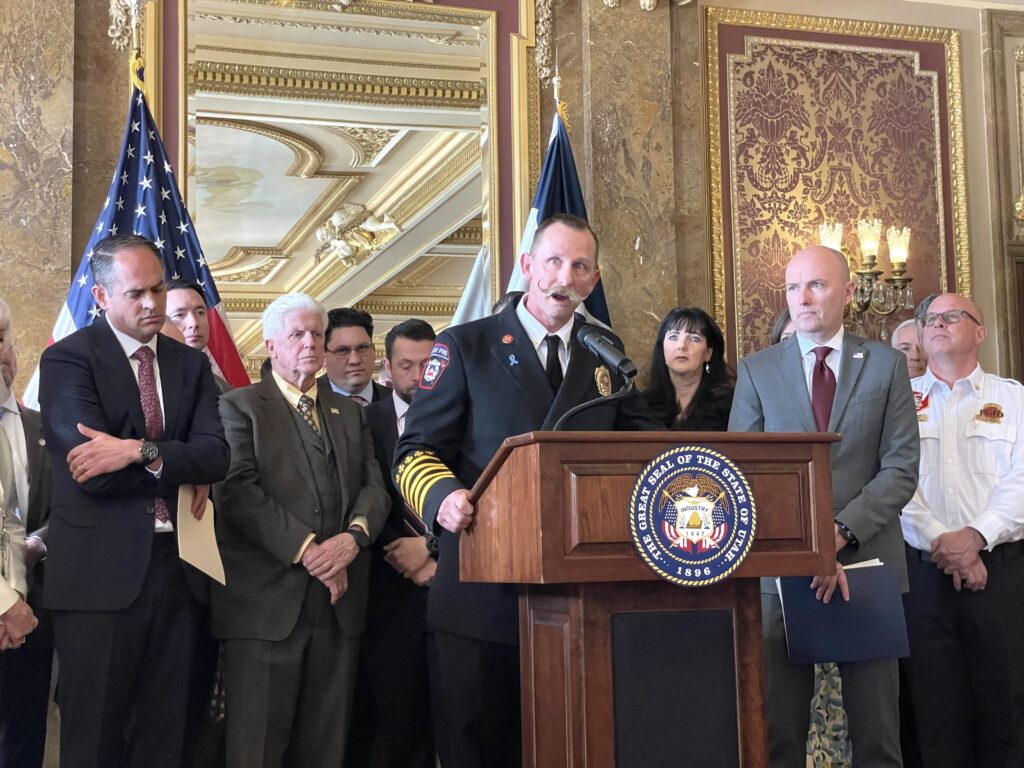

Lehi Fire Chief Jeremy Craft celebrates the passage of a bill to expand access to cancer screenings for firefighters during a news conference at the Utah Capitol in Salt Lake City on March 5, 2025. (Katie McKellar/Utah News Dispatch)
Surrounded by state dignitaries on Wednesday, Lehi Fire Chief Jeremy Craft said almost exactly a year ago he was diagnosed with prostate and renal cancer.
“I am currently battling cancer,” Craft said, wearing his fire department uniform. “But because of early testing, we’re going to get through this. I’m going to have a good quality of life. And quite honestly, I want that for my colleagues. For my brothers and sisters in the fire service.”
Craft stood alongside Gov. Spencer Cox and Utah lawmakers crowded in the Gold Room on Utah’s Capitol Hill for a news conference to celebrate the passage of legislation that will expand access to cancer screenings for public firefighters. He described the bill, HB65, as a life-saving measure for the state’s first responders that knowingly put themselves in harm’s way.
“When the bells ring,” Craft said, “we don’t hesitate to run in. We’ll answer any call without thinking about the danger. It’s afterwards that we have to sit around and wonder, did we get cancer?”
Craft said HB65 — sponsored by House Majority Assistant Whip Casey Snider, R-Paradise — who has also served as a volunteer firefighter in Cache County — will give Utah’s firefighters “peace of mind that we can continue to do what we love,” and be given the best chance to get ahead of any future cancer diagnosis.
“Yes, the risks are still there,” he said, but “early detection” can mean the difference between life and death.
The Utah Senate and the House on Wednesday voted unanimously to give HB65 final legislative passage. It now goes to Cox, who is expected to sign it.
“What an epic day for Utah,” Craft said.

It’s been a long time coming. Jack Tidrow, president of the Professional Firefighters of Utah, said, “this has been a 21-year journey for me and many others.” He said the late Sen. Ed Mayne, D-West Valley — who died of cancer in 2007 — “started the fire on this.” Then his wife, the late Democratic Sen. Karen Mayne — who died last year, also of cancer — took the torch. Both were remembered as champions for labor unions and blue-collar workers.
Snider’s HB65 builds on their previous work, including Karen Mayne’s 2015 bill that expanded workers’ compensation coverage to include four types of “presumptive” cancers for firefighters.
This year, legislative leaders agreed to include $3.7 million in ongoing money in the state’s budget to fund three years of cancer screening programs conducted by the Rocky Mountain Center for Occupational and Environmental Health as part of Utah Valley University’s statewide fire and rescue training program.
Despite pleas for veto, Utah Gov. Cox signs bill banning public unions from collective bargaining
Snider’s bill also expands cancer definitions by building on a previous bill, SB159 in 2023, which required the study of expanding occupational cancers for firefighters. HB65 increases the number of recognized cancers from four to 15, to formally recognize diseases including bladder, brain, lung and thyroid cancers, leukemias, and others as presumptive occupational illness.
The move is meant to make it easier for firefighters to access health care benefits and compensation for their treatment.
HB65 also comes the same year Utah lawmakers and public unions — including the Professional Firefighters of Utah — clashed over a controversial bill to ban public unions from collective bargaining. But no one brought that up during Wednesday’s announcement. They kept their focus on efforts meant to give firefighters the best fighting chance against their No. 1 killer: cancer.
“This is the least we can do,” said Senate Majority Assistant Whip Mike McKell, R-Spanish Fork, who carried the bill in the Senate chamber, where he told a story of firefighters responding to a massive fire at his farm in 2018 after a spark from a campfire lit by his oldest son sparked a flame that quickly engulfed four acres of cottonwood trees.
McKell also said he’ll also never forget when several Utah County communities were evacuated that same year after they were threatened by two massive mountainside fires. As Utahns evacuated, “your people went in,” he told firefighters.
“You saved my community,” McKell said. “This is the least we can do.”
House Speaker Mike Schultz, R-Hooper, also applauded the bill.
“On behalf of the citizens of the state, you’re putting your own lives at risk,” Schultz said. “To us here in the Legislature, this is very minimal. We should have done this years ago.”
Cox thanked lawmakers for passing “this important piece of legislation that has been a long time coming,” which he said will make Utah “a leader in the nation for firefighter health and safety.”
“Our true hope is that other states will copy us,” Cox said, adding that he plans to share HB65’s measures with other governors across the country and “asking them to do the same thing.” If it gets national legs, he said he hopes the effort will not only save Utah firefighters, but also help firefighters across the nation.
Snider said his bill is supported by “good data” and “the scientific fact that the profession of firefighting causes cancer.” In 2023, 72% of International Association of Firefighters’ line-of-duty deaths were linked to occupational cancer, according to the association.
But Snider said his bill isn’t just driven by statistics.
“Behind every number is a husband, a wife, a friend, a brother, a sister in this profession,” he said, clearing his throat as his voice strained with emotion. “And I look around this room, and I know that there isn’t a man or woman in uniform that has not lost somebody to this terrible disease in this career.”
Snider concluded: “We do this bill because of them, but we pass this bill to honor them.”

YOU MAKE OUR WORK POSSIBLE.