Utah News Dispatch
Utah aims to host critical minerals lab, hoping for federal recognition — and funding

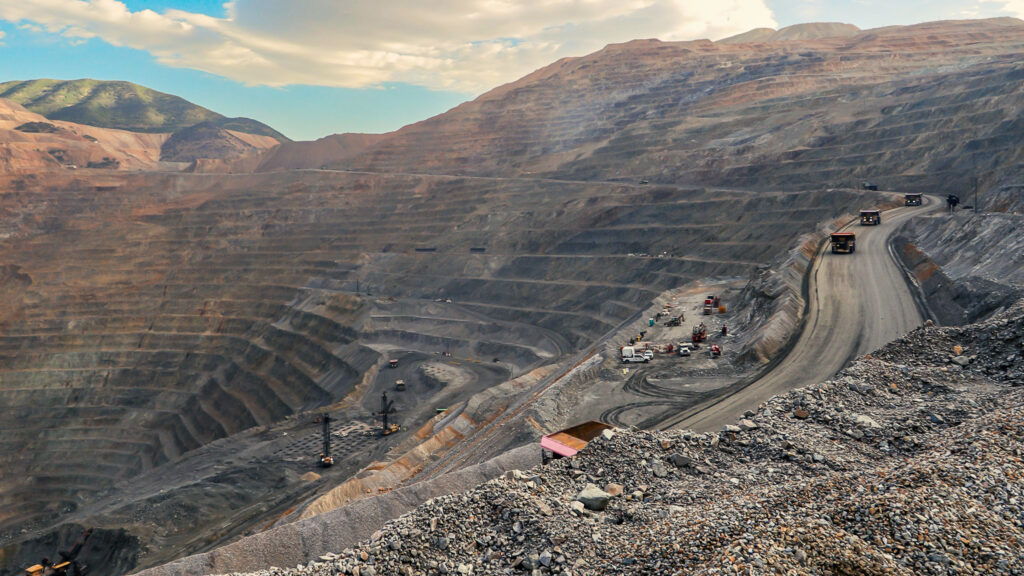

Operations at Kennecott’s Bingham Copper Mine are pictured. Part of Utah’s critical minerals strategy includes potentially extracting minerals from coal or copper mining tailings. (Photo by JT Taylor and Rio Tinto Kennecott)
Utah is poised to create new zones to eventually make its goal of capturing 20% to 25% of the country’s critical minerals demand a reality. The state also has its heart set on even extracting minerals from coal or copper mining tailings, and to build a lab where government, industry players and academia can collaborate.
Ogden Republican Sen. Ann Millner, who sponsored a bill the Legislature passed setting the framework to advance mining in the state, said the state has lots of potential, starting with hosting 50 of 60 critical minerals, the most diverse mineral estate of any state, according to the Legislature.
“Our goal is to determine which of those are extractable in an economically feasible way, and facilitate processes for doing that,” Millner said, “and processing it that does it in a way that’s environmentally sound as well.”
SUBSCRIBE: GET THE MORNING HEADLINES DELIVERED TO YOUR INBOX
But all those objectives will take time and may need future federal funding to come to fruition.
Utah looks to fill 20% to 25% of U.S. critical minerals demand
In a resolution lawmakers also passed this year, state leaders called on Utah’s congressional delegation to support a proposed Minerals for Industrial, National, and Economic Security Center (MINES Center), to secure a designation as a national lab, and to seek federal dollars for it.
“We have put some money in from the state, and we should be able to get, at this point, $1 million a year for the next 10 years, but that’s a really slow build, and our goal would be to see if we can also use that as matching money to be able to get additional federal money,” Millner said, “because this is a critical national security issue that this administration is focused on.”
The vision is that the lab becomes the critical minerals counterpart of the Idaho National Laboratory, which focuses on nuclear energy innovation. Millner said it’s going to look more like a warehouse.
“This is kind of a working center that allows you to buy some equipment, to have some folks who have mining expertise, who can work with industry coming in,” she said. “And instead of a company buying an expensive piece of equipment, they just lease some time working with some folks with expertise, etc. it saves them money, but allows us to facilitate that across multiple companies.”
Members of a newly created Critical Minerals Council — bringing together representatives from state agencies, the Legislature, the University of Utah and the mining industry — are required to present initial plans on the lab and any progress on critical minerals strategies before Oct. 1.
As of now, Millner said she has no idea how much money the state will need to power its critical minerals ambitions. But the bill, she added, “sets us up and makes us ready to be able to compete if opportunities come.”
Senate Budget Chair Jerry Stevenson, R-Layton, told reporters in early February, when the bill was still in negotiations that “the cost is a lot.” However, he said “there are a lot of ways to finance something like that, if that’s the direction we elect to go.”
A leadership priority
During his opening speech this general session, Senate President Stuart Adams highlighted the state’s desire to embark on a quest to expand critical minerals, especially, since Ionic Mineral Technologies found what they say may be the most significant critical minerals reserve in the country in the Silicon Ridge mine in Utah County.
The discovery, the company said in a news release, could represent a major source for elements needed for “advanced AI semiconductor chips, permanent magnets, defense surveillance systems, and energy technologies.”
During the speech, Adams introduced Adam Cohen, president and CEO of Associated Universities Inc (AUI), a research management corporation. Cohen helped oversee 13 of the 17 U.S. Department of Energy national laboratories while he worked for the agency, and Adams said, “has laid the groundwork for this new lab.”
“He’s been working and studying the entire United States for the last seven years. He’s determined that Utah is the best location for a critical minerals lab,” said Adams, R-Layton.