
Utah News Dispatch
Utah advocates, faith leaders call on lawmakers to take more action on homelessness


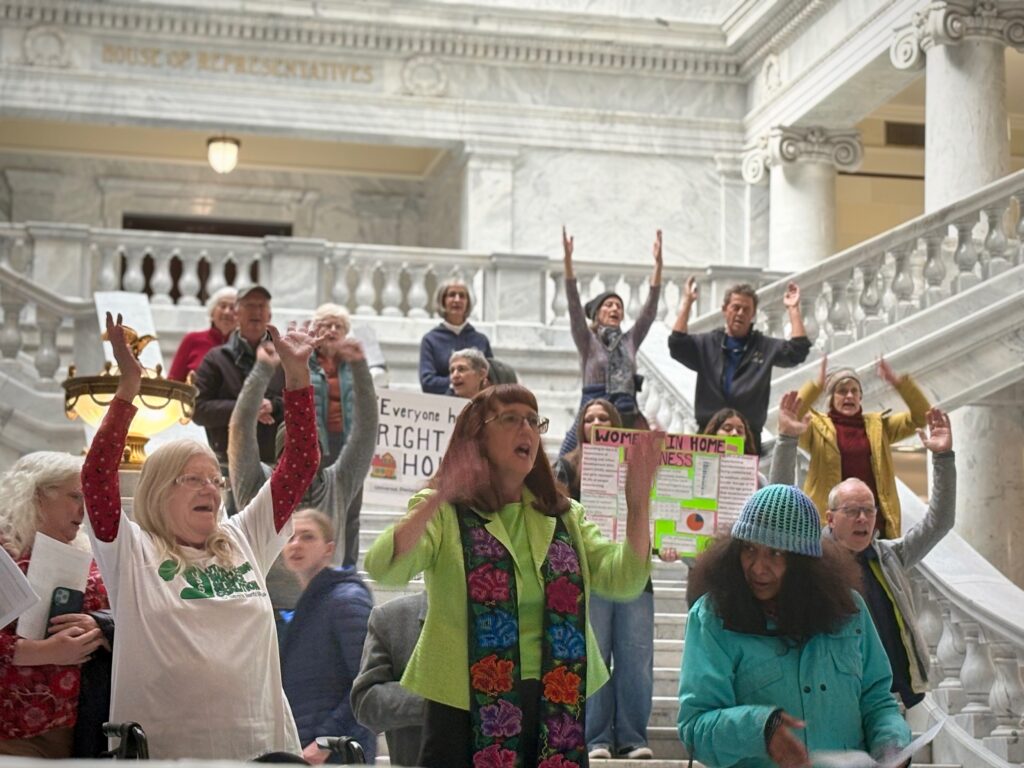


Members of the Faith and Advocacy Coalition and their supporters chant as they call on lawmakers to strengthen homeless services and expand affordable housing at the Utah State Capitol on Jan. 15, 2026. (Annie Knox, Utah News Dispatch)
Pastors, advocates and Democratic lawmakers called on the state Legislature Thursday to get clear on the money and steps needed to help the state’s homeless find stable housing, including those with severe mental illness, disabilities and substance use disorders.
The group of about 100 chanted and prayed together inside the state Capitol, where lawmakers will convene Tuesday for their annual, seven-week legislative session.
“Our message is simple: If Utah does not immediately begin making serious efforts to produce the housing and appropriate services to end homelessness, then it will soon be too late to avoid the shame of inviting the world’s elite to visit Utah during the 2034 Olympic Games,” said Levy Woodruff, chair of the governing board of First United Methodist Church in Salt Lake City.
Woodruff said state leaders have focused their discussions in the last decade on building better homeless shelters, but more attention is needed for resources and affordable housing that can help keep people from losing their homes.
What Utah lawmakers did — and didn’t — do for housing in 2025
Sen. Nate Blouin, D-Millcreek, said he’s working on a bill that would require the statewide housing analysis advocates are calling for.
“Utah needs a clear, honest plan for how many homes we need, who they are for and what it will take to get there, especially to protect seniors and people with developmental disabilities from being pushed into homelessness by a cost of living crisis that they did not create,” Blouin said.
Last year, two legislative proposals sought to provide more affordable housing by requiring cities of more than 65,000 to allow smaller homes and lots. Both failed to pass.
In a wide-ranging interview this week, Senate President Stuart Adams, R-Layton, told Utah News Dispatch that homelessness is a top priority this year — but he did not commit to a dollar figure.
“I’ve always said that the goal … isn’t just to house homeless people or find a spot for them. The goal is to try to get them some help,” he said. “We’re committed to try and tackle homelessness, and we’re going to do it the Utah way. We know that housing without treatment is not good.”
SUBSCRIBE: GET THE MORNING HEADLINES DELIVERED TO YOUR INBOX
Pressed on how much lawmakers will fund for homelessness, Adams said, “The amount of funding, I’m not going to commit to right now. But I think we’ll continue to try to do what we can. We’re committed to that.”
Adams said he’s a “big fan” of drug courts to encourage people to “either get clean or go to prison.”
“There’s got to be a combination of all of the above to try to get people in a better spot,” he said.
Gov. Spencer Cox has recommended that lawmakers use $25 million in one-time money and $20 million in ongoing funding for “homelessness and criminal justice high utilizers.”
He has also said a 1,300-bed proposed homeless campus in northwest Salt Lake City is a top priority for his administration, and is meant to help make Utah a “pilot” state to fulfill President Donald Trump’s executive order titled “Ending Crime and Disorder on America’s Streets.”
Some anti-poverty advocates on Thursday criticized the campus and proposals to use at least some of its beds for civil commitment or forced drug treatment.
Pastor Brigette Weier, of St. Matthew’s Lutheran Church in Taylorsville, sees it as a return to the “archaic” practice of forcing those with disabilities into segregated settings. Weier said the campus will cost taxpayers tens of millions of dollars, but “there’s another cost to our societal soul.”


Melisha Shaner of Magna said she and her daughter spent years in and out of homeless shelters before finding stable housing with help from a project-based voucher program.
It’s still difficult to make ends meet, said Shaner, with Powerful Moms who Care. As her family has grown, child care costs have made it hard for her and her husband to both work full time.
Asked by Utah News Dispatch what she wants lawmakers to consider, Shaner said: “Keeping roofs over kids’ heads is the biggest thing.”