Utah News Dispatch
University of Utah sees $8.4 million in limbo in NIH research amid federal DEI crackdown

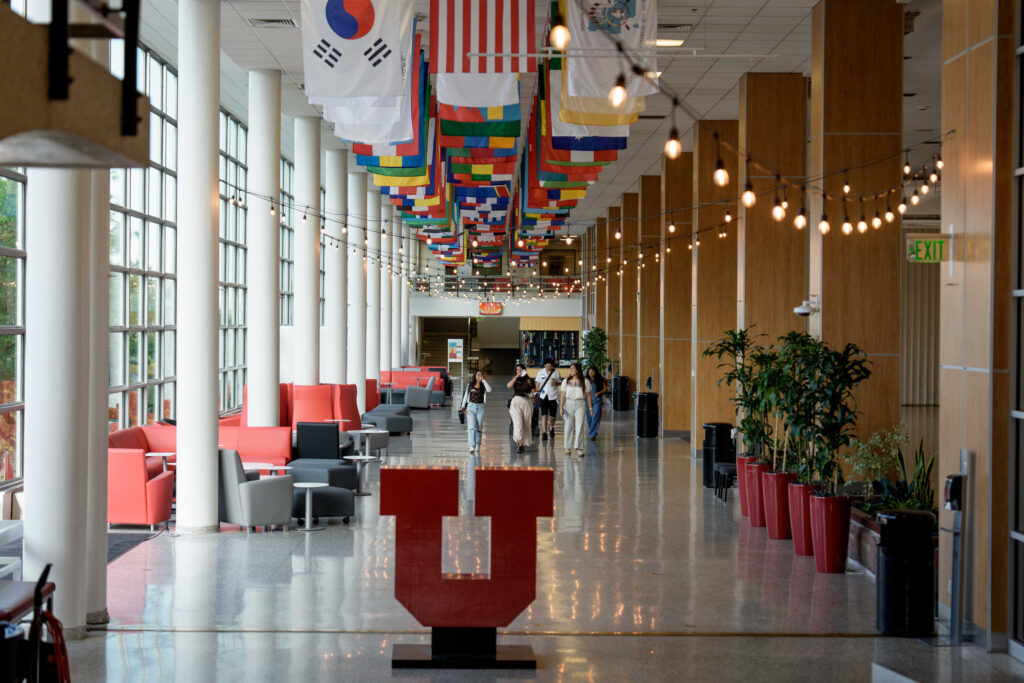

The A. Ray Olpin Student Union building on the University of Utah campus in Salt Lake City is pictured on Saturday, Aug. 23, 2025. (Photo by Spenser Heaps for Utah News Dispatch)
After the U.S. Supreme Court cleared the way for the Trump administration to terminate National Institutes of Health grants addressing diversity, equity and inclusion issues, Utah’s flagship university has reported a loss of about $8.4 million from 13 awards affected by the federal cuts.
Some of the affected awards were for health-related research, including a project meant to study the genetic diversity of pathogens to help inform the developments of antimicrobials and vaccines, and a study that aimed to further the understanding of mental health needs of ethnically diverse college students.
Others were programs that provided high school and graduate students to gain experience in research, Julie Kiefer, director of research communications at the University of Utah, said in an email.
SUBSCRIBE: GET THE MORNING HEADLINES DELIVERED TO YOUR INBOX
“Some researchers have been able to secure temporary funding but will need to identify alternative sources of funding to support their projects over the long-term,” Kiefer wrote. “The student training programs will not be able to continue if funding is not reinstated.”
Those training programs include U of U Step Up, which provides high school students of underrepresented backgrounds with biomedical science research opportunities, and Intermountain PREP, which intends to cover gaps in STEM education for students of diverse backgrounds. They are part of larger national programs managed by NIH, and terminated nationwide, Kiefer said. Currently, there is no indication that funding for these programs will be restored, she said in a statement.
According to Grant Witness, a database recording how the new policy has affected NIH grants, out of the 13 terminated awards, four are listed as possibly reinstated. A researcher on one of those projects confirmed the grant was recently returned, but said it is unclear why.
No other public university in the state was listed in the database, and compared to other states across the country, Utah is listed as moderately impacted by the terminations, way behind states like New York, Illinois, Massachusetts and California, which show the most extensive impacts.
The University of Utah only offered prepared statements after multiple requests for an interview on the status of its NIH grants.
Alzheimer’s research at risk
Jason Shepherd, a professor of neurobiology at the University of Utah’s school of medicine, who spoke to Utah News Dispatch in a personal capacity and not representing the school, said that amid all the federal budget changes, the issue isn’t just the termination of grants, but also the ongoing lack of clarity for future research funding.
Some of his peers have had awards taken away based on keywords used in their proposals, he said. According to The New York Times, federal agencies have flagged a variety of words for review in grant proposals and contracts that could conflict with President Donald Trump’s executive orders limiting diversity, equity and inclusion initiatives, among others.
In Shepherd’s case, the issue wasn’t a keyword, but the repercussions of the budget uncertainties that NIH is facing.
“The NIH is giving out less numbers of grants this year, and there’s just been chaos in terms of what the budget was going to be, what the next year’s budget is going to be,” Shepherd said. “The way the money has been mandated to be spent this year has influenced how many grants can get out.”
One of the projects Shepherd has been trying to fund with NIH awards focuses on studying a mechanism in which Alzheimer’s disease spreads across the brain once patients start to experience memory loss.
“If we could stop that from happening, we could effectively stop the progression of the disease,” he said.
His lab has pursued this investigation for the last five years, testing animal models and post-mortem human brain tissue.
“In order to lay down the sort of road tracks for drug discovery and making new therapies, this is the work that has to be done,” Shepherd said.
The team receives funding from private foundations like the Alzheimer’s Association, which is keeping the project going for the moment, he said. But, without a long-term NIH grant, the future of the research is becoming more and more uncertain.
“This grant that we applied for is a five-year grant. We would get half a million dollars per year to do the work,” he said. “But without that, I can’t hire anyone to do the work. We can’t pay for the animal facility. We can’t pay for reagents. So basically, it won’t be able to go ahead.”
It’s hard to tell how long it would take Shepherd’s team to develop a drug or therapy for humans, he said. But so far, they have revealed new insights into a disease that has seen little breakthroughs in the last decades.
If the lab isn’t able to secure NIH funding — which in the past he had no issue receiving — he’ll be forced to start laying people off starting next year. On top of that, he worries what this would mean for science and recruiting in research institutions in the country.
“If we’re looking at graduate programs, we’ve always been able to get the best and brightest students in the world, basically because of the science that’s happening in the states,” Shepherd said. “And, University of Utah is doing really well, especially at the medical school, and all of that momentum is now in jeopardy because of what’s happening to the NIH and in general, the sort of anti-immigration viewpoints that are laws that are being put in place.”