
Utah News Dispatch
To better prosecute domestic violence, Salt Lake County is training police to respond to trauma

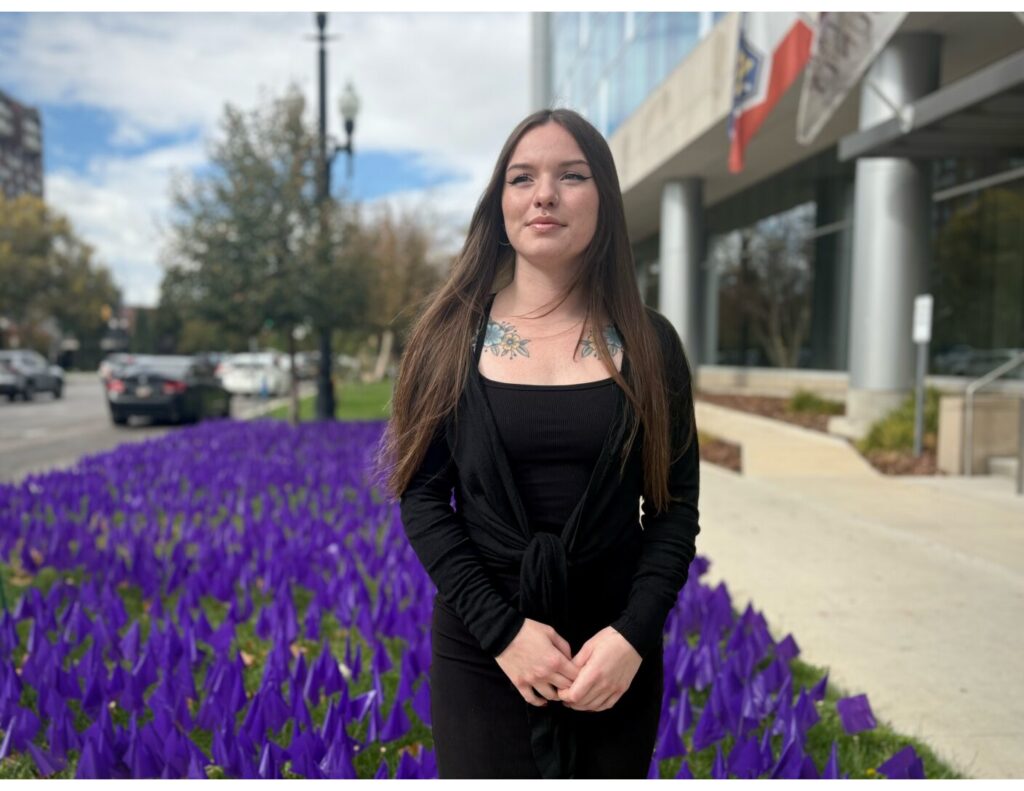

Alivia poses for a portrait outside the Salt Lake County District Attorney’s Office, where a display of purple flags honors survivors of domestic violence, on Thursday, Oct. 16, 2025. (Annie Knox, Utah News Dispatch)
With the days she walked on eggshells in her own home now firmly behind her, a Utah survivor of domestic violence breathed a big sigh on Thursday.
“It’s so relieving,” she said in an interview. “Now I just have to focus on myself, my healing journey, just picking up the pieces every single day.”
Alivia, who gave Utah News Dispatch permission to identify her by her first name, said police and prosecutors in Salt Lake City worked quickly and carefully to arrest and prosecute her perpetrator.
But Salt Lake County’s top prosecutor acknowledges that isn’t always the case. Many victims of domestic violence don’t have a positive experience with the justice system, District Attorney Sim Gill said, and many abusers are not brought to justice.
On Thursday, Gill said he wants to change that. He announced his office is training police throughout the county on how to ensure they gather all the evidence needed and how to interview those traumatized by abuse, without doing further harm.
He believes the instruction on best practices will help his office file more criminal charges without the added step of asking police to go back and gather more evidence.
“One of the things I want to minimize is the delay between an incident, and us filing,” Gill said in an interview. “Part of that is that if I’m sending this case back for further investigation, the urgency of the moment is being compromised.”
A grant from the U.S. Department of Justice – providing $500,000 over three years – is helping cover the cost of the training for five police departments: Salt Lake City, Riverton, Draper, West Jordan, and South Jordan, according to Gill’s office. But a longtime investigator working with the office is also leading trainings for other agencies upon request.
In South Jordan, detectives have received an early round of training that’s reinforced the effects of trauma, including a “freeze” response, said Lt. Adrian Montelongo with South Jordan police.
To help those reporting abuse feel more comfortable speaking with investigators, the department has been conducting interviews with them either at their homes or another space of their choice, and with victim advocates present, he said.
“They’re dispatchable,” Montelongo said of victim advocates. “Especially if they ask for one, we will call them out.”
On a statewide level, Gill said Utah has taken positive steps in addressing domestic violence in recent years. Under a 2023 state law, he noted, police must ask victims a series of questions that can help determine how much danger they’re in.
Days after officers’ deaths, Utah rolls out data on risk of domestic violence turning lethal
The surveys known as the lethality assessment protocol have also helped standardize how officers across the state investigate reports of domestic violence, Gill said.
But another state initiative has stalled. This year the Legislature did not fund a budget request to cover forensic exams for victims of attempted strangulation. Advocates say the exams are important because they can provide evidence for prosecutions and can reveal internal injuries or signs of a future stroke, even when there are no obvious external wounds, which also makes clear whether further medical care is needed.
“They should definitely put funding back into that,” Alivia told Utah News Dispatch.
At a news conference on Thursday, she and Gill urged Utahns to routinely check on anyone they suspect is being abused, ask how they can help, and recommend charting out a safety plan. Gill said it’s tempting to assume people in abusive relationships would simply leave, but there are many reasons why they might stay, including cultural, religious and financial factors.
“You’re going to always have the whys, the what ifs, the ‘What I could have done?’” Alivia said after the news conference. “I still get emotional about it, obviously. But time – that’s all you need. Time will heal.”