Utah News Dispatch
Some Utah voters weigh unregistering because of new law lifting certain privacy protections

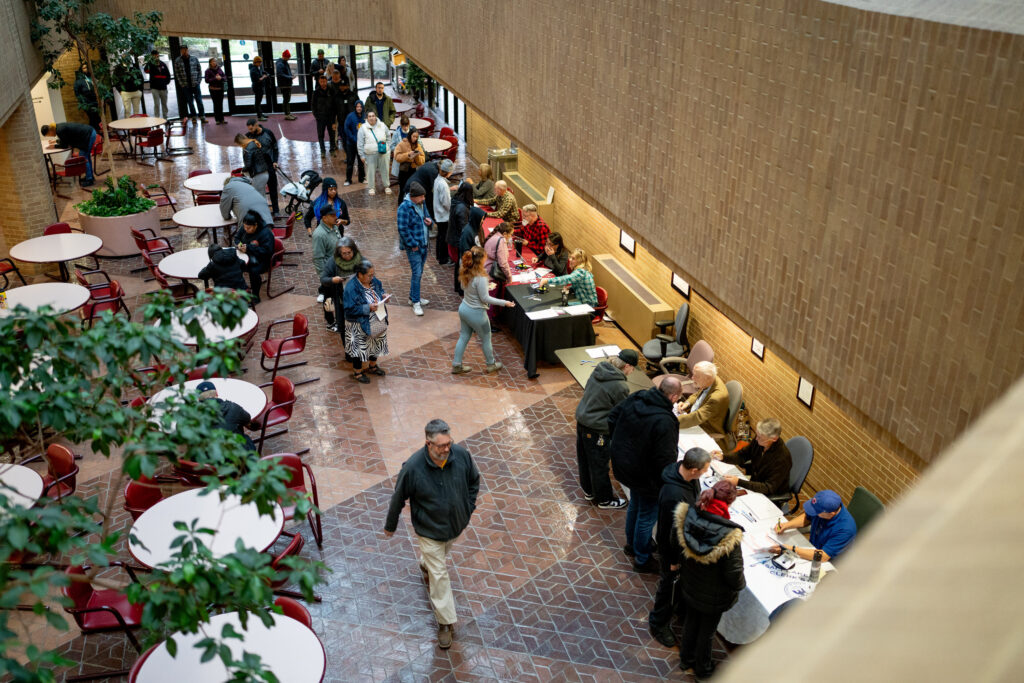

Voters line up at the Salt Lake County Government Center in Salt Lake City on Election Day, Tuesday, Nov. 5, 2024. (Photo by Spenser Heaps for Utah News Dispatch)
When David Yoder — a registered Utah voter living in South Jordan — got a letter from the lieutenant governor’s office earlier this month notifying of changes to Utah’s voter privacy law, he said he was left “fed up and frustrated.”
As an IT worker, Yoder told Utah News Dispatch he’s “very protective of my privacy,” and he knows how information like names and addresses can be used for scams or other malicious reasons. He’s also concerned about that information becoming more easily accessible during a time of heightened political tension and online vitriol on social media.
“I don’t want my name and address publicly available to anyone,” he said, while expressing concerns that he has a “real problem” with allowing that information to be “available for purchase.”
Private voter info to become public, but some Utahns, including police, can get exemptions
Even though the new law, SB153, criminalizes misusing the information — like posting the information online for free or otherwise — by making it a class A misdemeanor, Yoder worries that’s not going to stop it.
“The bad actors are going to do what they’re going to do,” he said.
Yoder is one of some 1.3 million Utah voters who had previously opted for some level of protections for their basic voter registration information, including their name, address, age range, party affiliation, and what elections they’ve voted in (but not how they voted, which has always been private).
New privacy law
In the letters sent to those 1.3 million voters, the office for the state’s top election official, Lt. Gov. Deidre Henderson, explained that thanks to the new law approved earlier this year by the 2026 Utah Legislature, come May 25 that information will become available to anyone willing to pay a $1,050 fee for a statewide list — unless voters seek and qualify for an “at-risk” voter status. The fees for county-specific lists vary depending on the county, according to the lieutenant governor’s office.
Registered voters who fall under any of the following categories can be eligible for an “at-risk” protected designation, according to the law:
- A person who is a victim, or is likely to be a victim, of domestic violence or dating violence.
- Law enforcement officers.
- Individuals protected by a protective or protection order.
- Members of the armed forces.
- Public figures. A public figure is defined in Utah law as “an individual who, due to the individual being considered for, holding, or having held a position of prominence in a public or private capacity, or due to the individual’s celebrity status, has an increased risk to the individual’s safety.” The law’s definition previously didn’t include elected officials, but SB153 changed it to include people who are “elected to public office, appointed to fill a vacancy in an elected public office, or employed by a government entity” if in relation to their public service they have “received a threat of harm to a person or property.”
- A person who resides with any of the individuals described above.
What to know about Utah’s new voter privacy law and how clerks are responding to concerns
State election officials have emphasized that while the new law allows “basic registration records” to be granted to anyone who requests them and pays the fee, the following personal information will remain “strictly private for all voters and may only be disclosed to government entities for election administration purposes”:
- Social Security numbers
- Driver’s license or state identification numbers
- Full dates of birth
- Email addresses
- Phone numbers
- Signatures
This isn’t the first time basic voter registration information has been publicly available in Utah. That information was public upon request before the Utah Legislature in 2018 passed a law that allowed Utahns to opt into a “withheld” status to keep their voter registration records private.
Since then, Utah lawmakers have debated whether that law went too far by reducing transparency around voter records and creating unintended consequences that pose challenges for candidates and political parties.
SB153 — sponsored by Sen. John Johnson, R-North Ogden, and Rep. Trevor Lee, R-Layton — is the latest change to privacy laws that rolls back the previous “withheld” option that nearly 300,000 Utah voters have used to shield their registration records without providing a specific reason.
Additionally, SB153 lifts the previous “private” status that allowed about 1 million voters to guard their records from anyone except political parties, candidates or government entities. In all, SB153’s changes will impact about 1.3 million of Utah’s more than 2 million registered voters.
When SB153 takes effect May 25, only voters who apply for and are granted an “at-risk” status will have shielded and anonymized records.
Letters to all of those “private” and “withheld” registered voters have now been mailed to them, according to the lieutenant governor’s office.
It’s not yet clear how many Utah voters will qualify for the “at-risk” status. Those wanting the designation have until May 6 to submit an application to their county clerks.
Some Utahns weigh unregistering to vote
Yoder said he doesn’t qualify for the “at-risk” designation under SB153’s new rules, and that leaves him in a conundrum he wishes he didn’t have to face. Should he unregister to vote to protect his privacy?
“I’ve considered that,” he said, but at the same time he doesn’t want to sacrifice his right to vote.
To him, the new law feels like a way to discourage more people from voting.
SUBSCRIBE: GET THE MORNING HEADLINES DELIVERED TO YOUR INBOX
“It’s a double-edged sword,” he said. “Because, yes, there is a privacy concern. But then there is an aspect of feeling like they’ve accomplished their goal, they got one more independent voter to not have voting rights. … You’re damned if you do, and you’re damned if you don’t.”
Yoder isn’t the only one who has weighed unregistering to vote as a direct result of the new law.
Shelly Jackson, deputy director of elections in the lieutenant governor’s office, told reporters on Tuesday that she has personally received phone calls from some voters telling her they’re planning on canceling their registration to protect their privacy.
“Yeah, I spoke to one last night, actually,” she said. “He said he was in the process of unregistering.”
Jackson said so far the lieutenant governor’s office has documented a “small handful of cases of people saying that they’re going to be unregistering.” Time will tell how many actually will.
But Jackson noted that during debate over the bill on Capitol Hill, “we did mention that as a potential side effect when we were in discussions about this bill.”
“So the lawmakers were aware that that was a potential side effect,” she said.
In response to those now wanting to unregister to vote because of the new law, Jackson said, “of course we want to express that that’s unfortunate.” But she also noted that SB153 explicitly prohibits election officials from “either encouraging or discouraging anyone” from completing the at-risk application.
“We’re just letting them know that the form is there and they should read through and see if they feel like they qualify,” she said.
Jackson also noted the new law put Utah in line with most other states when it comes to publicly accessible basic voter information. She also said there’s been a “long history” of transparency surrounding voter records.
When asked about heightened concern about doxing in today’s online age, Jackson said she’s personally unsure if “transparency laws have caught up to modern day challenges.”
“You know, in the 1960s we weren’t worried about people posting our information online, that wasn’t a thing,” she said.
Clerks’ concerns about deciding who qualifies as ‘at risk’
Voters aren’t the only ones who have expressed concerns with the new law.
Jackson said she’s been hearing from some county clerks that “don’t like being the ones making the decision of who qualifies and who doesn’t” for the at-risk status. That “discretion,” she said, has made some clerks feel “a little uncomfortable.”
What to know about Utah’s new voter privacy law and how clerks are responding to concerns
Voters, she said, have also expressed concerns about the law being implemented “potentially differently across counties.”
Asked if clerks have leeway when determining who qualifies for the “at risk” designation and who doesn’t, Jackson said they can refer to the framework created by the new law.
But if clerks aren’t sure about what to do about a specific application, “our advice to them has been to check with their county attorney, because their county attorney is ultimately the one that’s going to defend that decision,” she said.
There’s no formal appeals process included in the new law for rejected “at risk” applications. That means challenges could come in the form of lawsuits. But Salt Lake County Clerk Lannie Jackson also pointed out in an interview with Utah News Dispatch last week that there’s nothing stopping a voter from applying again if they’re rejected.
Still, Jackson said she’s heard concerns from clerks worried about being caught up in lawsuits due to new law. And they’re worried about putting people in dangerous positions if they reject an application.
“I’ve heard from clerks who are like, ‘I’m afraid of telling someone no, and then if something happens to them,’” she said.
Dispelling misconceptions
While speaking to reporters Tuesday, Jackson addressed several common misunderstandings state election officials have confronted while trying to educate voters about the new law.
Some people think the lieutenant governor’s office “decided on this policy” on its own, she said. “That’s not true.”
Lawmakers passed the law, and now the lieutenant governor’s office is required to enforce it.
And she said “voter history” — which will be included in the newly publicly available records — does not include how you voted, but rather what elections you’ve voted in.
Jackson also emphasized that it’s not true that all voter information — like drivers licenses or Social Security numbers — will be available. Those will stay private.
“We will not release driver’s license, Social Security, date of birth, those things,” Jackson said.
Jackson said she appreciates that the law now clearly defines what the “standard data set” is that is publicly available, and what’s not.
“That’s actually clear in this bill,” she said.