Utah News Dispatch
Salt Lake City mayor ‘encouraged’ by lawmakers’ approach to homeless funding this year

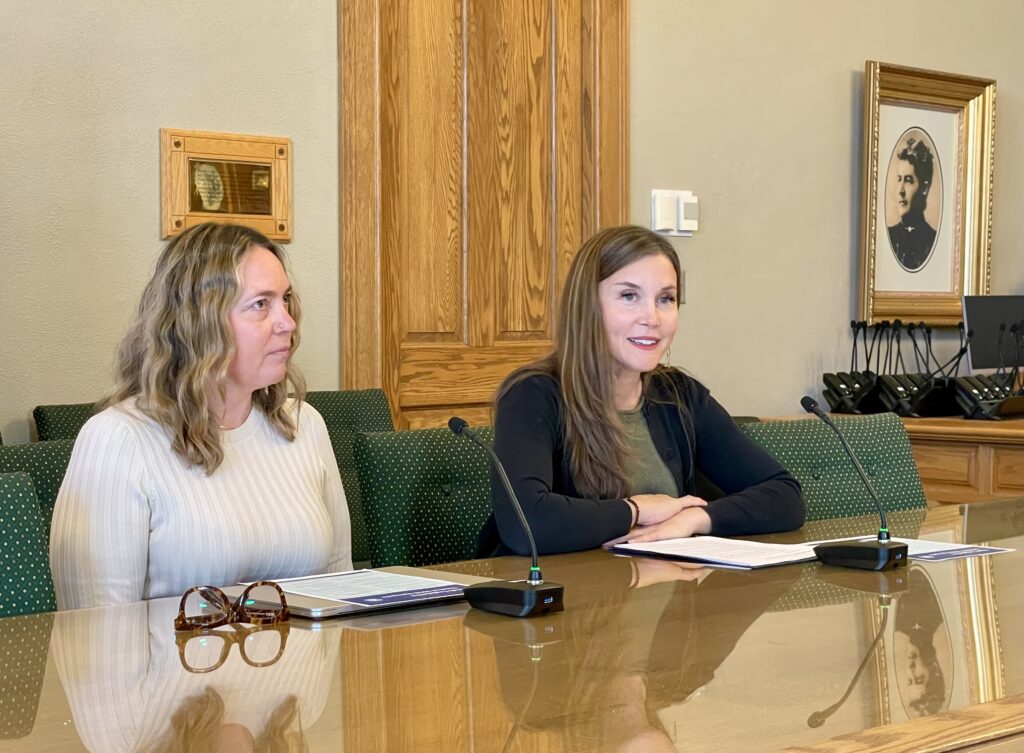

Salt Lake City Mayor Erin Mendenhall (right) and Angela Price, the city’s legislative affairs director, talk to reporters during a news conference at Salt Lake City Hall on March 11, 2026. (Katie McKellar/Utah News Dispatch)
Compared to a year ago — when Salt Lake City Mayor Erin Mendenhall expressed concerns that Utah lawmakers’ appetite to “control” the state’s capital city had grown to a new “punitive” level — this year’s session was starkly different.
“I can say without a doubt, this is one of the most productive legislative sessions that we’ve had as far as our relationship goes with state legislators,” Mendenhall told reporters during a news conference at City Hall on Wednesday focused on unpacking the session’s impact on Salt Lake City.
She and Angela Price, the city’s legislative affairs director, said this year’s session was largely underscored by bills that didn’t pass.
Some of the most controversial included a bill to cap how much cities could raise property taxes, and a bill to help facilitate a split of Salt Lake County. And another that made headlines before the session even started — to rename 900 South from Harvey Milk Boulevard to Charlie Kirk Boulevard — never progressed.
But among the things lawmakers did accomplish that Mendenhall said she was happy to see was a big commitment on homeless funding, including more than $17.5 million in long-sought ongoing money. The Legislature also reappropriated about $23 million in one-time money previously earmarked for “low barrier” emergency shelter toward a pot of $26 million in one-time funding for homelessness initiatives.
SUBSCRIBE: GET THE MORNING HEADLINES DELIVERED TO YOUR INBOX
Mendenhall, the leader of Utah’s Democratic capitol, expressed gratitude to Republican state leaders including Gov. Spencer Cox, Senate President Stuart Adams, House Speaker Mike Schultz and others “who have really partnered and worked with us, rather than against us.”
“It’s taken us years for us to foster these relationships, because many of them failed to previously exist,” she said. “I’m confident that Salt Lakers are better today because of those relationships that we’ve forged, and I appreciate the Legislature recognizing the importance of local government in our state.”
She acknowledged there are “of course, sometimes differences — major differences — between Salt Lake City and the Legislature.”
“But we are always going to stay at the table, and I’m committed to working with our partners on Capitol Hill to always bring about the best potential outcomes we can for Salt Lakers,” she said.
Homeless funding
Notably, lawmakers didn’t set aside any money specifically to build a controversial 1,300-bed homeless campus state leaders have proposed in Salt Lake City. Instead, Cox’s administration focused funding requests on “high utilizer” programs meant for people who are repeatedly arrested or spend the most nights in homeless shelters, along with expanding capacity for homeless shelters and mental and behavioral health.
State leaders say the campus idea hasn’t been abandoned — but rather they’re spending more time on formulating programs meant to inform the campus concept before funding the project’s construction. Based on the success of those programs, the governor said state leaders will determine whether to move forward with a campus.
Utah homeless leaders look to focus funding on ‘high utilizers’ while not ‘backing away’ from campus
Mendenhall called that approach a “good move.”
“I feel encouraged, actually,” she told reporters.
Previously, Mendenhall has advocated strongly for urgent expansion to the state’s homeless shelter system to meet needs of the state’s growing homeless population. However, she noted that “additional shelter beds are still an option” for the money state leaders set aside this year.
But at the same time, the mayor said she’s supportive of expanding efforts in Salt Lake County, which has explored a form of “diversionary justice” known as the Miami model that pulls people who are experiencing mental illness out of the criminal justice system and places them in community treatment programs.
She’s also supportive of using that funding to expand Salt Lake City’s Project CONNECT, which focuses resources on addressing the city’s 50 most-arrested people into treatment to relieve strain on resources and free up space for others in need.
“I’m very positive about that, versus a direct and too-focused investment in more shelter beds,” she said, adding that a comparatively small number of people are “consuming the majority of resources” in jails and homeless shelters.
“If we’re able to free up the capacity that is currently consumed by few and actually not serving them — they’re perpetually stuck in the cycle, their needs are not being met, the system isn’t working for them — then we acquire the kind of capacity that new beds would have given us, but with a more humane approach to the people who need it,” Mendenhall said.
She called it a “better approach for the taxpayers in the community who right now bear the brunt of the unmet needs.”
Homeless funding comes with a catch
The more than $17.5 million in ongoing funding and nearly $26 million in one-time money that lawmakers appropriated this year hinges on the requirement that “local governments” match the money on a one-to-one ratio.
Without that match, the Office of Homeless Services can’t spend a dime, according to intent language lawmakers included in one of their final budget bills, HB2.
Utah lawmakers move to boost ongoing funding for homeless with help from ZYN tax
That mandated match could double the money for homelessness — and bring the total to $35 million in ongoing money and $52 million in one-time money. But if cities and counties don’t pay up, that revenue could fall into limbo.
There’s an outstanding question mark over which local governments will answer that call for a match — and whether Salt Lake City will be expected to pay more than it already is, or if it’s a call to other cities or counties to pay more.
“I don’t know that there is a consensus opinion on that,” Mendenhall said. “I know that some legislators always want Salt Lake City to pay more for whatever the need is. And others who, I think, understand more of the complexity and the relationship that currently exists on this (and) know that we’re spending north of $25 million a year out of our general fund supporting the services and the impacts around homelessness in Salt Lake City.”
So Mendenhall said she hopes that the local match requirement “does not fall onto the host cities” that already have shelters in their city boundaries, including Salt Lake City.
“Because I know we’re already contributing far more than the mitigation funds we receive,” she said.
Currently, cities that don’t already host a homeless shelter must pay into a statewide homeless “mitigation” fund for cities that do host shelters. It’s funding that’s meant to be used to offset the impacts of the homeless shelters, but leaders of those cities — including Salt Lake City — have argued the money the state currently collects isn’t enough for host cities.
One bill the Legislature approved — HB308 — includes a provision that increases the amount that non-shelter cities must pay into that mitigation account — but only temporarily, for one year, in 2027. That’s expected to increase revenue to the state’s Homeless Shelter Cities Mitigation fund by about $753,000, according to the bill’s fiscal note.
That bill also includes a provision that enables existing shelters to temporarily expand their current bed capacity as long as they get permission from their host cities and execute an agreement.
Based on Salt Lake City’s population ratio to homeless shelters, some cities receive more mitigation funding from the statewide account than the capital city, Mendenhall noted. Salt Lake City receives about $2.7 million a year from the mitigation fund, “so it’s about a tenth of what Salt Lake City is actually paying” a year, she said.
The mayor added that Salt Lake City officials track “every dollar” the city is spending on homelessness, and “it’s profound.”
Ultimately, Mendenhall argued that the “current mitigation formula needs to change.”
“Frankly,” she said, up until now it’s been “a bargain for cities who do not have a shelter to pay such a minimal amount to not participate.”
“The costs of cities who do host services are escalating with inflation and the fact that most of the money we spend goes to the salaries of city employees who are doing this work and that, as you know, across the economic spectrum, is rising,” she said.
She added that she was “grateful” that the Utah League of Cities and Towns worked to come up with an interim task force to consider future changes to the mitigation formula.
“So it’s appropriate that the formula changes,” she said. “I expect all cities to need to invest more. But Salt Lake City’s investment has, for a long time, been exponentially greater than others.”