
Utah News Dispatch
Power District, still years away from MLB expansion announcement, starts construction

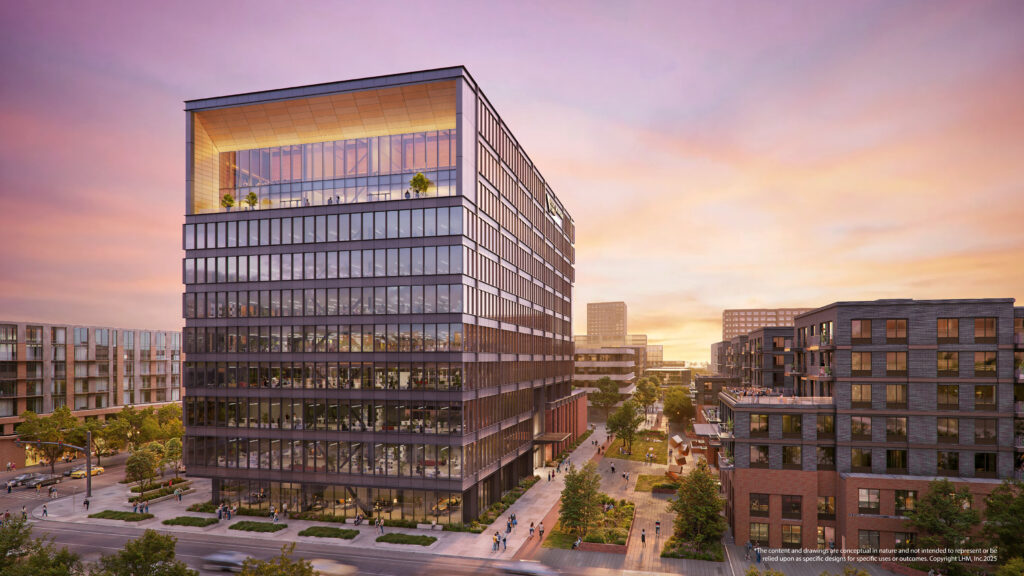

Conceptual rendering of Rocky Mountain Power’s future headquarters. (Courtesy of Larry H. Miller Company)
While a possible professional sports franchise for the area is still years off, North Temple is already undergoing change.
On the north side of the TRAX Power Station, a Salt Lake City affordable housing development has opened its doors, and the Star of India, a neighborhood staple, has a new facade. However, what may constitute the biggest change in the area broke ground on the south side of the station on Monday.
Rocky Mountain Power started construction on its new 10-story, 300,000-square-foot, all-electric headquarters, which alongside a potential Major League Baseball stadium, is set to become the landmark of the so-called Power District on Salt Lake City’s west side.
SUBSCRIBE: GET THE MORNING HEADLINES DELIVERED TO YOUR INBOX
MLB leaders haven’t released any team expansion plans, and won’t do so until MLB Commissioner Rob Manfred steps down from his role in 2029. But, with baseball insiders putting Salt Lake City on a shortlist of potential expansion markets, the Larry H. Miller Company, which is developing the district, hopes to have a foundation ready to host professional baseball.
“It’s a physical symbol that there’s progress being made at a site that would be the perfect location for Major League Baseball,” Steve Starks, CEO at the Larry H. Miller Company said on Monday, “and so when baseball gets ready to expand, and the owners decide, the commissioner is ready, they’ll look at this site and they’ll see there’s already momentum.”
SLC may not have an MLB team yet, but has a deadline if it wants a say in stadium plans
When finished, the campus will join a 100-acre sports and entertainment district that aspires to become an extension of downtown and is governed by a state-appointed authority born out of a law the Utah Legislature approved in 2024. That legislation also created a tax structure to raise up to $900 million to help fund the stadium.
Since the law passed, the Larry H. Miller Company has done remediation work, advanced development agreements, and updated its vision for the site, Starks said. If everything goes according to plan, a new stadium will be shovel-ready within 12 months, only awaiting word from the MLB.
But, regardless of whether Salt Lake City gets a baseball team or not, the Power District will become a new multiuse hub, Starks said, with access to a clean Jordan River, thousands of people living on the site, other offices, restaurants and entertainment options.
The Power District master plan includes 4,700 housing units, with a mixture of housing types and price points, according to a news release, as well as 320,000 square feet dedicated to retail, 300 hotel rooms, one mile of riverfront clean-up and access, trails and green spaces.

Tremonton Republican Sen. Scott Sandall, who chairs the Utah Fairpark Area Investment and Restoration District Board, also known as UFAIR, said he expects it all to come together in the next three to five years. But, now that the district’s governing body is in place, he doesn’t think more legislation will be needed for the district during the next general session.
“That legislation is already in place, and UFAIR is responsible for the state’s part of a ballpark when the Major League announcement happens,” Sandall said. “I’m just going to be positive about that.”
While city input is more limited for this project than it was with the Downtown Revitalization District — created to accommodate Utah’s NHL team — Salt Lake City Mayor Erin Mendenhall said on Monday she is excited about the possibilities for the west side of the city, an area that’s home to the state’s most diverse communities.
“Today marks the beginning of a catalytic investment in this neighborhood that this neighborhood has not only wanted but deserved for a very long time,” Mendenhall said. “It’s part of a growing momentum that we’re seeing all across the west side, where community vision is converging with long planned public improvements and private investment.”
Mendenhall also called for this new chapter of the west side to go hand in hand with sustainability. She highlighted Salt Lake City’s commitment, alongside other Utah communities, to match its electricity consumption with renewable energy generation through Rocky Mountain Power’s system.
“Our entire state needs those improvements, but few places more than the west side of Salt Lake City, which has disproportionately suffered from poor air quality in the past,” Mendenhall said.