Alexis Ence
Senator John D. Johnson & Alexis Ence Announce the New Southern Utah Podcast
The launch of PoliticIt Dixie marks more than a new podcast feed. It is an explicit effort to put Southern Utah’s stories, concerns, and conservative perspectives into the public square with clarity and context. At the core of the new program is a promise to center conversation around community heritage, responsible governance, and rigorous local engagement—issues that matter deeply to Washington County and the wider St. George region.

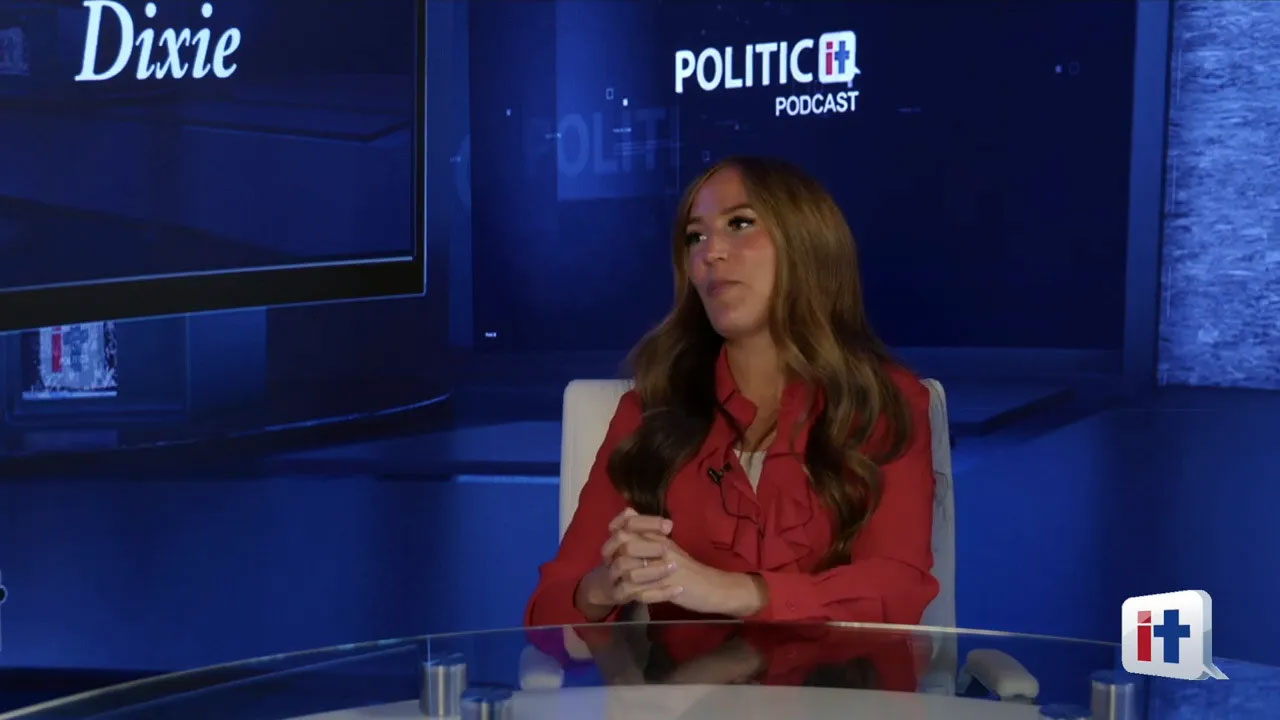
The PoliticIt Podcast is expanding to Southern Utah! In this special announcement episode, host Utah State Senator John D. Johnson introduces PoliticIt Dixie, the newest addition to the PoliticIt network.
Joining the show is Alexis Ence, a former professor at Utah Tech University and President of the St. George Republican Women, who will host the new program focused on the issues, leaders, and conversations shaping Southern Utah.
The launch of PoliticIt Dixie marks more than a new podcast feed. It is an explicit effort to put Southern Utah’s stories, concerns, and conservative perspectives into the public square with clarity and context. At the core of the new program is a promise to center conversation around community heritage, responsible governance, and rigorous local engagement—issues that matter deeply to Washington County and the wider St. George region.
PoliticIt Radio – Signal in the Red Rock (PoliticIt Dixie)
Why PoliticIt Dixie?
PoliticIt Dixie was created as a response to a gap: southern Utah voices are often discussed from afar, but rarely given a persistent platform that understands the local cultural context. The new show aims to change that by featuring conversations with elected officials, community leaders, and policy thinkers who live and work in southern Utah.
The guiding idea behind the program is simple. Local journalism and civic conversation should reflect the priorities of the community they serve. For many in Washington County, those priorities include family, faith, small-business vitality, and a long-rooted relationship with local institutions like Utah Tech University. PoliticIt Dixie intends to be the forum where those priorities are explored, defended, and thoughtfully challenged.

The Dixie Name: Heritage, Misunderstanding, and Healing
One of the first topics the new program tackles is the contentious history of the “Dixie” name in southern Utah. The label has been the flashpoint for years of debate because it means different things to different people. National narratives have painted it with broad strokes, while local residents and historians emphasize a distinct and specific regional heritage.
At the center of the local perspective is the phrase the community calls the Dixie spirit. This is not a marketing slogan; it is a lived history. During the Great Depression, both the university and the local temple were struggling financially. The church at the time considered cutting one of the institutions to preserve the other. According to local recollection and research, the community chose to sacrifice for the university. Families who barely had enough for themselves donated firewood, crops, and money so dormitories would stay warm and students could continue their education. That sustained effort is, in the minds of many, the origin story of a community that values mutual aid and investment in future generations.
To many residents, reducing the name to a national political symbol missed the point entirely: “Dixie” was a local shorthand for community resilience and shared history. The removal or alteration of the name felt to some like an erasure of that heritage. The incoming leadership at Utah Tech, including President Smead, has shown an interest in rebuilding trust by meeting with locals, learning those stories firsthand, and allowing local heritage groups to have a voice in how history is honored.

Community, Universities, and Local Identity
Universities do not exist in a vacuum. Faculty, administrators, and students rotate through. The real continuity comes from the surrounding community—the people who keep traditions alive after people move on. That continuity is what made the Dixie name meaningful to many families and alumni. A central purpose of PoliticIt Dixie will be to bring those community perspectives back into the conversation about what institutions should represent.
Who is Alexis Ence and Why This Matters
Alexis Ence brings a mix of academic experience and civic leadership to the new show. Formerly a faculty member at Utah Tech University, she also serves as the president of the Washington County Republican Women—the largest federated club in the state. Ence combines an understanding of higher education, local culture, and conservative grassroots organizing.
Her background is regional and practical. Teaching in higher education gave her insight into the everyday workings of a university and how those institutions intersect with the broader community. Leading a large, federated club taught her the value of a big-tent approach within party organizations: keeping lines of communication open, encouraging disagreement without ostracism, and treating civic engagement as a space for ideas rather than for ideological litmus tests.
Conservative Women’s Organizing and the Value of Inclusion
Washington County Republican Women exemplify a pragmatic conservatism. The club’s growth and award recognition reflect a politics that welcomes varied backgrounds and robust discussion. Ence insists on inclusion for the sake of both strategy and principle. She believes alienating members over single-issue purity hurts civic institutions and electoral prospects. The lesson is simple: a healthy local organization benefits from debate and dissent, not from enforced intellectual conformity.

What Southern Utah Wants: Family, Freedom, and Common-Sense Governance
Several themes recur across conversations about the region. Southern Utah’s political culture centers on family values, religious freedom, property rights, and local control. That does not translate neatly into a single partisan script. Rather than extremes, the community favors practical policies that preserve local autonomy and protect liberties.
PoliticIt Dixie aims to be a platform where those priorities can be explained to a broader audience: what does respect for local identity look like in practice? How do state policies affect the rural and suburban communities of southern Utah differently from urban centers? The show will ask those questions and amplify the voices that grapple with them daily.
Redistricting, Prop 4, and the Erosion of Trust
One of the central political issues discussed is a recent ballot-driven reform known as Prop 4. Its supporters pitched it as a way to remove partisanship from map drawing by establishing an independent process. Critics, however, argue that the measure has produced the opposite of what was promised: more chaos, less accountability, and maps that create extreme, noncompetitive districts.

Why Prop 4 Sparked Such Strong Reactions
- Perception vs. Intention — Many who voted against the measure felt it did not reflect the substance of what was printed in the pamphlet and the broader promises sold to voters. After implementation, the results were judged by some as inconsistent with the expectations that had been created.
- Accountability — When map drawing is performed by independent commissions, critics note that the normal levers of democratic accountability—electing and holding legislators responsible—become harder to apply. If citizens disagree with how lines are drawn, the path to remedy can be opaque or legally fraught.
- Unintended Consequences — Rather than creating more competitive districts, the new maps in some cases concentrated like-minded voters, producing districts that are more ideologically homogeneous and therefore more extreme.
The result, according to many local observers, has been a loss of balanced representation and an increase in divisive politics. Where representatives once had to appeal to a broad cross-section of voters, the new lines can reward the most extreme voices within a party—because those districts no longer require broad cross-party or cross-regional appeal to secure victory.

Practical Harms for Southern Utah
The effects are concrete. One consequence is the increased travel and logistical burden placed on representatives now responsible for sprawling districts that contain dozens of counties. Districts that span large geographic areas require more travel, larger travel budgets, and more complex constituent outreach. Small, rural counties can feel sidelined when their needs are not addressed on the same footing as concentrated urban areas within the same district.
Another result is the political uncertainty and fragmentation created by sharply divided districts. Several local leaders have voiced a sense that southern Utah’s influence in the congressional delegation is diluted—Southern Utah concerns can get swallowed in broader, more partisan districts that do not reflect the region’s priorities.
Accountability and the Constitution
There is a deeper constitutional argument at play. State constitutions vest the legislature with explicit responsibilities, including reapportionment and representation. Some observers argue that ballot initiatives should not be used to fundamentally restructure how representation is determined, because doing so subverts the constitutionally intended process for altering government. They point out that constitutional amendments and legislative reform are the lawful channels for such changes precisely because they preserve clarity and accountability.
“A pure democracy is two sheep and two wolves on a sheep debating over what’s for dinner,”
—an analogy offered during the conversation—illustrates the danger perceived by critics: direct democracy without safeguards can expend the rights of minorities in the name of majority rule.
Gerrymandering or Hyper-Polarization? The Debate Continues
Harmful maps can be crafted for partisan advantage on either side of the aisle. The core worry for many is not merely politics as usual; it is that the new maps create districts where the incentives for compromise are reduced. When representatives face primary challenges from their own party more than general election opponents, the pressure to move toward the extremes increases.
Some go further and argue for legal action to challenge the current maps. Courts can be an avenue for redress when maps violate constitutional protections or fail to respect compactness and community of interest. Others prefer legislative remedies or ballot measures tailored to set clear, objective principles for map drawing while keeping final authority with elected representatives or a more transparent process.
Electoral Fallout: Seats, Candidates, and the Human Cost
Electoral consequences follow swiftly from radical changes to districts. The announcement that a sitting representative might not seek reelection—cited in local conversations as the “first casualty” of the upheaval—highlights the personal and political toll such reforms can take.
Beyond retirements, the reshuffling of districts can produce surprising matchups and fractious primary battles. Candidates who once represented a cohesive geographic area may find themselves drawn into contests with very different constituencies. These transitional moments can produce intraparty conflict and long-term damage to the party’s ability to present unified governance solutions.
What Southern Utah Needs from Its Representatives
At the core of the conversation about maps and representation is a simple set of expectations many southern Utah residents hold for their elected officials:
- Accessibility — Representatives should be reachable across the district and present at local forums, not just in urban centers.
- Practical Solutions — Residents prefer problem-solving approaches over rhetorical purity—policies that keep small businesses alive, protect water resources, and respect local culture.
- Accountability — Voters want to know who is making decisions and how they can hold those decision makers accountable at the ballot box.
- Respect for Local Identity — State officials should care about how names, institutions, and traditions matter to rural and suburban communities.
When districts reward politicians for seeking the middle ground, these expectations become realistic goals. When districts reward tribal politics, those goals become harder to achieve.
Big Tent Conservatism and the Path Forward
Part of the remedy suggested by local leaders is intentionally cultural: return to a broad-tent conservatism that keeps space for different views, experiences, and backgrounds. In places where the party becomes a uniform ideological club, the risk is a shrinking base and less electoral durability. A big-tent approach argues that unity can coexist with vigorous debate.
Practical steps to rebuild trust and effectiveness include:
- Re-emphasize Local Institutions: Support universities and community organizations that connect generations and preserve regional memory.
- Foster Cross-County Dialogue: Create forums where neighboring counties can discuss shared challenges in transportation, water management, and education.
- Increase Transparency Around Maps: When maps are redrawn, require clear published criteria, public hearings across affected counties, and mechanisms for residents to appeal or explain their concerns.
- Prioritize Practical Governance: Encourage elected officials to prioritize legislation that reduces friction in residents’ lives—permitting reform, education flexibility, and rural infrastructure—over culture-war signaling.
- Protect the Role of the Legislature: Explore ways to restore appropriate constitutional roles for elected bodies while preserving independent review to prevent blatant gerrymandering.
Civic Engagement: The Most Powerful Remedy
Ultimately, the healthiest antidote to confusion and disaffection is a more engaged citizenry. Local clubs, precinct meetings, town halls, and community media outlets are the civic infrastructure that make accountable representation possible. PoliticIt Dixie’s central mission is to strengthen that infrastructure by giving southern Utah leaders a reliable forum to explain policy choices and listen to counterarguments.
Leadership in a democracy is not about silence or dominance; it is about conversation. When residents, party activists, journalists, and elected officials commit to listening and debating on the merits, the result is typically better policy and more trust.

Practical Takeaways for Southern Utah Residents
For people who live and work in Washington County and nearby areas, there are tangible steps to help shape the region’s political future:
- Show up to local meetings and attend hearings about districting, school boards, and local planning.
- Engage with local civic groups whose activities are rooted in community service rather than national culture wars.
- Support platforms that prioritize regional reporting so that local stories are told accurately and consistently.
- Encourage elected officials to conduct listening tours across rural counties and to publish clear travel and outreach plans.
- Demand transparency from bodies that oversee redistricting, including timelines, map-drawing criteria, and public comment periods.
Conclusion: A New Platform, A Clear Purpose
PoliticIt Dixie represents a strategic effort to bring Southern Utah’s conservative voices into a sustained conversation about community, governance, and representation. The region’s history—embodied in the Dixie spirit—its institutions, and its civic organizations together create a foundation to rebuild trust after a period of polarizing change.
Redistricting and ballot measures like Prop 4 forced difficult conversations about how Americans govern themselves at the state level. Those debates are not abstractions. They shape who gets represented, how well local needs are prioritized, and whether democratic systems remain accountable to citizens. The best responses are both legal and cultural: insist on fair, transparent procedures while cultivating a politics that welcomes debate and local engagement.
Southern Utah would benefit from a politics that upholds local identity, respects representative institutions, and prizes practical problem solving. Platforms that center regional context can play a constructive role by elevating voices that have historically been underrepresented in statewide and national dialogue and by fostering the kind of civil conversation that leads to durable public policy.
Where to Start
For those who care about the future of southern Utah, the path forward begins with participation: attending meetings, joining civic organizations, and insisting on transparency in public processes. Building a political culture that values both heritage and responsible governance requires patience—but it starts with the everyday choices of residents and leaders who choose conversation over chaos.