
Utah News Dispatch
Maloy, Lyman talk ICE, data centers in debate for Utah’s new 3rd Congressional District

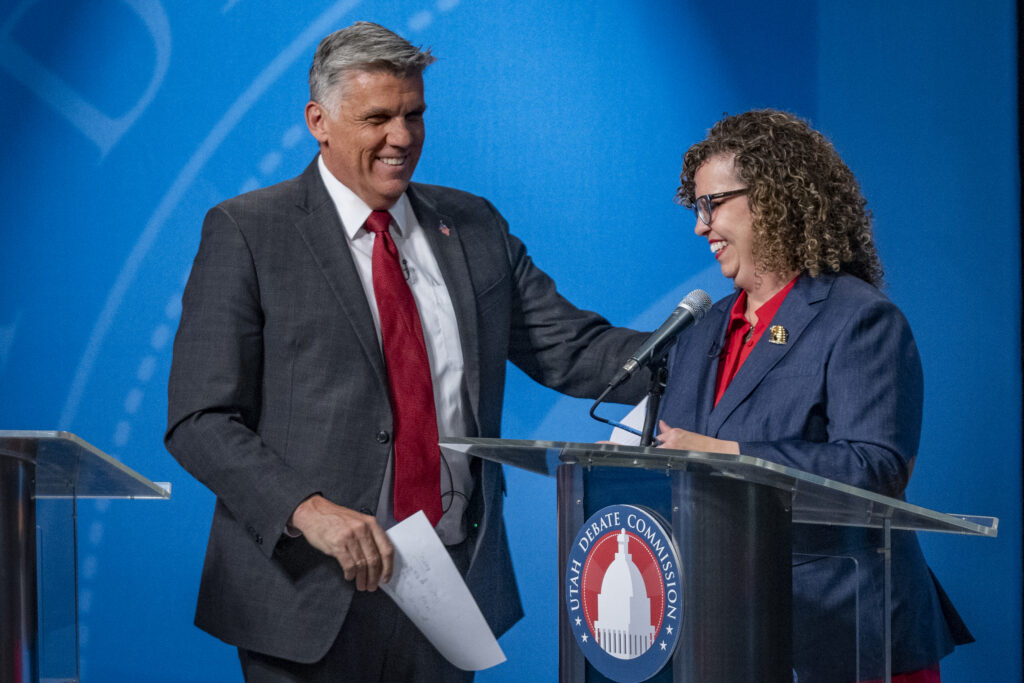

Phil Lyman and Rep. Celeste Maloy at the end of the 3rd Congressional District GOP primary debate in Salt Lake City on Monday, June 1, 2026. (Pool photo by Rick Egan/The Salt Lake Tribune)
In a polite debate that lacked any fiery jabs, Rep. Celeste Maloy and her Republican challenger Phil Lyman took the stage on Monday to debate issues ranging from high costs of living, the national debt, water, data centers, artificial intelligence regulations and more.
While their political views often overlapped, Maloy painted herself as the qualified, experienced candidate with the track record to prove it, while Lyman made the case that he is an anti-establishment candidate ready to upset the “status quo.”
There were a few moments where the exchange hosted by the Utah Debate Commission and broadcast by PBS Utah showcased differences between the two candidates competing in the upcoming June 23 primary to be the Republican front-runner in Utah’s newly drawn, deeply red 3rd Congressional District that spans from Utah County’s suburbs, across the state’s eastern side all the way to its southern corners.
One of those moments came when moderator Thomas Wright, a former Utah Republican Party chair, asked if they support the proposal to build a large-scale U.S. Immigration and Customs Enforcement detention center in Utah.
ICE detention center
Maloy said she supports “having more beds for federal detainees in Utah.”
“This is something I’ve been working on for years, actually. We don’t have enough beds for detainees that the marshals pick up, or ICE,” she said, though she added that she’d also like to see the Trump administration “work with Utah and treat us like we are a state that supports them, and find a place, and do it in a way that makes sense for the state, and not have a heavy hand the way a Democrat administration would be expected to act in Utah.”
Lyman, on the other hand, said he doesn’t support the proposed detention center. Rather than being housed after being arrested, he argued ICE detainees should just be quickly deported.
“No, I don’t think that Utah should build a giant facility to house illegal immigrants. I think those immigrants should be shipped back to their countries,” Lyman said. “And the only crime worthy of deportation should be that you entered the country illegally. … No, I do not support building a facility out there. Utah has kind of a prison mentality already, and I’m afraid that if we build a big facility like that, the emphasis would be more to keep it full than to get it emptied.”

Data centers
Maloy and Lyman and some similar answers when Wright asked them if they supported the proposal for a massive data center in Box Elder County — a controversial project backed by celebrity investor Kevin O’Leary.
While Maloy said she sees the need for more data centers, both she and Lyman argued the project needed more transparency to assuage public concerns.
“On paper, Utah is a perfect place to build data centers. Unfortunately, data centers aren’t built on paper,” Maloy said. “And states are made up of people. And the people in Utah have questions. And they want those questions answered.”
Maloy also argued that “we have a unique opportunity in Utah to lead on AI policy and development, that’s going to require data centers.”
Massive Box Elder County data center could increase Utah’s carbon emissions by 50%
“But in order to build data centers in Utah, we’ve got to make sure that we’re siting them where people want them, and we’re building the type that match our resources,” she said.
While Maloy said Utah is “not a great place” for data centers that require vast amounts of water for cooling, she said the state would be a better fit for “air-cooled” data centers, which she said “take a lot of power.”
“We can produce power in Utah, but we don’t have any more water,” Maloy said. “So we should be making thoughtful decisions about building data centers in Utah that match Utah’s needs, Utah’s resources, and what the people of Utah are asking for. And we have to make sure we bring the public along and answer their questions along the way.”
Lyman said he recently went to a protest in Box Elder County, and even though there were many people there with differing political views, he said “the one thing we have in common is we don’t like being treated poorly.”

“And the people were treated poorly in this instance. They weren’t consulted. They were told what was going on,” he said, accusing Utah state leaders of responding to the backlash with “a reprimand, a put down, a condescension towards those people.”
Lyman appeared to be referring to comments made by Gov. Spencer Cox — whom Lyman unsuccessfully challenged in Utah’s 2024 gubernatorial election.
“That type of government is what creates more of the questions than were maybe there in the first place,” Lyman said, adding that he doesn’t “agree with the process” that has led to the data center proposal getting an initial green light from the three-person Box Elder County Commission, which consented to the project area being created by the special district called the Military Installation Development Authority.
“I don’t agree that Utah is the best place for data centers,” he said. “They are water intensive and they are a drain on resources. And those things can all be measured if we have transparency on the front end of it. If we don’t have transparency, then it’s a no go for me.”
SUBSCRIBE: GET THE MORNING HEADLINES DELIVERED TO YOUR INBOX.
Pressed again on whether they support the Box Elder county proposal based on what they know about it today, Maloy said she supports “building data centers in Utah when the people of Utah support them, and right now I don’t know that we have that in Box Elder County.”
“So if the people who want to build the data center can answer the questions and bring the public along, then yes,” Maloy added.
Lyman said even though he’s “a fan of Kevin O’Leary, a fan of data, I’m a fan of computers, I’m a fan of technology,” but as far as the data center proposal in Box Elder County is concerned, he said “until they’re transparent about it, I’m opposed to it.”
Post-debate scrum
After the debate, Maloy and Lyman each spent 10 minutes answering questions from reporters.
During the scrum, Lyman said voters should pick him over Maloy because of her voting record, which he attacked.
“She’s done a lot of good things, but she’s done a lot of really bad things,” he said, including “voting to not reveal the hush money payments from Congress to the victims of sexual harassment by members of Congress,” which Lyman called “a bad vote on her part.”
On a 357-65 vote in March, the House voted to effectively kill a resolution sponsored by Rep. Nancy Mace, R-South Carolina, that would have made public all reports on allegations of congressional lawmakers and aides engaging in sexual misconduct or harassment.
In a joint statement, the Republican and Democratic leaders of the House Ethics Committee argued against the resolution, saying it “could chill victim cooperation and witness participation in ongoing and future investigations” and would make it harder for the committee “to investigate and eliminate sexual misconduct in the House,” NBC News reported.
Maloy, during a scrum with reporters before Lyman attacked her voting record, pointed to her positions on important congressional committees including the appropriations and natural resources committees that enable her to be a voice on issues that she said are “important to Utah.”
Utah Republican Party delegates pick challenger over congressional incumbent, split on another
“I’m in the middle of my first (full) term. I’m just getting started on addressing the issues that I ran to address, and I want to keep fixing problems for Utahns,” Maloy said. To Lyman’s criticisms of Congress, Maloy said “it’s easy to criticize Congress on the outside. When you’re on the inside, you have to find ways to get things done, and that’s what I’ve been doing.”
Lyman qualified to compete against Maloy in the upcoming primary after Utah Republican Party delegates were split on the two during the party’s nominating convention in April.
Neither Maloy nor Lyman reached the 60% threshold to secure the party nomination, so delegates sent them both to the primary ballot. Maloy got 50.95% (482 votes) while Lyman got 49.04% (464 votes).
The last time Maloy faced a Republican challenger — when Colby Jenkins competed against her in 2024 — she won on an extremely thin margin, with 50.08%, or 176 votes. Maloy noted that she’s running in a new district now under Utah’s new court-ordered congressional map, and at the time of her first primary she was still a “brand new member” of Congress who didn’t have the track record that she does now.
Ahead of the June 23 primary, by-mail ballots are expected to start hitting mailboxes this week, starting Tuesday.