Utah News Dispatch
‘Lives are at stake,’ health, food aid advocates say of Medicaid, SNAP cuts in ‘big, beautiful bill’

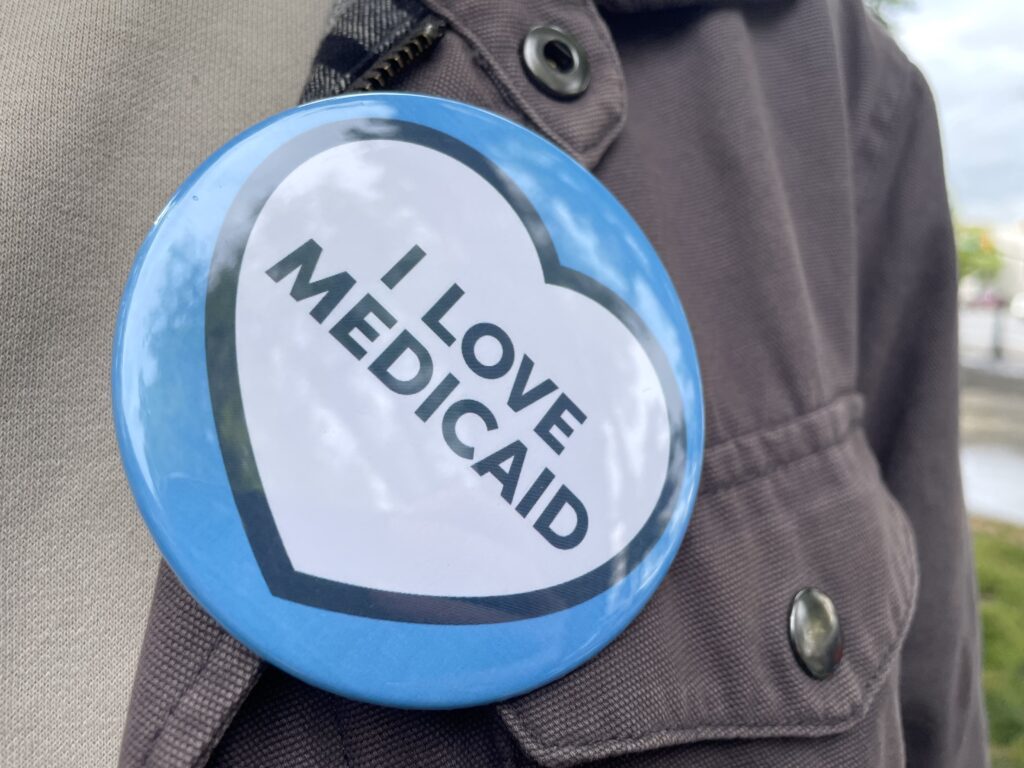

A supporter wears an “I love Medicaid” button during a news conference held at Pioneer Park in Salt Lake City on May 6, 2025. (Katie McKellar/Utah News Dispatch)
A coalition of concerned Utah health, food aid and housing advocates rallied together on a virtual call Wednesday to raise alarms about “devastating” fallout if the massive tax and spending bill that’s been dubbed President Donald Trump’s “One Big, Beautiful Bill Act” gets approved.
Estimates for how many people in Utah would be affected have been a moving target as the bill has made its way through Congress, but advocates warn tens of thousands could lose Medicaid coverage and thousands more in Utah who rely on the nation’s largest federal food assistance program, the Supplemental Nutrition Assistance Program (SNAP), could be at risk of losing food benefits.
They also warned “lives are at stake” because the proposed cuts could especially threaten Utah’s rural hospitals and clinics, which could lead to reduced access to health care. Further, they said the cuts would have far-reaching effects that would lead to job losses, increased hunger, and declining health for people across the nation, including Utah.
Analysis: Upwards of 80K Utahns could lose health insurance under ‘big, beautiful’ bill’
“Over 60,000 Utahns could lose Medicaid coverage because of these cuts, which we know will hit rural Utah particularly hard,” said Nate Crippes with the Disability Law Center, which is also a member of the Protect Medicaid Utah Coalition. “On top of the coverage loss many Utahns — including children, those who are low income, who have disabilities, who are aging — will also now face greater insecurity.”
Crippes said “thousands of jobs” across Utah could be at risk due to economic fallout from the cuts.
“While the impacts on some communities will be abrupt,” he said, “the aftershock will be felt by all Utahns.”
After the U.S. Senate passed its version of the bill Tuesday, it now awaits another vote in the U.S. House. Wednesday, the bill hit a roadblock as far-right members of the House GOP objected to the Senate’s version. Members of the House Freedom Caucus balked at several provisions in the sprawling bill, including that it would increase the federal deficit by $3.4 trillion.
But a vote in the House still looms. And though advocates acknowledged their complaints may be falling on deaf ears from Utah’s all-Republican congressional delegation, they said they’re not going to stop fighting or give up hope — even if the cuts to Medicaid and SNAP get approved.
They urged Utahns to do the same — not give up.
“Whether there’s hope or not, the correct thing for anybody individually to do is still to contact your Congress person and make the effort,” said Neil Rickard, a child nutrition advocate with the advocacy group Utahns Against Hunger. “At the very worst, you’ve emphasized that these are very real issues. Whatever happens with the outcome of this bill, the core issues that we’re talking about right now are still going to exist.”
But if the bill does pass? Rickard said the fight to restore Medicaid and SNAP benefits is just beginning.
“We have a huge problem on our hands and we need to start addressing it,” he said. “It’s very bad … but the work does not stop.”
‘Absolutely the wrong time’ to shift SNAP costs to states
Among the advocates who warned against the cuts Wednesday was Glenn Bailey, executive director of Crossroads Urban Center, which he described as the “agency of last resort” that provides food pantry assistance to low-income Utahns.
US House GOP struggles to advance megabill against Freedom Caucus resistance
He said SNAP and Medicaid help people from “falling through the cracks” and ending up in food pantries to begin with. Today, Bailey said Crossroads Urban Center serves up to 13,000 people every month between its two food pantries, “and the need is continuing to go up” amid Utah’s increasing housing costs.
“This is absolutely the wrong time to make cuts in the safety net, particularly in food resources that help single parents,” Bailey said. He added that adding “red tape” like work requirements or other barriers would be a “big mistake,” especially “for the most vulnerable people in our communities.”
If the bill passes, Bailey said the federal government will be “spending a whole lot more money and exploding the national deficit in order to do less for the people who need it the most.”
“It’s a big mistake,” he said.
How would Utah deal with the cuts? Former legislator weighs in
Marsha Judkins, a moderate Republican from Provo who is a former Utah legislator who served on the Social Services Appropriations Subcommittee for six years, said the cuts will likely affect Utahns who need the services rather than weed out fraud because, she said, fraud in Utah’s programs is rare.
Judkins, who did not seek reelection last year, said she’s seen first-hand how legislators are “very careful about the money received from the federal government.”
“The Medicaid and SNAP programs in Utah have very little fraud, misuse or waste,” she said. “The application process is very rigorous, and the clients on these programs are often reviewed to make sure that they still qualify.”
The proposed cuts could lead to several possible scenarios, she said, but “all of them have some fairly severe consequences to every-day Utahns.”
“Legislators could decide to make the cuts permanent, and then they would either cut people from the programs or cut the benefits they are receiving,” she said. “Who would be cut and the services that would be cut? New moms, possibly receiving postpartum care. Addiction recovery. Services for those who have serious mental illness. Children who have complex health needs. Patients battling cancer.”
SUBSCRIBE: GET THE MORNING HEADLINES DELIVERED TO YOUR INBOX
While proponents argue the cuts are meant to go after people committing fraud, Judkins said, “in Utah we simply don’t have that problem, and it’s going to be real people who are going to be cut. And they’re going to be cut from programs that they truly need.”
She also warned that “unintended consequences” could be increased hospital costs, increased hospital visits, longer wait times for care, and increases in health insurance premiums, “and that’s just to name a few.”
Rural hospitals at risk
Matthew McCollough, rural hospital improvement director for the Utah Hospital Association, warned rural hospitals are especially at risk from the cuts.
Roughly 1,300 “critical access” hospitals, or hospitals that are located in rural and underserved areas, currently exist across the U.S., with an average operating margin of only 2.5%, “so they’re barely getting by,” he said. He added that 46% of rural hospitals are operating with a budget deficit, while in states that have not expanded Medicaid, 53% of those hospitals are operating in the red.
He added that 188 rural hospitals nationwide have already closed or converted to a rural emergency hospital status “because they were unable to keep the doors open.” And about 432 rural hospitals are already vulnerable to closure.
“And that’s today,” he said, adding that the federal cuts would only further jeopardize “an already very vulnerable, fragile rural health care system.”
He stressed that it’s important to realize “these are real people that need care.”