
Utah News Dispatch
Lee, Maloy’s push to undo Grand Staircase-Escalante plan goes into new territory

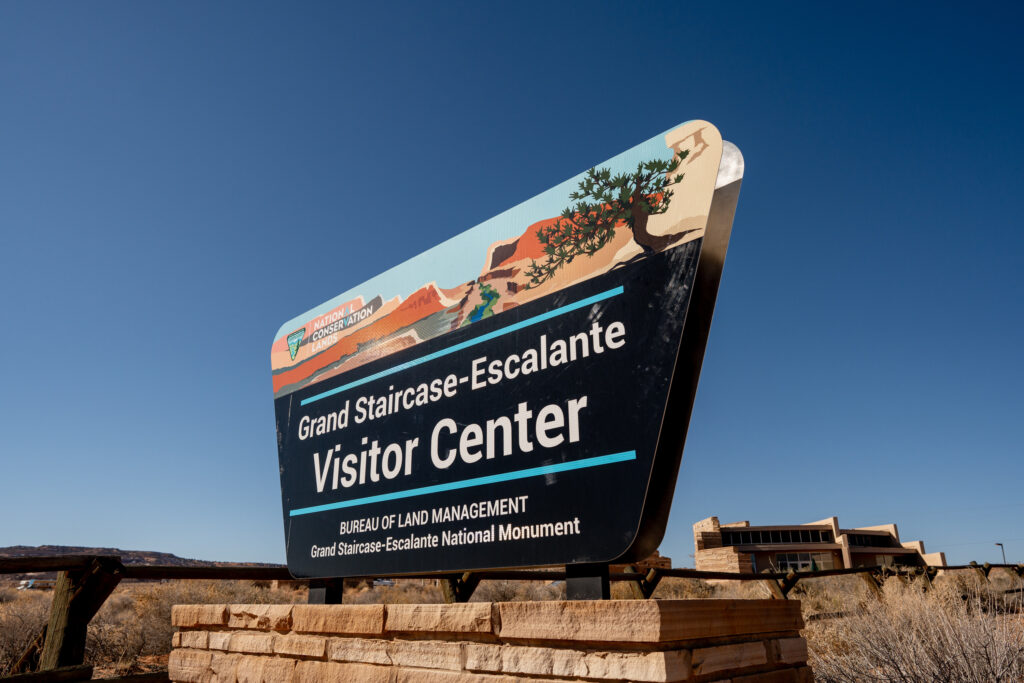

A sign welcomes visitors to a Grand Staircase-Escalante National Monument Visitor Center in Big Water, Utah on Sunday, Feb. 2, 2025. (Photo by Spenser Heaps for Utah News Dispatch)
When President Donald Trump announced from the Utah Capitol that he was downsizing the Bears Ears and Grand Staircase-Escalante national monuments in 2017, environmental groups fought back with a lawsuit before the day was over.
But now they’re pushing back against what they say is a new threat to Grand Staircase-Escalante’s 1.9 million acres in southern Utah, this time under a different set of rules that make winning a court fight seem like even more of a long shot.
Two members of Utah’s congressional delegation, Sen. Mike Lee and Rep. Celeste Maloy, are proposing to repeal Biden-era standards for managing the vast monument, calling them too restrictive on uses like road access and too far from what neighboring communities wanted.
The lawmakers are using a new strategy allowing Congress to make the change on an expedited timeline and with a simple majority of votes in the House and Senate under the Congressional Review Act, or CRA. It’s a process never before used on a national monument, and it precludes the moves from most any sort of judicial review.
SUBSCRIBE: GET THE MORNING HEADLINES DELIVERED TO YOUR INBOX.
“I don’t really like to say never, but it feels very difficult to chart a path forward to litigate those kinds of decisions,” said Steve Bloch, legal director for the Southern Utah Wilderness Alliance.
“The fight to stop the CRA is really in Congress.”
The group is working to persuade Congressional representatives from outside of Utah to oppose it, making a case that federally protected lands are for everyone, not just Utahns. The state’s all-Republican congressional delegation supports Lee and Maloy’s push.
Legal experts agree the maneuver is hard to fight in court and say it would leave federal land managers guessing about what they’re supposed to do next.
The CRA would bar officials from managing the land in a “substantially similar” manner in the future, but it’s not clear how different the new framework needs to be, noted Mark Squillace, law professor at the University of Colorado Boulder. That uncertainty could “seriously handicap” the U.S. Bureau of Land Management from doing its job, he told Utah News Dispatch.
“Most likely what it means is there’s just not going to be a plan,” Squillace said.
Some cattle grazing is currently allowed within the monument, he pointed out. If Congress agrees with Lee and Maloy and rejects the current management plan, “does that mean they can’t have livestock grazing anymore, because that would be substantially similar to what they had already approved? I think we just don’t know.”
Grand Staircase-Escalante was established by former President Bill Clinton in 1996 over the objections of Utah officials and under the Antiquities Act, a century-old law giving presidents authority to declare monuments to protect places of cultural, historical and scientific significance.
After President Donald Trump downsized the monuments during his first term, President Joe Biden restored both to their original size. His administration finalized the Grand Staircase management plan prioritizing conservation in the last days of his presidency.
Utah’s congressional delegation condemned the conservation-focused blueprint as federal overreach, saying it limits grazing and recreation. Grazing is still allowed across all but 7% of the monument, while shooting is permitted within over 90%, Bloch said.
Some critics have raised alarm that undoing the management plan could invite mining, but Bloch said no matter what happens with the proposal before Congress, the proclamations establishing Grand Staircase-Escalante prohibit new mining claims and mineral leases.


Lee, chairman of the Senate Committee on Energy and Natural Resources, has said the Antiquities Act was designed to protect specific objects and “reserve only the smallest area compatible with their protection” but gave way to a “sweeping land-use regime” at Grand Staircase. He was a proponent of Trump’s 2017 move to shrink the monument’s boundaries, but emphasized the new proposal he and Maloy are sponsoring would not affect its size.
Spokespeople for Lee and Maloy did not immediately return requests for comment from Utah News Dispatch. They have not given details on the elements of the current plan they disagree with, and don’t have to under the CRA process, said John Ruple, a research professor of law at the University of Utah’s Wallace Stegner Center for Land Resources and the Environment.
During Trump’s first administration, Congress used the Congressional Review Act 16 times to overturn rules issued by a number of federal agencies, Ruple said. The current Congress has done so 23 times so far, he said, more than all others combined.
Maloy has said if the CRA effort is successful and signed by the president, the measure would revert the monument’s management plan to a prior version under Trump’s first administration. But that plan didn’t cover its current boundaries, Ruple said, leaving questions about the rules that would apply to the rest.
“Essentially with the CRA, you have this kind of scorched earth tool that just breaks things,” he said, “and kind of leaves chaos in its wake.”