Utah News Dispatch
Lawmakers left sexual assault programs out of the budget, forcing service providers to fundraise

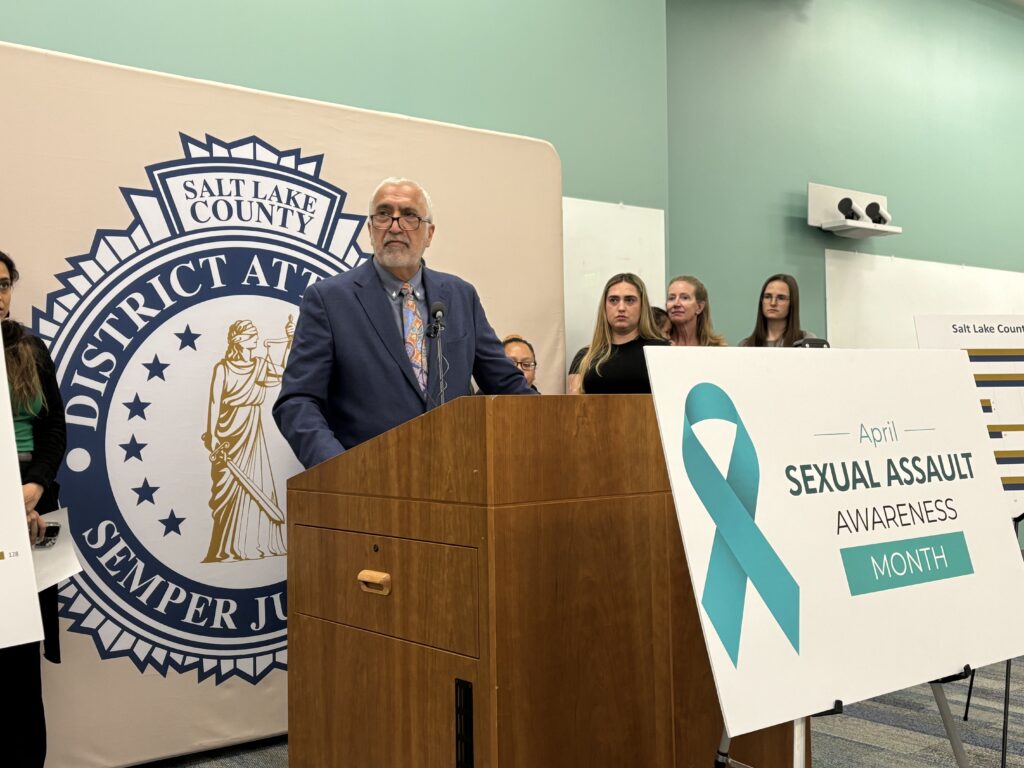

Salt Lake County District Attorney Sim Gill speaks to reporters about Sexual Assault Awareness Month at his office in Salt Lake City on Thursday, April 17, 2025. (Kyle Dunphey/Utah News Dispatch)
Utah has rates of sexual violence that often trump the national average — according to the Salt Lake County District Attorney’s Office, 1 in 3 Utah women will experience sexual violence, compared to 1 in 5 women nationally.
Yet this year, the state’s service providers are forced to fundraise and solicit federal money, which is in increasingly short supply, after lawmakers snubbed the Utah Coalition Against Sexual Assault’s request for funding that would have gone to the state’s rape crisis programs. According to the request, the money was intended to provide “meaningful sexual prevention work,” like education and training.
“Prevention education works. It can change the way individuals think. It can change the way communities interact. It changes relationships. It is the least funded source of service for victims in the state of Utah,” said Gary Scheller, associate director of the Rape Recovery Center.
The coalition asked lawmakers for almost $3.3 million — the Legislature’s Social Services Appropriations Committee recommended just over $1.6 million. But ultimately, funding for the coalition was not included in the final budget.
SUBSCRIBE: GET THE MORNING HEADLINES DELIVERED TO YOUR INBOX
Now, with April being Sexual Assault Awareness Month, Scheller’s nonprofit, which provides advocacy for victims, clinical therapy, education and training, will be forced to fundraise and look to the federal government to fill the void.
Lawmakers said it was a tight budget year, and a number of programs never received funding. Still, some of the programs funded by the state’s nearly $30 billion budget include $40 million in annual funds for the Utah Fits All Scholarship voucher program, $20 million in one-time funding for the state’s first-time home buyer program, and dozens of other programs and allocations that cost far more than what the Coalition Against Sexual Assault was asking for.
“What I would like to say really loudly to our state Legislature is, what you fund reflects your priorities,” Scheller said on Thursday during an event at the Salt Lake County District Attorney’s Office marking Sexual Assault Awareness Month. “So when we see millions going here and millions going there and this being cut and that being cut, that is equivalent to the state Legislature saying, these are our priorities, these not so much.”
The Utah Domestic Violence Coalition is in a similar boat, after their request for $200,000 in annual funds was also left out of the state’s budget. The money would have allowed police departments around the state to continue to administer a critical health care service for victims of domestic violence while bolstering investigations.
Legislature snubs funding for domestic violence health care service, forcing nonprofit to fundraise
Scheller said the lack of state funds will have a “significant” impact to the Rape Recovery Center.
The center, and other sexual assault support programs, have been sharing a $600,000 allocation from the state spread out over three years — for the Rape Recovery Center, that’s about $15,000 to $20,000 each year, according to Scheller.
Now that the Legislature snubbed their request this year, Scheller said education and prevention programs, which are already underfunded, will continue to be spread thin.
“These prevention and education programs, with state school board approved curriculum, where we can get into schools and talk to students about consent and healthy relationships — those will be greatly minimized. So now we’re going to go looking for other ways to continue to do that,” Scheller said.
Sex crimes continue to be an issue in Utah. According to Salt Lake County District Attorney Sim Gill, 88 out of 100 women who are sexually assaulted in Utah will choose not to come forward. Of the 12 that do report the crime, six will likely be re-victimized “though the way that we respond to them,” Gill said. “Because we’re not trauma informed, because we’re not victim centered.”
Data from Gill’s office shows the extent of sexual violence in the county, which fluctuates year to year.
The office filed 81 rape charges in 2023, compared to 89 in 2024; 51 object rape charges in 2023, compared to 54 in 2024; 22 rape of a child charges in 2023, compared to 10 in 2024; 104 sex battery charges in 2024, compared to 72 in 2024; 100 lewdness charges in 2023, compared to 90 in 2024; 35 sodomy of a child charges in 2023, compared to 26 in 2024; and 20 aggravated sexual assault charges in 2023, compared to 15 in 2024.
“I hope this encourages our policymakers to know that they need to fully fund our institutional partners and our community partners,” Gill said.