
Utah News Dispatch
Judge voids controversial constitutional amendment on Utah’s Nov. 5 ballot

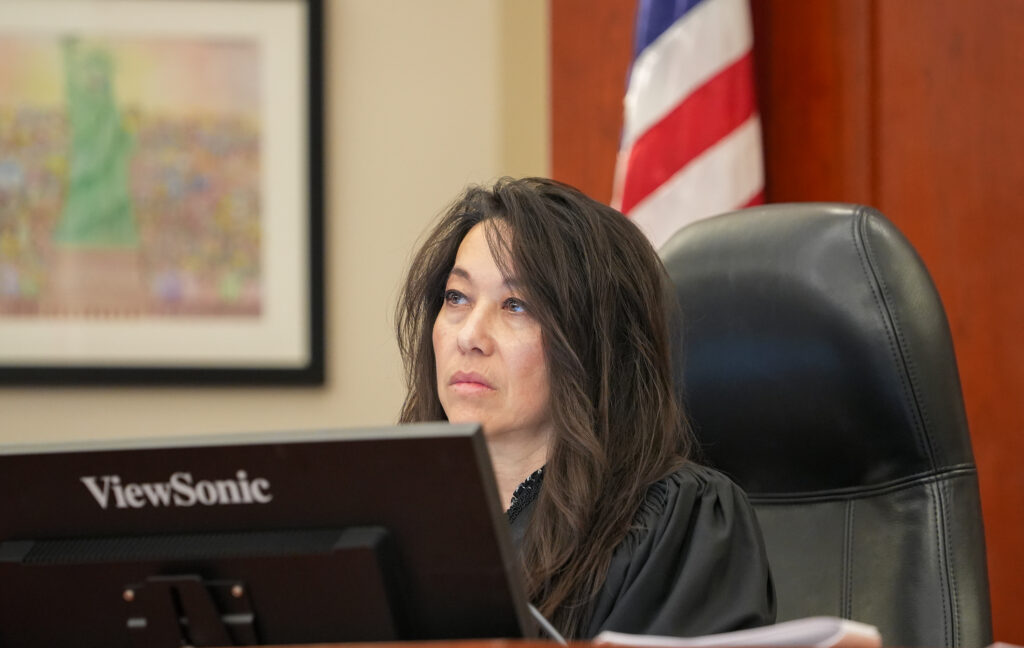

Judge Dianna M. Gibson listens to arguments during an injunction hearing in 3rd District Court in Salt Lake City, Wednesday, Sept. 11, 2024, challenging the inclusion of constitutional Amendment D on the general election ballot. (Pool photo by Chris Samuels/The Salt Lake Tribune)
In a remarkable ruling issued Thursday morning — the second time in less than three months the courts have rebuked the Utah Legislature — a judge declared a controversial constitutional amendment question on the Nov. 5 ballot void.
After hearing oral arguments less than 24 hours prior, 3rd District Court Judge Dianna Gibson sided with plaintiffs who alleged the ballot language of constitutional Amendment D (which would enshrine the Utah Legislature’s power to repeal and replace ballot initiatives), violated the Utah Constitution because it was “false and misleading” — written to trick voters into giving up their constitutional rights.
“The people are entitled to an accurate summary of any proposed constitutional amendment that impacts their fundamental rights and they are entitled to the constitutionally required notice, by publication in a newspaper two months before the election,” the judge wrote. “These requirements are fundamental to the integrity of our democracy.”
‘Orwellian doublespeak’: Lawsuit asks judge to scrap ‘misleading’ Utah constitutional amendment
The same plaintiffs (the League of Women Voters of Utah, Mormon Women for Ethical Government, and individual voters from Salt Lake County) have been in a yearslong legal battle alleging the Utah Legislature engaged in unlawful gerrymandering and violated the Utah Constitution when it repealed and replaced Better Boundaries’ 2018 voter-approved ballot initiative that required lawmakers to use an independent redistricting commission. That same case is also before Gibson after it was remanded back to district court by the Utah Supreme Court.
Plaintiffs argued Amendment D should be struck from the ballot entirely. While the judge wrote removing it would be “legally justifiable,” she opted to keep the language on the ballot because striking it so close to ballot printing deadlines “may jeopardize Utah’s ability to comply with all election deadlines and may significantly increase the parties’ exposure to legal, financial and timing risks” when it comes to the Nov. 5 election.
That also allows the ballot question to remain in case state officials successfully appeal the decision.
However, the judge also noted state officials were “somewhat responsible” for the impact on ballot printing by holding a special session to place the constitutional amendment on the ballot so close to the general election.
“They truncated the deadlines, sidestepped normal processes, and proposed in short order a constitutional amendment, with inaccurate descriptions, to shift power from the people to the Legislature,” the judge wrote.
When the Utah Supreme Court issued a unanimous opinion in July remanding the anti-gerrymandering case back to district court, that ruling set limits on the Utah Legislature’s power to repeal and replace government reform initiatives.
At the time, the Republican-controlled Utah Legislature reacted with defiance. The Legislature called itself into an “emergency” special session last month to sidestep the Utah Supreme Court’s interpretation of the constitution and instead ask voters to rewrite the Utah Constitution in favor of lawmakers’ interpretation of their power over ballot initiatives.
Anti-gerrymandering groups then sued, alleging Amendment D’s ballot language written by top Republican legislative leaders was “false and misleading” because it mischaracterized the true effect of the constitutional amendment. While the ballot question said the amendment would “strengthen” and “clarify” Utah’s ballot initiative process if passed, plaintiffs argued in court it would actually “weaken” voter initiatives because it would enshrine in the Utah Constitution the Legislature’s power to change or repeal any ballot initiative.
Plaintiffs also successfully argued state officials failed to meet publication requirements for proposed constitutional amendments. The Utah Constitution explicitly states the Legislature “shall cause” the text of constitutional amendments to be “published in at least one newspaper in every county of the state, where a newspaper is published, for two months immediately preceding the next general election.”
The judge ruled the Utah Legislature failed to meet those requirements.
“While the Legislature has every right to request the amendment, it has the duty and the obligation to accurately communicate the ‘subject matter’ of the proposed amendment to voters and to publish the text of the amendment to voters and to publish the text of the amendment in a newspaper in each county two months before the election,” Gibson wrote in her order. “It has failed to do both.”
State election officials, whose attorneys had urged the judge to issue a ruling Wednesday night because they needed to begin printing the first batches of ballots Thursday, accepted the judge’s ruling.
“We appreciate the court’s prompt attention and serious consideration of this matter. State and county election officials will move forward as ordered,” Lt. Gov. Deidre Henderson said in a prepared statement.
Better Boundaries board member Ryan Bell issued a celebratory statement in reaction to the ruling.
“Amendment D was a deceptive power grab written by two leaders of the legislature. We applaud the Court’s decision and interpretation of the Utah Constitution to void Amendment D on the November ballot,” Bell said. “Amending our founding document should never be shrouded with misleading language and rushed in this fashion. Utahns overwhelmingly want and deserve a proper balance of power in our state government and the Court agreed.”
Utah Senate President Stuart Adams, R-Layton, and House Speaker Mike Schultz, R-Hooper, issued another scathing statement in response to the ruling, saying they were “extremely disappointed by the lower court’s policymaking action from the bench.”
Utah Legislature asks voters to change constitution, skirt Supreme Court ballot initiatives ruling
“It’s disheartening that the courts — not the 1.9 million Utah voters — will determine the future policies of our state,” the House speaker and Senate president said. “This underscores our concerns about governance by initiative as an out-of-state interest group from Washington D.C., with seemingly unlimited funds, blocked Utah voters from voicing their opinions at the ballot box.”
Their statement appears to be referring to Campaign Legal Center, a nonprofit based in the nation’s capital with a mission of advancing “democracy through the law, fighting for every American’s right to participate in and affect the democratic process,” according to its website. The Campaign Legal Center joined the League of Women Voters of Utah and other plaintiffs’ in the lawsuit fighting to void Amendment D.
Adams and Schultz’s statement continued, going on to question the judge’s “impartiality” and claiming “interference” in the election.
“The court’s actions have introduced significant uncertainty into the electoral process, raising concerns about the impartiality and timing of judicial interventions. Such interference during an ongoing election undermines public confidence in the integrity of the process,” they said. “The court is denying the right of the people to vote and should not be exerting undue influence on this election.”
In what critics characterized as a “red herring” to entice voters, Utah’s legislative leaders added a second prong to Amendment D that would also ban “foreign individuals, entities or governments” from influencing an initiative or referendum. There is no evidence that “foreign entities” have contributed to any ballot initiatives or referenda in Utah, but legislative leaders argued it’s meant to prevent it from ever happening.
But the biggest constitutional change at the heart of Amendment D would make clear the Utah Legislature has the ultimate power to amend, enact or repeal any law adopted by a ballot initiative.
Utah Supreme Court hands big win to plaintiffs in anti-gerrymandering lawsuit
That’s even though the Utah Supreme Court interpreted the Utah Constitution as granting voters the right to alter or reform their government through ballot initiative, and ruled the Utah Legislature does not have unfettered discretion to change laws enacted by ballot initiatives and cannot change government reform initiatives in ways that “impair the reform.” Lawmakers could, however, make legislative changes to government reform initiatives if they’re able to show they were “narrowly tailored to advance a compelling government interest,” according to the Utah Supreme Court ruling.
Utah’s top Republican legislative leaders, however, argued the constitutional amendment was needed because the Utah Supreme Court’s ruling paved the way for invincible “super laws” enacted by ballot initiatives that the Utah Legislature would have no way of changing and invite California-style governance to the Beehive State. They have criticized the ruling as one that upset a 100-year “balance” in the powers they’ve long assumed the Utah Constitution granted the Legislature.
Adams and Schultz said they would continue to fight. A Senate spokesperson said state officials plan to appeal the decision, which could bring the case before the Utah Supreme Court.
“We will not stop fighting for Utahns,” Adams and Schultz said. “It’s critical we find a path forward that safeguards our state from external influence and keeps Utah’s future in Utah’s hands. We will continue to exhaust all options to prevent foreign entities from altering our state and clarify the over a century-long constitutional practice, including our appeal to the Utah Supreme Court. We urge them to undo this wrong and preserve the voices of Utahns.”
Utah Democrats celebrated the ruling. Senate Minority Leader Luz Escamilla, D-Salt Lake City, and House Minority Leader Angela Romero, D-Salt Lake City, issued a joint statement thanking the plaintiffs for defending Utah voters’ rights and playing “a vital role in protecting our democracy.”
“The Legislature’s actions aimed to override voter decisions and increase their own power,” Escamilla and Romero said. “By shifting responsibility for drafting the ballot question from nonpartisan staff to the President and Speaker, they allowed themselves to omit key details that would mislead voters.”
Escamilla and Romero also criticized GOP legislative leaders for not acknowledging the role they played that led to Thursday’s court decision.
“While the Republican supermajority claims this decision undermines the people’s ability to decide on the amendment, they ignore their own role in distorting the process,” they said. “Their manipulation of the wording, failure to publish the amendment as required, and withholding critical information, have deliberately obstructed a fair and transparent vote.”
Escamilla and Romero also urged Utah voters to “stay informed and engaged as the situation develops.”
“Protecting the integrity of our democracy is essential to ensuring the will of the people is respected,” they said. “We are committed to defending a system that amplifies, rather than undermines, voters’ voices.”
Read the judge’s full ruling here:
SUPPORT NEWS YOU TRUST.