
Utah News Dispatch
Is Utah falling short of its water policy potential?

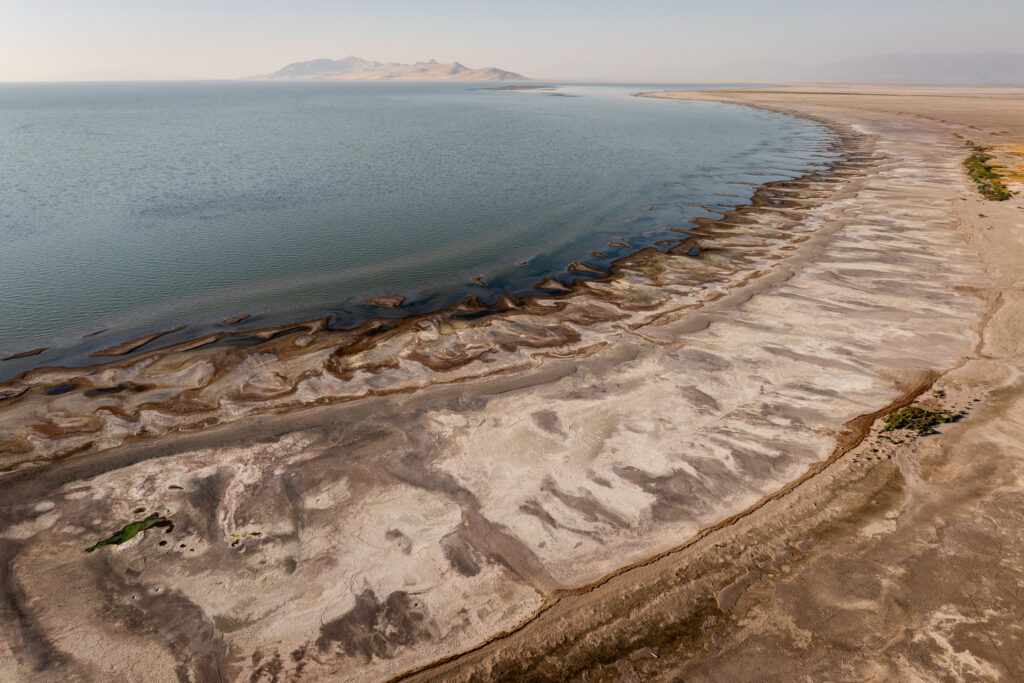

The shores of the Great Salt Lake are pictured at Great Salt Lake State Park near Magna on Tuesday, Aug. 5, 2025. (Photo by Spenser Heaps for Utah News Dispatch)
Early migrants to the territory that is now Utah were harried out of every state they settled in during the first half of the 19th century, including New York, Ohio, Illinois, and Missouri. The long-running narrative has always been that these places denied folks religious freedom, but the westward-migrating pilgrims gave locals plenty of reason for objecting to their social and religious practices, including the practice of polygamy in highly monogamous American society and their insistence that Christianity in America had gone entirely apostate.
The “Days of ’47” pioneers sought shelter in the last remaining un-surveyed piece of land left in continental North America. Here, Utahns established a culture of Sabbath day church attendance, early marriage, copious childbearing, and an obedient workforce placing absolute trust in unregulated capitalism. The state more recently has championed a focus on winter Olympics, luxury temple construction and luxury housing, college and professional sports fandom rather than citizen participation in democratic government, a great economy, a solvent state government, and unregulated use of water resources.
Utah’s regularly expressed need to be the best or near best at everything springs inevitably out of the claim to have the best religion and the closest communication with God of all the Christian churches. How can one’s leaders speak regularly to God and not have a leg-up on everybody else in everything from soup to nuts on God’s green earth?
However, more recently leaders and average citizens of the state have manifestly contributed mightily to a 25-year drought of the sort that Old Testament prophets would have unhesitatingly called a punishment from God for ignoring water resource management for so long . . . in a desert no less! Gov. Spencer Cox recently raised eyebrows when he said nobody should be looking down on any neighbor who lets their lawn go yellow today.
Last year, the governor’s approach was to “pray for rain,” and the heavens actually produced some. This year, after a precipitous relapse back to the parsimonious productivity of previous years’ summer monsoons, the governor seems to be getting more desperate, and perhaps a bit more realistic.
One of the most obvious restraints holding Utah back from greater achievement in public policy is political philosophy. Utah’s guiding civic philosophy from “day one” in 1847 is the idea that spiritual people do not need to be forced by government to do anything. One of the state’s most oft-repeated sayings is, “Teach them correct principles, and they govern themselves.” In other words, Utah embraces a radical libertarianism that says if we make sure everybody gets proper instruction, government will have little need to regulate anyone’s public behavior.
Folks, this philosophy hasn’t worked in water resources management. This summer I followed the governor’s reasonable suggestion to let my lawn go yellow, and now in late summer there is still a great sea of green on all sides of me throughout the suburban Salt Lake City community I live in.
Many religious people misunderstand Jesus’ admonition to not judge others. Christians must leave the judging to God and not to fallible human beings, or so the thought goes. This is in part the approach taken by the state’s new water distribution plan for Great Salt Lake mineral extraction companies. The state plans in 2026 to make “voluntary agreements” to conserve water with these companies who account for over 7% of the lake’s human depletion of water resources. Those who do not enter into such agreements may suffer diminishment or loss of water rights when lake levels are low. This is a competent program that is about 20 years overdue.
However, a “hands-off” philosophy still bedevils at-home water consumption in my neighborhood. The water company regularly sends me a comparison of my water use with that of the average of my neighbors. The idea here seems to be that I will be gently shamed into changing my ways if I am using more than average. However, there is no penalty if I don’t.
Utahns, as much as any group nationwide, also misunderstand the concept of states’ rights and local home rule. States and localities are given the police power by our Constitution to decide things like penalties for exorbitant use of water precisely because it is best for locals to make these decisions rather than have the federal government step in to regulate things with one-size-fits-all policies.
One recent Utah article asks, “What if the mega drought lasts another 25 years?” as some professionals are predicting. Preventing the consequences of such an occurrence should not be a matter of mere luck, but aggressive public policy. Folks need to pay a price for not conserving water.