Utah News Dispatch
‘Is it accurate’? Judge weighs whether to pull constitutional amendment from Utah ballot

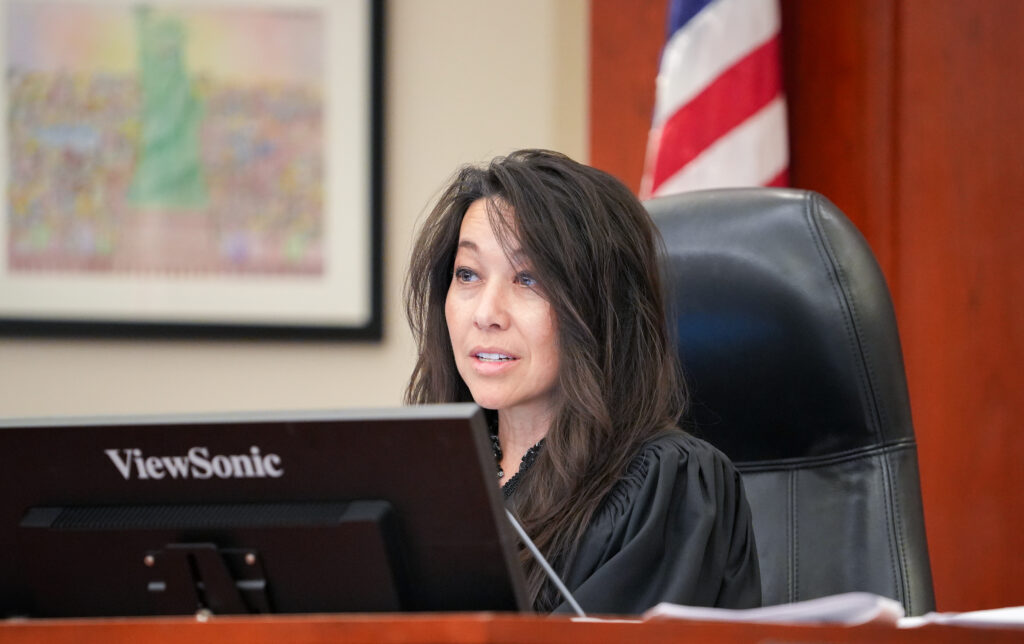

Judge Dianna M. Gibson makes remarks during an injunction hearing in 3rd District Court in Salt Lake City, Wednesday, Sept. 11, 2024, challenging the inclusion of constitutional Amendment D on the general election ballot. (Pool photo by Chris Samuels/The Salt Lake Tribune)
With election officials under tight ballot printing deadlines anxiously awaiting her decision, a judge expects to issue a ruling sometime Wednesday evening in a lawsuit asking her to block a controversial proposed constitutional amendment from appearing on the Nov. 5 ballot that would enshrine the Utah Legislature’s power to change or repeal any ballot initiative.
Third District Court Judge Diana Gibson heard oral arguments Wednesday afternoon in the case, in which anti-gerrymandering groups argued the ballot language of Amendment D — written by the Legislature’s top Republican leaders — is unconstitutional because it’s “false and misleading.” Additionally, they argued the proposed amendment didn’t meet constitutional requirements that its language be published in newspapers in all counties across the state two months before the election.
‘Orwellian doublespeak’: Lawsuit asks judge to scrap ‘misleading’ Utah constitutional amendment
Attorneys representing the Utah Legislature and state election officials, however, argued constitutional publication requirements have been met because state officials have published the information online, and local media have covered the issue extensively in a “torrent” of news articles.
They also argued voiding Amendment D itself would be a “suppression tactic” that could cause delays and confusion while contending the ballot language — which states the constitutional amendment will “strengthen” and “clarify” Utah’s voter initiative process — is accurate because it would uphold the Legislature’s historical understanding of its power over ballot initiatives.
That’s even though the proposed constitutional amendment and this latest legal battle involving the state’s redistricting process came in direct response to a unanimous Utah Supreme Court opinion in July that set limits on the Utah Legislature’s power to repeal and replace government reform initiatives — a ruling that sent anti-gerrymandering groups’ lawsuit back to the district court and dismayed Utah’s Republican leaders, who have long believed they hold the ultimate authority to alter or even totally repeal voter-approved ballot initiatives.
In reaction to that ruling and after conservative groups urged lawmakers to “correct” the Utah Supreme Court ruling, the Utah Legislature called itself into an “emergency” special session in an attempt to render the ruling moot by asking voters for permission to rewrite the constitution in favor of lawmakers’ interpretation.
The issue
Amendment D, plaintiffs argue, would actually weaken voters’ ballot initiative power — not strengthen it — which is the opposite of how the constitutional amendment is characterized in its ballot language.
“It is 100% false to say that if the voters vote yes on the amendment, state law will be changed to require the Legislature to respect the intent of voters when they pass an initiative. It does the precise opposite of that,” said Mark Gaber, an attorney for the Campaign Legal Center who represented the plaintiffs (the League of Women Voters of Utah, Mormon Women for Ethical Government, and individual Salt Lake County residents who claim they have been disenfranchised by unlawful gerrymandering).

While the Utah Legislature also passed a special session bill contingent on the passage of Amendment D to require lawmakers, if amending a ballot initiative, to “give deference” to the initiative’s general purpose, it also allows lawmakers to amend the law in any manner if they determine it necessary to “mitigate an adverse fiscal impact.”
But even then, Gaber argued, if the Utah Constitution is changed, it would supersede that new Utah law and give the Legislature authority to do as they please. That new law also wouldn’t apply to repealing a ballot initiative, he said.
“This ballot language cannot stand,” Gaber said, arguing it mischaracterizes the effect of the constitutional amendment.
“A reasonably intelligent voter who read the amendment would think that they were strengthening the initiative process to put limits on the legislature’s ability to repeal an initiative and disregard the intent of the voters,” Gaber said. “That is just indisputably not what the text of the amendment does.”
He argued it would cause irreparable harm to Utah voters to have a misleading question on the ballot.
“I can’t imagine how the public interest is served by having ballot language and asking them to vote on something that tells them the exact opposite of what would happen if they vote in favor of an amendment to their declaration of rights in their constitution,” Gaber said.
Representing the Legislature and other state officials, attorney Tyler Green urged the judge to protect the “integrity of the election process” by not removing the question, which he said would cause voter confusion and potential ballot printing delays. Letting it stay on the ballot but voiding it, he argued, would also confuse voters.
Judge questions impact, implementation of Amendment D
The judge pressed Green on Amendment D’s language.
“Is it accurate?” she asked, bluntly.
“Yes,” Green said. “It does strengthen it. It does clarify it.”
“This is the way everyone had understood this process to operate in Utah,” he said, pointing to conservative groups’ call to the Legislature to act in the wake of the Utah Supreme Court ruling.
Gibson, however, wrestled with that assertion.
“But it omits something that’s pretty important,” Gibson said, “and that’s the fact that it relieves the Legislature of having to establish a compelling state interest and make any amendments through narrowly tailored needs. So it basically abrogates the Supreme Court’s recent ruling in this case. And the (ballot) summary does not explain that.”
The judge questioned whether that omission makes the question inaccurate.
“Your honor, I don’t think it does,” Green argued. He acknowledged plaintiffs contend so, but he said the Utah Supreme Court ruling left more questions than answers that have yet to be litigated, so the Utah Legislature responded to calls to “strengthen and clarify” the law.
Gibson pressed further.
“Does it increase the Legislature’s authority with regard to citizen initiatives?” she questioned.
“No, I don’t think it does,” Green said. “What it does is what the ballot summary description says, which is strengthens and clarifies the way that the state’s historical representative democracy path and direct democracy path have always (been) understood to operate.”

The judge, however, pointed out that the constitutional amendment would make clear in the Utah Constitution that “notwithstanding any other provision of this Constitution, the people’s exercise” of their ballot initiative or referendum power “does not limit or preclude the exercise of Legislative power, including through amending, enacting or repealing a law, by the Legislature.”
She questioned if that provision would “change, in any way” the Legislature’s authority over ballot initiatives. Green repeated his argument that it would “restate” what state officials “understood the law to be” before the Utah Supreme Court ruling.
Gaber, in his arguments, pointed out that the Utah Legislature’s 2020 move to repeal and replace the 2018 Better Boundaries voter initiative was the first time the Legislature attempted to assert its power over a government reform ballot initiative — and the Utah Supreme Court hasn’t needed to interpret that meaning until now.
“This is a right that’s existed since 1985,” Gaber said. “We’re here today because the Legislature sought for the first time to violate it.”
State arguments
Before Wednesday’s 3 p.m. hearing, the judge had a matter of hours to read the state’s response to the lawsuit urging removal of Amendment D. In their written argument filed Wednesday morning, state attorneys urged the judge to issue an immediate order to keep Amendment D on the ballot, noting Lt. Gov. Deidre Henderson had already certified ballot language and sent it to clerks across all of Utah’s 29 counties.
“Plaintiffs suggest, falsely, that the language of Amendment D is a state secret,” state attorneys argued, while adding that its full text will be included in a voter information packet that will be available online. “Plaintiffs demean the State and its voters by suggesting that they are incapable of considering the amendment.”
State attorneys also argued that the plaintiffs’ claims the ballot language is a “suppression tactic” is a paradox.
“The only suppression tactic is Plaintiffs’ demand to deny 1.73 million Utahns the right to vote,” state attorneys wrote. “Litigation by a few cannot preclude voting by all in Utah.”

They called the “eleventh-hour motion” asking to void Amendment D “a dangerous invitation to sow confusion and destroy confidence in the election.”
Ballot printing, they said, starts Thursday, and an order to strike Amendment D “would leave virtually no recourse for Utah’s 1.73 million registered voters.”
If the judge needs more time to consider an alternative option — leaving Amendment D on the ballot but issuing an order that would void it and any votes cast for it — state attorneys urged the judge to issue an order on that by Friday “to allow an immediate and expedited appeal, if necessary, to remove any cloud of doubt over the election and to give Utahns the confidence that their votes matter and will count.”
State attorneys argued when Proposition 4 was put on the ballot and passed in 2018 to create an independent redistricting commission it prevailed by a slim margin — 0.6% or 6,944 votes — and they noted a majority of voters in 25 out of Utah’s 29 counties voted it down. It only passed in Salt Lake, Summit, Grand and Carbon counties, with more than 512,000 Utahns voting against it.
“Out-of-state special-interest groups and labor unions financed Proposition 4, providing $1.5 million of the $2 million raised by Proposition 4’s sponsors,” state attorneys wrote, adding that more than $400,000 came from contributors like Washington-based organizations including the National Education Association, California-based labor organizations, and “other East Coast groups” including the American Civil Liberties Union.
Proposition 4’s biggest donation, they noted, was more than $1.1 million from Houston-based Action Now Initiative, which was funded by Texas-based billionaires John and Laura Arnold. That nonprofit has given significant grants to both left- and right-leaning groups, according to Influence Watch.
State attorneys also pointed out that the Utah Legislature’s repeal and replacement of Proposition 4, SB200, came after more than a year of negotiations with Better Boundaries, and it was characterized as a “compromise” bill that turned the redistricting commission into an advisory role while preserving the Utah Legislature’s “constitutional mandate” to redistrict.
The Utah Constitution explicitly says the Legislature “shall divide the state into congressional, legislative, and other districts” — a provision that the Utah Legislature’s Republican legislative leadership has continually pointed to while defending their belief that the Legislature has the ultimate authority to alter, repeal or replace any ballot initiative.
The Utah Supreme Court’s unanimous July 11 opinion, however, said otherwise, placing limits on the legislature’s powers when it comes to government-reform initiatives. The ruling sent shockwaves across Utah, with anti-gerrymandering advocates celebrating while Utah’s Republican legislative leaders seethed, fearing it would dramatically weaken their constitutional authority over all ballot initiatives and effectively turn them into “super laws” immune from legislative changes.
That’s not necessarily what the Utah Supreme Court ruling said, though it does leave an open question over how other ballot initiatives could be litigated. While the ruling makes clear the Legislature’s power to amend government-reform initiatives has limits, the ruling also explicitly states “this does not mean that the Legislature cannot amend a government-reform initiative at all.” The ruling states lawmakers’ changes could legally stand if they “at least do not impair the reform,” and more substantial changes could withstand a constitutional challenge if lawmakers show they were “narrowly tailored to advance a compelling government interest.”
On top of arguing Amendment D’s language is “misleading and false,” plaintiffs also claim the Legislature violated the constitution because it did not publish it in at least one newspaper in every county of the state where a newspaper is published for two months before the election, which the constitution explicitly requires.
State attorneys pointed to extensive news coverage of the August special session and the ballot language that was made public Sept. 4 as meeting that requirement, including a nearly page-long citation of local headlines.
“Plaintiffs cannot seriously maintain that a proposed amendment is ‘void’ unless the Legislature insists that it be reprinted for two continuous months in hard-copy newspapers that no longer exist,” state attorneys wrote. “Nor can plaintiffs seriously maintain that the proposed amendment is a state secret when it has been widely published in newspapers and online since the August special session.”
State attorneys also argued against the claim that Amendment D’s ballot language violates the constitution by being “false and misleading.” While plaintiffs contend the ballot summary incorrectly characterizes Amendment D as one that would “strengthen” Utah’s ballot initiative process, state attorneys argue it would “strengthen” it by banning foreign interference as well as “‘strengthen’ how the initiative process had long been understood.”
“Most fundamentally, plaintiffs’ quibbling with the ballot summary ignores that voters have full and unfettered access to the full amendment text now, in the forthcoming 2024 Voter Information Pamphlet, and posted at voting precincts,” state attorneys wrote.
That voter pamphlet, however, would not be printed or circulated along with ballots as it has been in the past, state officials told Gibson in Wednesday’s court hearing. Gaber argued that some Utahns, “particularly elderly Utahns,” may not know how to find that voter pamphlet online
“I don’t think it takes a lot of evidence to know that this entire move online in violation to the Constitution is not to the benefit of all Utahns,” Gaber said.
SUPPORT NEWS YOU TRUST.