Utah News Dispatch
How will Utah deal with fallout from the ‘big, beautiful’ law?


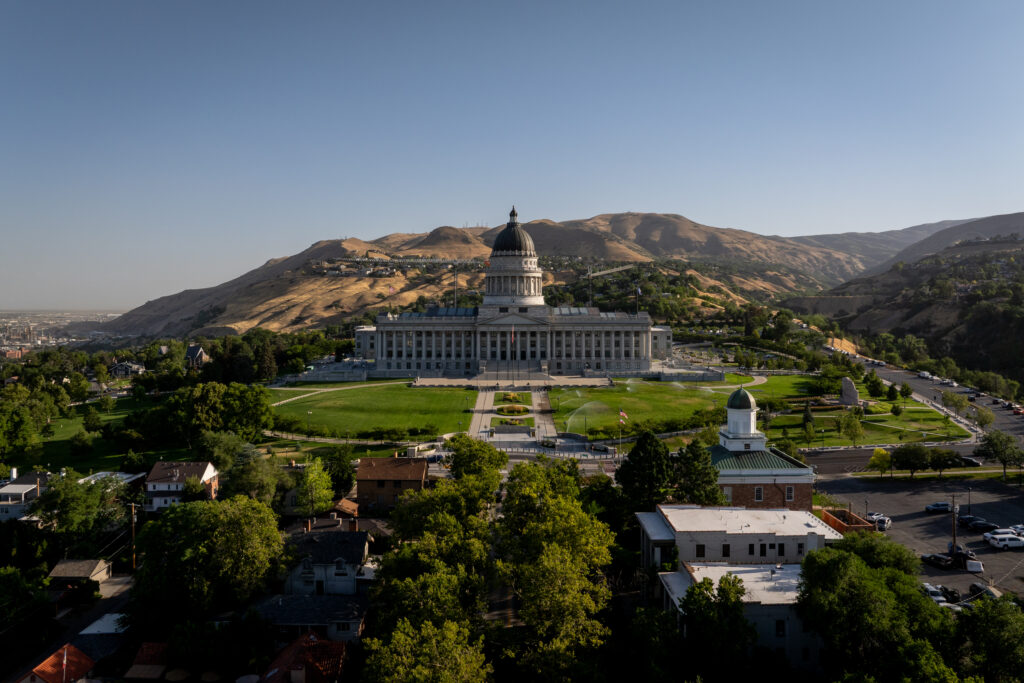


The Capitol in Salt Lake City is pictured on Thursday, July 10, 2025. (Photo by Spenser Heaps for Utah News Dispatch)
In the month since President Donald Trump signed the “big, beautiful bill” into law, more questions than answers remain when it comes to its impact on Utahns.
State leaders are still working to wrap their heads around its wide-ranging consequences to the state and its budget — but in a report circulated to legislators on July 22, legislative researchers took a preliminary stab at summarizing what they know so far about the new law’s impacts on Utah and future policy decisions lawmakers may need to tackle to deal with its fallout in coming months and years.
The impacts span many different state agencies, but some of the law’s most dramatic cuts hit health and human services the hardest, especially when it comes to health insurance coverage through Medicaid and the Affordable Care Act, and loss of payments to hospitals that serve Medicaid recipients.
In the report, legislative researchers point to estimates by the health policy outlet KFF that the “big, beautiful” law will cut federal Medicaid spending by $1 trillion over the next 10 years, which represents 15% of federal spending on Medicaid for that time period.
Utah, that analysis projects, will see a 15% cut in federal spending over 10 years, or between $4 billion and $7 billion in that time frame.
Utah hospitals ‘deeply concerned’ about Medicaid cuts. Rural areas could lose an estimated $870M
Other benefits for low-income Utahns, including food aid assistance known as SNAP, the Supplemental Nutrition Assistance Program, are also expected to shrink due to restricted eligibility and removed exceptions to work requirements. In the report, legislative researchers wrote that an estimated 3,009 people will lose SNAP benefits in Utah due to eligibility changes.
Immigrants, in particular — including lawfully present immigrants such as asylees, refugees and those with temporary protected status — face restricted eligibility for health coverage. Additionally, the law also eliminates SNAP eligibility for certain people who are classified as “alien” under federal law and legally present in the U.S., including those who have qualified for conditional entry under the asylum and refugee laws or based on urgent humanitarian reasons.
But it’s not only immigrants that will be impacted by eligibility restrictions for health and food aid benefits. New work requirements and other eligibility restrictions span wider.
Impact to Medicaid, ACA, mired with uncertainty
With an effective date of no later than Dec. 31, 2026, new Medicaid work requirements mandate that adults ages 19 to 64 must complete at least 80 hours per month of work, education or community service. The bill includes a list of exemptions for work requirements, including for pregnant women, foster youth, members of a tribe, people considered “medically frail” or who have special medical needs, people who are already complying with SNAP or Temporary Assistance for Needy Families work requirements, parents or caregivers of a dependent child age 13 and under, people with disabilities, or individuals who are incarcerated or recently released, according to the report.
“Utah’s Medicaid expansion program will have a reduction in enrollment due to these changes,” legislative researchers wrote in the report, pointing to an estimate from Manatt Health that predicts 33,000 people in Utah will lose coverage.
SUBSCRIBE: GET THE MORNING HEADLINES DELIVERED TO YOUR INBOX
Other national analyses say more — but Jeniffer Strohecker, Utah’s Medicaid director, told Utah News Dispatch on Tuesday that any estimates of how many Utahns could be at risk of losing coverage come with big “caveats” at this point. She said that’s because state officials are still working with federal officials to clearly define exactly who will or won’t be eligible. Those questions will likely take months to answer, she said, while also emphasizing that those changes aren’t set to take effect until late 2026, so at the moment Utahns aren’t at immediate risk of losing coverage.
“You’ll see numbers out there, but I still think it’s too early to really look at the true impact,” Strohecker said. “So you’ll see a refinement of those numbers over time, as more of those questions are answered.”
For now, uncertainty abounds. It’s not yet known exactly how many Utahns will lose health coverage due to a variety of reasons, not just because of a loss of eligibility for Medicaid, but also inability to continue to afford ACA coverage due to enhanced premium tax credits that are set to expire at the end of 2025, plus other changes to ACA included in the “big, beautiful” law.
State officials themselves have unanswered questions when it comes to implementing changes to Medicaid work requirements or their exemptions on certain groups of people — including, for example, how to define “medically frail.”
Strohecker said she and other Utah officials are working with the Centers for Medicare and Medicaid Services to clarify numerous questions about how Utah will implement the new requirements, including “medically frail” exemptions to work requirements. She said those conversations have overlapped with discussions that were already happening after Utah officials, on July 3 — the day before Trump signed the “big, beautiful bill” — submitted its own work requirement waiver application.
Advocates sound alarm as Utah looks to impose work requirements on Medicaid expansion
But now that the bill has been signed into law, Strohecker said state officials don’t expect to implement Utah’s work requirement waiver since it would likely take months of discussion before getting approval from the federal government. Instead, she said Utah’s waiver has acted as a jumping off point for further discussions with federal officials to eventually mesh Utah’s proposals into what ultimately gets implemented under the new law. She said the hope is to “use elements” of Utah’s waiver to “inform what the federal requirements look like.”
“That is exactly the strategy we have pivoted to,” Strohecker said. “We are in discussion with CMS. They are very introductory, but Utah is included in those introductory decisions, and there are no decisions that have been made right now. Utah wants to inform the discussions. As we engage with CMS, we hope to be a voice that can help inform what the federal requirements look like.”
Strohecker said during the public comment period for Utah’s work requirement waiver, Utah officials heard concerns that work requirements will create difficult administrative barriers for Utahns that will lead to lost coverage even if they’re eligible. To address those concerns, she said state officials want to prioritize making it as easy as possible for eligible Utahns to access coverage.
“For us, as a Medicaid program, we have a year and a half to think about a required implementation for work requirements, we’re doing that work today,” she said. “We’re assessing impact today. We’re evaluating our staffing needs, we’re evaluating our system programming needs, and all the partnerships that we need. So we are actively engaging in that work today so that we are prepared a year and a half from now.”
Worried about your Medicaid coverage?
Utah officials stress that changes from the “big, beautiful” law aren’t set to take effect until late 2026, so Utahns aren’t at immediate risk of losing coverage.
If Utahns have questions or concerns about their Medicaid benefits or health plans, state officials urged them to call 1-866-608-9422 or email HPR@utah.gov.
For questions about eligibility, contact the Department of Workforce Services online or call (801) 526-0950.
As for the impact of changes to ACA, legislative researchers didn’t offer any clear numbers of how many Utahns could lose premium tax credit eligibility, saying that’s difficult to estimate, but they warned it’s “very likely that some will, causing their premium to increase substantially.”
Health policy outlet KFF has used Congressional Budget Office estimates to analyze the law’s potential impacts on states. While noting that “anticipating how states will respond to Medicaid policy is a major source of uncertainty in CBO’s cost estimates,” KFF’s analysis offered a range of enrollment impacts in each state, varying by plus or minus 25% from a midpoint estimate to account for that uncertainty.
In Utah, KFF estimated that the changes to Medicaid, combined with the changes to ACA and the expiration of enhanced premium tax credits, will result in 180,000 more people in Utah left uninsured — but that could vary between 130,000 to 220,000, based on that 25% range of uncertainty. Of the total increase in the number of those left uninsured, KFF estimated 52,000 will lose coverage due to changes in Medicaid, while 130,000 could become uninsured due to ACA changes.
However, the true number of people in Utah that ultimately do — or don’t — lose coverage hinges on what Utah state officials and lawmakers decide to do in coming years and months in response to the new law.
Utah Republican leaders say they’re still working to understand impacts
In response to requests for interviews with Utah’s top Republican legislative leaders for this story, spokespeople for both House Speaker Mike Schultz, R-Hooper, and Senate President Stuart Adams, R-Layton, issued prepared statements saying lawmakers are still working to evaluate how Utah will respond.
“Speaker Schultz and House majority leadership are continuing to carefully review the bill and its implications for Utah,” said Alexa Musselman, the House’s majority director of strategic communication. “Our top priority remains serving our constituents and ensuring Utah remains the best place to live, work, and raise a family.”
‘Lives are at stake,’ health, food aid advocates say of Medicaid, SNAP cuts in ‘big, beautiful bill’
Aundrea Peterson, deputy chief of staff for the Utah Senate majority, said Adams and other senators will “work closely” with the Office of Legislative Research and General Counsel, legislative fiscal analysts and the Department of Health and Human Services “as they review the bill and evaluate the next steps.”
“Utah consistently ranks as the top state in the nation, and senators remain committed to building on that and putting Utahns first,” Peterson said.
Pressed on whether lawmakers will need to tackle any of the impacts in a special session this fall, or will wait until the 2026 general session to start addressing them, Peterson said, “Everyone is still working to understand the implementation and what, if any, the necessary steps will be.”
When asked about the new law’s impact on Utahns’ Medicaid and ACA coverage during his PBS Utah news conference last month, Utah Gov. Spencer Cox’s answers were similar.
“We’ll be working with the Legislature to look very closely at what that means,” Cox said. “Again, many of those cuts are going to be implemented later under the terms of the bill. And so I think everybody’s trying to figure out what that means and what the impact is ultimately going to be.”

The governor added that state leaders are supportive of implementing a work requirement — something they tried to do years ago before a previous waiver was suspended amid the COVID-19 pandemic and then rejected under President Joe Biden’s administration.
Cox also said “helping people get on private insurance is going to be really important. Making sure that we’re implementing the law faithfully, and that we have the funding necessary to impact people.”
“We end up paying for this one way or another,” Cox added. “If people … don’t have health care coverage and they end up going to the emergency room, which is where you get the most expensive care, all that does is raise rates for everybody else in this state. So we’ll look at programs … to help people who are struggling with their health care, and we’ll look back at those programs to see if there’s a way to implement more in the future.”
Cox also said the impact to SNAP “may mean we end up funding more from the state level as our budgets allow us to do that.”
The governor, however, also expressed some skepticism about whether the federal cuts will actually come to fruition.
“I’m going to be really blunt,” he said. “Look, these pay-fors in some of these bills, we’ve seen this before, we saw this under (former) President (Barack) Obama, where they pass a bill and they’re going to pay for it with cuts in the future. And then those cuts never happen because Congress ends up feeling the heat, and they change the law a year later to prevent them from happening. So, I’m a little dubious that those pay-fors will all come through. But we’ll see.”
‘I just don’t know where we get the money from’
The Utah Legislature’s top Democrats — House Minority Leader Angela Romero, D-Salt Lake City, and Senate Minority Leader Luz Escamilla, D-Salt Lake City — told Utah News Dispatch they haven’t yet heard whether the agenda for a special session expected this fall will tackle any impacts from the “big, beautiful” law, but they do expect lawmakers to start wrestling with its implications in coming months, and it will likely be a topic for the 2026 session and onward.
Calling it the “big, beautiful, horrible bill,” Escamilla said its impacts will take years to fully implement, adding that many of its changes will not take effect until after the 2026 election cycle. But she also worries there’s only so much time to deal with its impacts, both on state agency operations, and on Utahns’ lives.
“Here’s where we are,” she said. “Whether you’re a provider or an elected official, both local government or state government, we’re all going to be impacted, right?”
Even though estimates are difficult to pin down at the moment, Escamilla said the “bottom line” is tens of millions of Americans are going to lose their health insurance over the next 10 years and insurance premiums are going to increase unless the law changes.
“People are panicking, rightly so,” she said. “This is the most gigantic cut on a safety net that the federal government has done, ever.”

If the cuts do indeed come to fruition, “someone else is going to have to cover those gaps,” she said, whether it comes from state government, local government funds, charitable giving or elsewhere.
“The needs are increasing, they’re not decreasing. Somehow, the people are still going to need access to health care and food,” she said. “The bottom line of this bill passing, is that states are going to have to cover the difference. And it’s in the hundreds of millions of dollars.”
Escamilla worries that Utah’s budget “is not even equipped” to handle such a massive funding gap. She also said the Medicaid work requirements alone will create an “operational nightmare” to implement, which will result in people losing coverage simply because of red tape.
However, Escamilla said in talks thus far with legislative leaders, there appears to be “an interest in making sure families in Utah are taken care of” and close or at least partially fill the funding gaps.
“But I just don’t know where we get the money from,” she said.
Romero said she was left with more questions than answers when she read through the legislative researchers’ report on the law’s impacts to Utah, calling it “vague.”
“I’m still curious (about) what’s going to happen here at the state level and what we’ll be able to do and what we won’t be able to do,” Romero said. “There’s so much that is still unknown. … “I’m hoping that as we move further along, we get more answers.”
Romero said she’s particularly concerned about the bill’s impact on immigrants, including those in the country legally.
“Some of my biggest concerns are some of our most vulnerable and marginalized communities and just how are we going to adequately share this information without causing more fear that’s already there?” she said. “There’s just a lot of uncertainty right now.”