Utah News Dispatch
‘Housing not handcuffs’: National advocacy groups take aim at Utah’s homeless campus


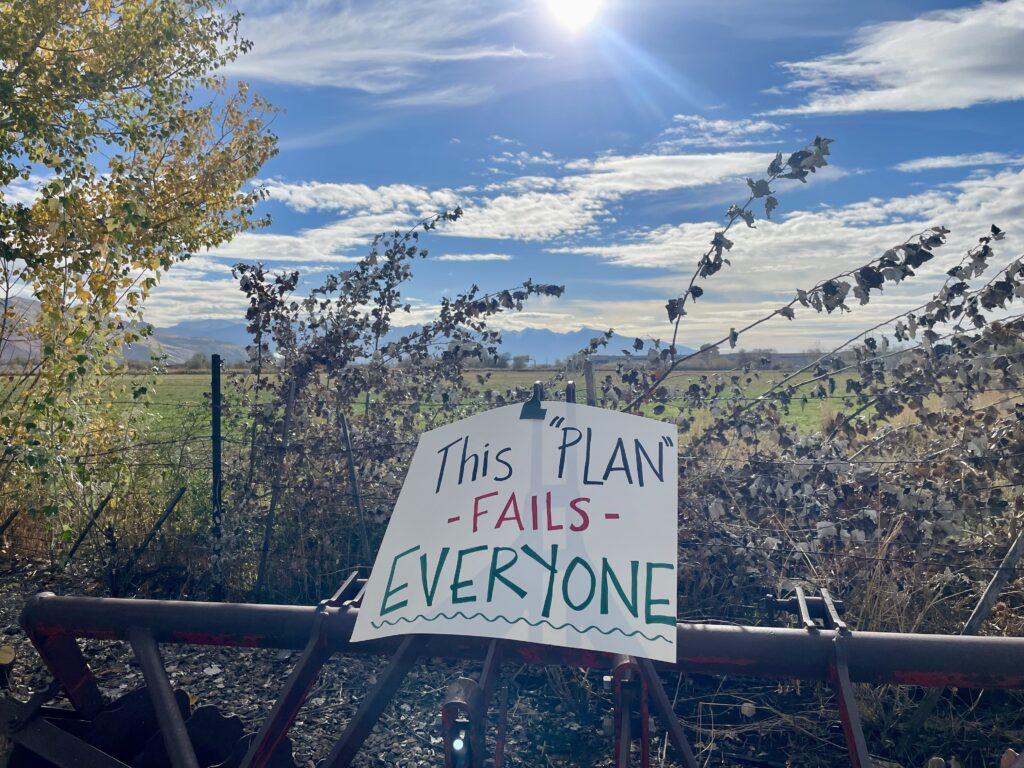


A protest sign is pictured on the edges of a 15-acre property that state leaders have picked to build a 1,300-bed homeless “campus” in the Northpointe area of Salt Lake City, pictured on Nov. 18, 2025. (Katie McKellar/Utah News Dispatch)
National homelessness advocates and Democratic members of Congress from other states aimed criticisms at Utah while launching a new campaign called “Housing Not Handcuffs” to fight any federal funding being used for “homeless detention camps.”
The National Homelessness Law Center, a nonprofit based in Washington, D.C., held a mass organizing call on Thursday to launch the campaign amid what the group described in a news release as “a surge in Trump-backed anti-homeless policies around the country.”
Congress members including Reps. Maxwell Frost, D-Florida, and Delia Ramirez, D-Illinois, along with one of Utah’s top Democrats, House Minority Leader Rep. Angela Romero, D-Salt Lake City, joined the call.
Alongside civil rights, disability and behavioral health advocates based in Utah, they urged people across the country to fight against proposals that would “criminalize” and “isolate” people experiencing homelessness rather than fund solutions like housing and supportive services.
Utah Gov. Cox says homeless campus — envisioned to fulfill Trump’s order — is a ‘top priority’
“This is coming up here in Utah, but this is not just a Utah issue,” said Evan Done, advocacy and public policy director with the nonprofit Utah Support Advocates for Recovery Awareness. “This is being used as a blueprint that’s being watched by other states and the Trump administration to replicate this model across the country.”
Much of the call focused on a proposal being floated in Utah to build a 1,300-bed “transformative” homeless campus on a nearly 16-acre piece of property at the northwest edge of Salt Lake City.
The envisioned campus still lacks funding, and it’s unclear if or when it will become a reality. But powerful Republican state players, including Gov. Spencer Cox, have expressed support for building the campus as a way to crack down on camping and drug use while also providing drug and mental health treatment.
State officials have estimated it would cost more than $75 million to build the campus and north of $34 million dollars a year to operate. Cox, in his budget recommendation to lawmakers last month, proposed using $25 million in one-time money and $20 million in ongoing funding for “homelessness and criminal justice utilizers” as part of the campus proposal, while also saying he’d look to other local governments and the federal government to fill funding gaps.
SUBSCRIBE: GET THE MORNING HEADLINES DELIVERED TO YOUR INBOX
Utah lawmakers, however, have not yet made any budget commitments for the homeless campus. And the courts last month blocked the Trump administration from imposing new restrictions on more than $3 billion in grant funding that’s used for permanent supportive housing and other homeless services — likely complicating Utah’s chances of receiving diverted funds for the homeless campus project.
But the National Homelessness Law Center, in Thursday’s news release, warned that the Cicero Institute — a Texas-based conservative think tank that has been linked to lobbying efforts to crack down on camping in other states — “is lobbying in support of Utah’s plan.”
Along with the campaign’s launch, Frost issued a letter signed by other members of Congress to Housing and Urban Development Secretary Scott Turner urging the agency to demand that no federal funds be used to to build a “homeless detention camp in Utah — or anywhere else,” said Jesse Rabinowitz, director of campaigns and communications at the National Homelessness Law Center.


In a recorded video message played during Thursday’s call, Frost called Utah’s proposed homeless campus “very radical and very inhumane.”
“This would be the first homeless detention camp to be paid for by taxpayer dollars using federal money in our nation,” Frost said. “Why should you care about this, even if you don’t live in Utah? Well it’s because this proposal is kind of a test, and they want to take it and export it to states across the nation, including my state of Florida.”
Frost said Utah is “going to try to use federal taxpayer dollars to make this internment and detention camp a reality,” and he’s “leading the charge in Congress to demand that HUD not provide a single dime of taxpayer money to this horrible, horrible project in Utah.”
Requests for comment to Gov. Spencer Cox’s office and the Utah Office of Homeless Services were not immediately returned Thursday.
Utah’s new homeless campus should have 300-plus beds for civil commitment, board chair says
Utah’s top House Democrat, Romero, said she and other Democrats continue to have concerns about the proposed campus, and they’re “not sure what’s going to happen,” noting Utah’s budget is especially tight this year after it lost more than $300 million in income tax revenue due to federal tax cuts.
“We’re hopeful there’s a way of defeating this campus from ever being built,” Romero said.
Actual plans for the campus are still taking shape. But some of the state’s top homelessness leaders have previously proposed including upwards of 300 beds for people who are civilly committed — or court ordered into mental health treatment. They have also envisioned an “accountability center” or a “secure residential placement facility” for substance abuse treatment as an alternative to jail, where people who are “sanctioned” to go there would not be able to leave voluntarily.
Some homelessness, housing and low-income aid advocates have criticized the proposed campus project and expressed concerns about forcing drug or mental health treatment on people while shifting away from “Housing First” strategies.
But Cox has defended it as a way to bring more “accountability” but also more “compassion” into Utah’s homelessness system by not letting people addicted to drugs or those with mental illness languish on the streets.
Utah’s 1,300-bed homeless “campus” proposal has garnered national attention as a response to President Donald Trump’s executive order titled “Ending Crime and Disorder on America’s Streets.”
Homelessness advocates, environmentalists rally against homeless ‘mega shelter’
That executive order encourages states and cities to remove people experiencing homelessness from the streets and force them into drug or mental health treatment. Trump’s order also called for ending funding support for long-maintained federal “Housing First” strategies that prioritize federal funding to programs that provide immediate housing.
National groups including the National Homelessness Law Center have condemned the order as enacting “backwards, expensive and ineffective policies that make homelessness worse” while directing states to “treat homelessness and mental illness as a crime.”
Eleanor Menlove, director of policy at the American Civil Liberties Union of Utah, expressed concerns with Utah’s homeless campus proposal because it “undermines civil rights in a way we haven’t seen in a long time.” Trump’s executive order, she said, “tries to reshape the legal landscape around expanding civil commitment, which obviously undermines due process.”
She said Trump’s executive order is “trying to pressure states through conditioning the receipt of federal funds on whether states can adopt and enforce a maximally flexible civil commitment standard.”
Menlove worries that the plans discussed so far include “hundreds of beds for involuntary civil commitment with little to no guardrails, and is a very frightening realization of what the executive order envisions.”
Nate Crippes, public affairs supervising attorney at the Disability Law Center of Utah, said instead of the campus, state leaders should focus instead on “building a robust, community-based mental health system.”
“We need things like intensive case management for people, wraparound services, more housing, scattered site housing, not congregate settings,” he said, arguing in favor of services in community-based settings that wouldn’t isolate people with mental health needs. “That’s really where the state should be spending its money, instead of focusing on more institutions.”