
Utah News Dispatch
Homelessness advocates, environmentalists rally against homeless ‘mega shelter’

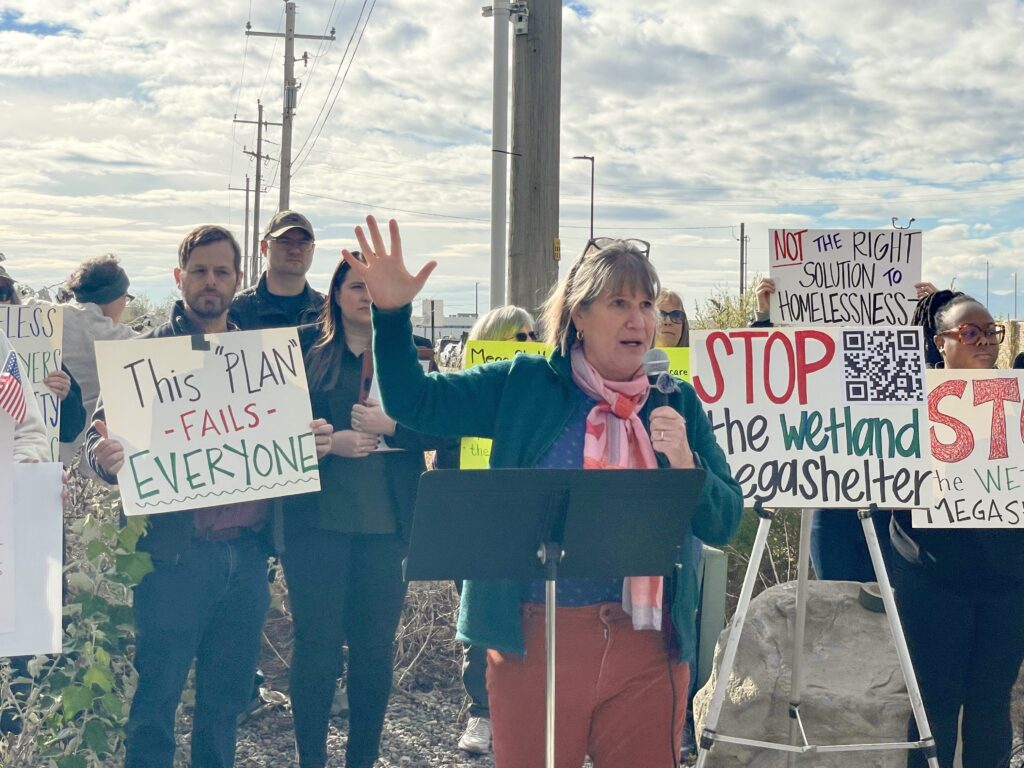

Deeda Seed, a campaigner for the Center for Biological Diversity, and low-income aid advocates hold a news conference to oppose a 1,300-bed homeless “campus” being proposed in Salt Lake City’s Northpointe area on Nov. 18, 2025. (Katie McKellar/Utah News Dispatch)
Low-income aid advocates, faith leaders and environmental groups came together Tuesday to stand against state leaders’ proposal to put a 1,300-bed homeless “campus” in a field with wetlands near a small agricultural neighborhood in northwest Salt Lake City.
They held a news conference on the side of the road near the property to announce they were delivering a letter that had been signed by more than 1,400 people to Senate President Stuart Adams, R-Layton, and House Speaker Mike Schultz, R-Hooper, who have both expressed support for moving away from “Housing First” strategies in favor of programs that will bring more “accountability” to the state’s homeless system.
Utah’s new homeless campus should have 300-plus beds for civil commitment, board chair says
The letter calls on state leaders to “halt” the project because it’s “so bad in so many ways,” said Deeda Seed, a senior campaigner with the Center for Biological Diversity.
“We recognize Utah’s urgent need for expanded homeless services and support effectively assisting individuals experiencing homelessness with dignity and compassion,” the letter says. “However, the proposed campus would bring new safety, environmental, health, and infrastructure challenges to an area unequipped for them, placing an unfair burden on one neighborhood to absorb a statewide issue.”
“There are times when you just need to stand up and say, ‘the emperor has no clothes,’” said Bill Tibbitts, deputy executive director of the low-income aid nonprofit Crossroads Urban Center. “This project is a hodgepodge of bad ideas that even if they fit together, they still won’t work because they’re all bad ideas.”
Gov. Spencer Cox recently called the campus a “top priority” in order to both bring more “compassion” and “accountability” to Utah’s homelessness system.
State leaders’ vision (which has been years in the works) also coincides with President Donald Trump’s executive order issued in July, titled “Ending Crime and Disorder on America’s Streets.” That executive order encourages cities and states to enforce stricter anti-camping laws, expands power to involuntarily treat and civilly commit people experiencing homelessness, and directs federal officials to end support for “Housing First” strategies, an approach to homelessness that prioritizes providing housing while offering — but not requiring — treatment.

Plans for the campus are still taking shape. But the state’s top homelessness leaders have proposed including hundreds of beds for people who are civilly committed — or court ordered into mental health treatment. They also envision an “accountability center” or a “secure residential placement facility” for substance abuse treatment as an alternative to jail, where people who are “sanctioned” to go there would not be able to leave voluntarily.
In response to a request for comment about the letter, Utah’s Office of Homeless Services referred to the campus’ website, which describes the campus as a place where people experiencing homelessness “can find help for recovery, mental health, healthcare, employment, criminal justice assistance, and housing through services and treatment accessible in a single location.”
“This is more than a campus, it’s a turning point for Utah of reimagining hope,” says the state’s homeless coordinator, Wayne Niederhauser, in a statement on that website. “It will further fulfill the identified need to provide additional beds and treatment in Utah’s homeless response while providing individuals served by the campus a transformative path from crisis to stability and, ultimately, thriving.”
Schultz, Adams and the governor did not respond to a request for comment Tuesday.
Not a shelter but a prison, advocates say
Tibbitts, however, said the campus’ vision is the result of a group of “very influential people who have had this idea that if you build a shelter, you will reduce homelessness.”
Utah Gov. Cox says homeless campus — envisioned to fulfill Trump’s order — is a ‘top priority’
“That’s a lot like saying that if you built a better emergency room less people would get sick,” he said, arguing that the fact that more people are becoming homeless for the first time “has nothing to do with what’s happening inside a homeless shelter” but rather “everything to do with what’s happening in the economy, what’s happening in people’s lives.”
One of the biggest objections Tibbitts says advocates have is that the proposed campus is shaping up to be more of a prison where people will be forced into drug or mental health treatment.
“Incarceration is not a homeless service,” he said. “That will make the entire campus feel like a correctional facility and reduce outcomes for everyone.”
State leaders including Cox have argued true “compassion” is not allowing people to suffer with drug addiction or mental illness while sleeping on the streets.
But Tibbitts said the real problem is a lack of emergency homeless shelter capacity in Utah’s existing system, as well as a lack of investment in other existing resources like deeply affordable housing for low-income people or seniors on fixed incomes.
“You need to actually help people be stable in the community, and that’s not going to happen with a mega shelter,” he said. “It’s going to happen with housing.”
The Rev. Brigette Weier, the pastor at St. Matthew Lutheran Church in Taylorsville and a member of the Crossroads Faith and Advocacy Coalition to End Hunger and Homelessness, said true “compassion” is meeting people where they are and providing housing first while also addressing larger economical issues.
‘Compassion that kills’: Gov. Cox says ‘sea change’ in Utah’s homeless system is coming
“If we are truly a compassionate people, we will do what it takes to be with the people that are suffering to meet their needs,” she said. “And that is to raise the minimum wage, which is lagging a generation.”
She also said true compassion is giving anyone and everyone health care.
“Everybody with a body deserves health care. That is compassion,” she said. “It is not for the rich. It is not for the elite. Having a body is what entitles you to health care.”
She also argued state leaders need to stop using a “lack of money” as an “excuse.” Last year, Utah’s state budget exceeded $30.8 billion.
“It is not a lack of money,” she said. “It is a lack of will, and it is a lack of political will from our elected leaders.”

Treatment by choice, not coercion
Dusty Trent, the pastor of Murray Baptist Church, said he’s “lived through addiction and knows what it’s like to lose control of your own life.”
“When I was at my lowest, the turning point in my recovery didn’t come from being pushed somewhere or told what I had to do,” he said. “It came when people treated me like a human being with choices, dignity, and the right to say yes or no. Healing can’t be forced, and recovery never grows out of coercion. That’s why this proposed mega shelter concerns me so deeply.”
He said it’s built on “the involuntary model, moving large numbers of vulnerable people into a massive, centralized facility.”
“Anyone who has lived with addiction, trauma or instability knows that being placed somewhere against your will doesn’t create safety or trust. It creates fear, and it pushes people further from real help,” he said.
Instead, Trent said “what works” is “smaller shelters, supportive housing, trauma-informed care, peer support and human-sized solutions.”
The governor and other state leaders have argued that Utah’s existing homeless system hasn’t worked, with more people becoming homeless and many cycling in and out of jail and shelters with substance abuse and mental health issues going unaddressed.
But Trent and other advocates argued state leaders should focus on pumping more money into existing services — especially supportive and deeply affordable housing — rather than experimenting with a new, expensive campus.
Weier took issue with describing the campus as an “involuntary shelter.”
“No, that’s too clean. It’s a prison with no due process. That’s actually not quite right either,” she said. “It’s a concentration camp where people will have to prove their worth and depend on the people who are making a profit off of them to be let free.”
Cox recently balked at a quote in a New York Times article in which a woman experiencing homelessness compared a rendering of the homeless campus to a “concentration camp.” The governor argued it’s “crazy” to compare the project to “Nazi Germany” as if “Hitler were to, what, round up people who are dying on the streets in their own filth addicted to drugs and giving them the support they need? Like, there is no comparison — at all.”
Advocates call for more focus on housing, health care and wages
Weier said she’s concerned about state leaders’ plans to move away from Housing First strategies.
“For the Utah lawmakers to abandon Housing First, in which we used to lead the nation, is as if I were to leave my car on the side of the road because I refused to pay to put gas in it, and decided to go back to a horse and buggy,” she said. “The Utah Legislature, nor our federal government, have never truly, adequately funded Housing First for it to have a chance to succeed.”
Utah Gov. Cox says homeless campus — envisioned to fulfill Trump’s order — is a ‘top priority’
She argued it’s “disingenuous” to say Housing First hasn’t worked “because it’s never been tried.”
Weier pointed to the governor’s recent comments that the campus will be a “statement of who we are as a state.”
“My Lord, I pray that is not true,” she said. “I pray that we are better than involuntary incarceration of our beloved siblings who deserve care, dignity and flourishing on their own terms.”
The Rev. Lora Young, minister for South Valley Unitarian Universalist Society in Cottonwood Heights, said she also opposes the “mega shelter,” calling the rhetoric around it “appalling.”
“People experiencing homelessness are not in need of moral development,” she said, arguing state leaders should be focusing their attention and funding upstream of all social issues rather than expanding capacity for involuntary drug and mental health treatment.
“Unaffordable, unsafe or just plain unavailable housing, artificially low wages, artificially high food prices, and artificially high medical costs are the primary drivers which lead someone to find themselves unhoused,” she said.
“We live in a system that consistently places profit over people (and) profit over the land,” she added. “This is the moral failing. The evidence is clear. Profits over people create poverty and suffering. Profits over the land create environmental degradation and poor life outcomes for everyone in the community.”

Housing First
Susy Colvin, with Powerful Moms Who Care, said she relies on a housing assistance voucher to keep a roof over her head in Salt Lake City. She argued homelessness is full of misconceptions, and she worried that moving away from Housing First strategies would result in hundreds more people becoming homeless.
“If they do away with the Housing First model and take away our voucher, we will be homeless again,” she said. “Our rent is double our income. That’s just our reality. It’s not because we’re mentally ill. It’s not because we’re drug users. It’s not because we’re lazy. It’s the very real reality that our income will not cover our rent and we are maxed out on our earning power.”
She took issue with a model that focuses on making “people that are worthy to be housed.”
“What makes you worthy?” she asked state leaders. “Search your heart. I don’t want to hear about their worth. I want to hear about your worth. What makes you worthy to have a safe, comfortable place to sleep at night?”
Northpointe community concerns
Throughout Tuesday’s press conference held alongside a busy road, speakers had to raise their voices to be heard over the semitrailers continually roaring by.
The trucks were evidence of the warehouse district development pressures that have been chipping away at the neighborhoods’ agricultural fabric.
Allison Musser, who lives in the Northpointe community, said it appears state leaders chose the Northpointe neighborhood out of “convenience” because it was the “path of least resistance,” while also accusing Salt Lake City leaders of allowing “unchecked industrial expansion.”

The neighborhood — with a busy warehouse district now pushing up against it — is Salt Lake City’s “last agricultural district,” Musser said, “home to generational families, small farms and about 60 single-family homes in this area, but nearly 1,500 housing units in the larger census tract surrounding the neighborhood.”
Musser said the plans for the campus are also “fiscally reckless,” pointing to state officials’ estimates that the campus will cost upwards of $75 million to build and $34 million in ongoing funding every year — but so far no funding source has been identified. She also pointed to the overrun price tag on the state’s $1 billion prison in a wetland area in northwest Salt Lake City.
“Have we learned nothing from our costly new prison?” she said.
The Northpointe community believes in “real solutions” to help people experiencing homelessness. “But sacrificing an established neighborhood simply because it’s the path of least resistance is not a solution,” she said. “Northpointe deserves protection.”
Wetland concerns
Seed said the area proposed for the shelter contains wetlands — previously protected in Salt Lake County’s shoreline area preservation plan before the area was annexed into Salt Lake City — that will be “paved over with impermeable surfaces,” which could have a “really significant impact on the environment.”
“Paving them over has implications beyond the actual site, and has ripple effects outward. From an ecological standpoint, development like this proposed mega shelter would be significantly destructive,” she said.
Seed also pointed out mosquitos thrive in the area — much like the new Salt Lake City prison property, which has had a “horrible mosquito problem,” and “there are no good solutions.”
“You end up spraying people with pesticides, which are very dangerous, or you let them be exposed to mosquitos,” she said.
The “mega shelter” proposal is a “horrible idea,” Seed said, that will cause more harm than good.