
Utah News Dispatch
GOP legislative leaders begrudgingly say they’ll redraw Utah’s congressional map, as court ordered

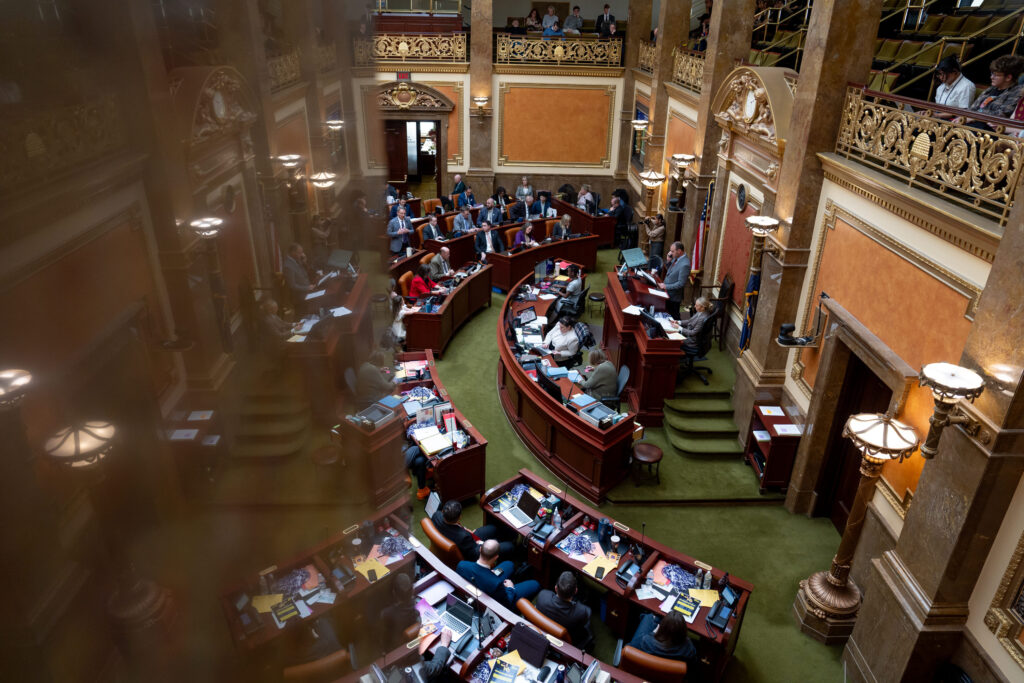

Members of the House of Representatives work at the Capitol in Salt Lake City on Thursday, Feb. 6, 2025. (Photo by Spenser Heaps for Utah News Dispatch)
Utah’s top Republican legislative leaders say they’ll obey court orders and redraw the state’s congressional boundaries after a judge earlier this week ruled the map last adopted in 2021 was a product of an unconstitutional process.
But they also made it crystal clear they’re not happy about it.
“Despite a misguided court ruling and an arbitrary 30-day deadline, the Utah Legislature will defend its constitutional authority and move forward with redrawing the state’s congressional map,” House Speaker Mike Schultz, R-Hooper, and Senate President Stuart Adams, R-Layton, said in a joint statement issued Thursday.
SUBSCRIBE: GET THE MORNING HEADLINES DELIVERED TO YOUR INBOX
While Adams and Schultz say state attorneys plan to appeal the decision to the Utah Supreme Court, in the meantime they say they’ll follow the order’s timeline, which requires them to submit a new map to the court by Sept. 24 at 5 p.m.
“While we will continue to pursue every legal option available — including requesting a stay from the Utah Supreme Court if necessary — we will attempt to redistrict under these unprecedented constraints, consistent with our oath to represent the best interests of Utah,” they said.
The ruling comes as a redistricting arms race is unfolding across the nation as President Donald Trump looks to grow Republicans’ slim majority in the U.S. House ahead of the 2026 midterm elections.
For years, Utah’s four U.S. House seats have been reliably Republican, especially after the Utah Legislature went through their last redistricting process in 2021. That year, Utah lawmakers drew their maps after they repealed a 2018 voter-approved ballot initiative known as Proposition 4 and replaced it with SB200, a law that turned the proposition’s independent commission into an advisory body lawmakers could ignore, and they did just that.
This week, Gibson deemed that repeal and replacement of the Better Boundaries voter initiative unconstitutional, and found that the map lawmakers drew was a result of an unconstitutional process.
But in their statement, Adams and Schultz asserted 3rd District Court Judge Dianna Gibson’s ruling itself was unconstitutional.
“The court’s order unconstitutionally ties the Legislature’s hands by mandating certain redistricting criteria when the U.S. and Utah constitutions leave it to the people’s representatives in the legislature to redistrict,” Adams and Schultz said.
Criticizing that ruling, Utah Republicans argue the Utah Constitution’s plain language requires the Legislature to carry out the task of redistricting. Gibson’s ruling, however, said the term “Legislature” in that provision “does not exclude the legislative power of the people.”
“Neither the U.S. Constitution nor the Utah Constitution grants sole and exclusive authority over redistricting to the Legislature,” Gibson wrote. “Because legislative power is shared co-equally and co-extensively between the Legislature and the people, and because redistricting is legislative, the people have the fundamental constitution right and authority to propose redistricting legislation that is binding on the Legislature.”
Gibson’s order requires the Legislature to “design and enact a remedial congressional map that complies with the mandatory redistricting standards and requirements originally established under Proposition 4.”
Asked whether legislative leaders plan to adhere to those requirements included in Gibson’s order, Schultz told Utah News Dispatch they do — but that they plan to draw a map with districts that include both rural and urban voters.
“The state of Utah has always preferred the ‘slice of the pie’ model instead of the ‘doughnut hole’ model,” Schultz said.
Utah’s current congressional map is a form of what’s been called the “slice of the pie” approach, dissecting Utah’s urban core and most populated area of Salt Lake County into four separate districts.
The “doughnut hole” approach would create a map that may, for example, carve out a district concentrated around the state’s capital of Salt Lake City, the state’s darkest blue Democratic stronghold.
“We can and will continue to pursue the same goal we have had from the outset — for each member of Congress to represent both urban and rural voices,” Schultz and Adams said in their statement. “This model provides a true statewide perspective, ensuring that all Utahns — whether they live in rural towns, suburban neighborhoods or our capital city — have four strong voices in Washington, D.C.”
Better Boundaries’ Proposition 4 — which the judge explicitly said in her ruling is now law in Utah — requires the new map to be drawn with a process that adheres to the following redistricting standards “to the greatest extent practicable and in the following order of priority:”
- Adhere to the U.S. and Utah Constitutions and other applicable law, achieving equal population among districts using the most recent national decennial census.
- Minimize the division of cities and counties across multiple districts, giving first priority to minimizing the division of cities and second priority to minimizing the division of counties.
- Create districts that are geographically compact and contiguous.
- Preserve traditional neighborhoods and communities of interests.
- Follow geographic features and natural barriers.
- Don’t draw districts that unduly favor or disfavor any incumbent, candidate or political party. Partisan political data, such as partisan election results, voting records, party affiliation information, and home addresses of incumbents or candidates may not be considered.
Schultz told Utah News Dispatch he believes it’s possible to draw a “slice of pie” style map while also adhering to Proposition 4’s standards.
“We’ll see what that looks like, but that’s certainly our goal,” Schultz said. “We have to follow the guidelines in Prop 4. We know and recognize that. But we think there’s flexibility inside that, and that’s what we’re going to be shooting for, because that’s what’s best for the state of Utah.”
Adams and Schultz also criticized the tight, 30-day timeline set by Gibson.
“When we last drew congressional boundaries, the Legislature spent nearly six months traveling the state and holding more than 20 public meetings to gather input,” they said. “Now, the court has allowed only 30 days to complete the same complex process, leaving little opportunity for meaningful, statewide public involvement. Even more concerning, after hearing summary judgments in January, the judge waited months to issue a ruling — only to then impose this rushed deadline on the public and the Legislature. Such a timeline is not only unreasonable, it is fundamentally unfair to Utahns.”
Judge orders Utah Legislature to draw new congressional maps
Schultz said such a short amount of time to draw and adopt a new map is “just not fair to the citizens,” allowing “no input, virtually, from them.” He said it’s not yet clear exactly what the process will be for lawmakers to draw the map or whether the public will have any time to weigh in.
“We don’t know the process. Clearly there’s not enough time for it to go through public processes contemplated in Proposition 4, and that’s what makes this so confusing,” he said. “These are questions that we still don’t know.”
Back in 2021, after an extensive public process, the Independent Redistricting Commission proposed a set of congressional maps that lawmakers didn’t use in favor of their own, using the same standards included in Proposition 4.
Pressed on whether Utah lawmakers would consider one of those maps proposed by the independent redistricting commission back in 2021, Schultz balked.
“Then that’s taking it completely out of the Legislature’s hands,” he said.
Gibson’s ruling also allows plaintiffs and other third parties to submit proposed remedial maps to the court on Sept. 24 “in the event that the Legislature does not enact a remedial map that complies with Proposition 4,” or if the plaintiffs “contend that the remedial map fails to abide by and conform to Proposition 4’s mandatory redistricting standards and requirements.”
Elizabeth Rasmussen, executive director of Better Boundaries, said in a prepared statement issued Thursday saying the group is “encouraged” by Schultz and Adams’ comments that they’ll move forward with new maps.
“Utahns voted for independent redistricting in 2018, and the court has now confirmed that decision must be respected,” Rasmussen said.
Rasmussen said Better Boundaries has “always been about fairness” and Proposition 4 set standards to achieve that fairness.
“It is now up to the Legislature to draw maps that reflect these standards,” she said. “Utahns deserve districts that keep communities together and give every voter a voice — not districts that protect politicians.”
Rasmussen said Proposition 4 was an “attempt to restore accountability to all of our elected officials.”
“It was not focused on a particular outcome but an attempt to fix a broken process,” she said. “Ronald Reagan called gerrymandering ‘a national disgrace’ and we look forward to seeing fair maps for all Utahns.”
Adams and Schultz said in their statement that they plan to draw a map that has districts that represent both rural and urban voices. That approach indicates they’re reluctant to go with what’s been called a “donut hole” approach, or drawing a map that carves out a district concentrated around the state’s capital of Salt Lake City, the state’s darkest blue Democratic stronghold.
“We can and will continue to pursue the same goal we have had from the outset — for each member of Congress to represent both urban and rural voices,” Schultz and Adams said. “This model provides a true statewide perspective, ensuring that all Utahns — whether they live in rural towns, suburban neighborhoods or our capital city — have four strong voices in Washington, D.C.”