Utah News Dispatch
Faith groups, advocates urge Utah Legislature to fund operations for new family shelter


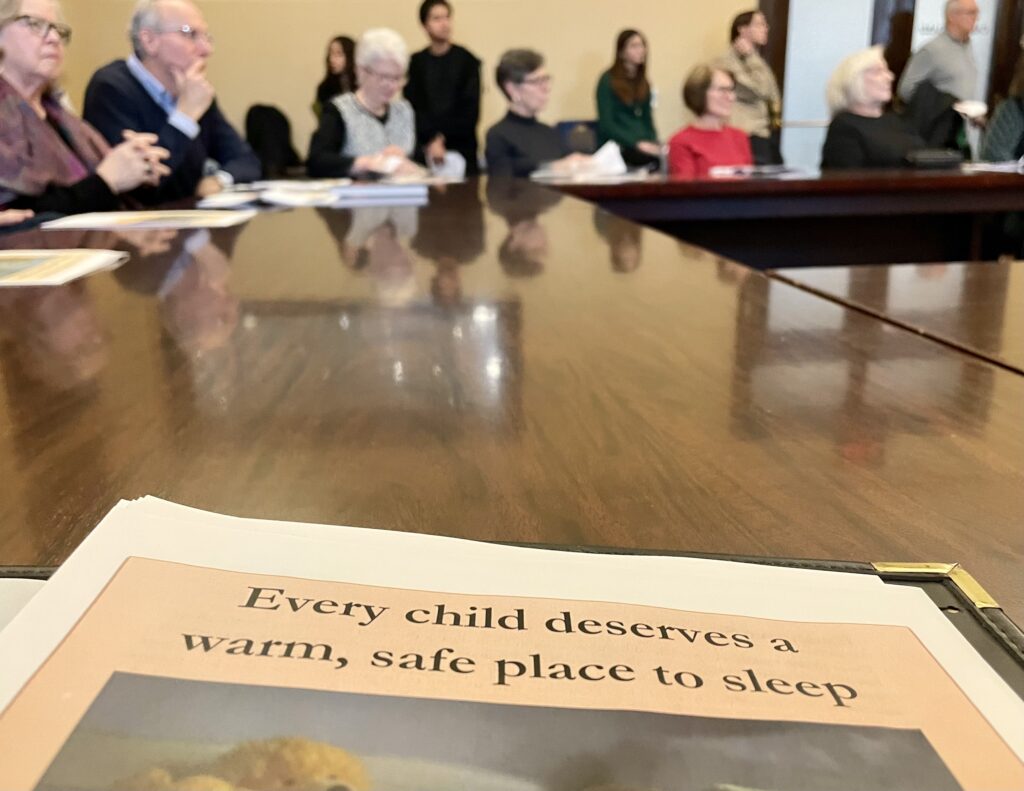


A new report on child homelessness in Utah by the Crossroads Urban Center sits on a table during an event where faith leaders and advocates gathered at the Utah Capitol on Jan. 24, 2025. (Katie McKellar / Utah News Dispatch)
Members of various churches across Utah and homelessness advocates gathered around a large table at the Utah Capitol on Friday to urge the Utah Legislature to fully fund about $5.8 million a year toward a new family homeless shelter.
Utah Gov. Spencer Cox’s administration has recommended lawmakers fund operations for the new shelter, which South Salt Lake city leaders recently voted to open in an old Motel 6 at 315 W. 3300 South with capacity for up to 85 families. The Salt Lake Tribune reported leaders expect the new shelter to open in March or April.
Currently, the shelter is funded through June, but in order for its doors to stay open, Cox’s state homeless coordinator, Wayne Niederhauser, is asking lawmakers to devote ongoing funding — which is more difficult to come by than one-time funding.
But with the state’s more than $30.6 billion budget far from being finalized, which usually doesn’t occur until the final weeks of the 2025 session scheduled to end March 7, legislative leaders aren’t yet commiting to whether they’ll fully fund the request, though they say it’s a “big issue” that’s on their radar.
“Every child deserves a warm, safe place to sleep.”
A chorus of voices repeated that refrain after each speaker during Friday’s gathering of the Faith and Advocacy Coalition to End Hunger and Homelessness. The phrase is also the title of a new report released that day by the Crossroads Urban Center that estimated more than 16,000 children experienced homelessness in Utah in recent years.
“State leaders have an opportunity to eliminate unsheltered homelessness for families with children by supporting Gov. Cox’s budget recommendation to fund the operations of a new family shelter in South Salt Lake City,” the report says. “This new family shelter has been needed since 2023 when the need for family shelter surged beyond what could be met by existing shelters in Utah.”


Currently, the state’s only family-specific shelter is the Connie Crosby Family Resource Center in Midvale, which houses up to 300 people a night. It’s been operating at max capacity, leaving unhoused families with children limited shelter options, especially when funding for motel vouchers runs out.
The report also encourages lawmakers to take “long term action toward decreasing family homelessness” by putting $2 million more into the Olene Walker Housing Loan Fund to spur creation of affordable housing “geared toward the specific needs of families coming out of homelessness.”
“Local leaders can be part of efforts to reduce child and family homelessness by supporting the development of adequate, affordable housing that meets the needs of families in their communities and by becoming engaged with efforts to create job opportunities for low-income parents,” the report says.
Utah homeless board OKs search for up to 1,200-bed ‘centralized campus.’ What now?
Niederhauser attended Friday’s gathering, explaining that the $5.8 million in ongoing funds is part of the governor’s overall request that the Legislature fund about $18.8 million in new money toward efforts to alleviate homelessness. Niederhauser said he’s also working to drum up support for about $13 million in one-time money to help fund additional “winter response” emergency shelter space over the next year while he and other state officials work to site and build a new 30-acre homeless “campus” with space for up to 1,200 beds.
For the new South Salt Lake family shelter, Niederhauser said the state Homeless Services Board did grant the shelter’s operator, The Road Home, money to “get it open and operate for several months” through June, “but we also need ongoing funds from the Legislature this year to make that facility operate on an ongoing basis, which is desperately needed.”
“Hopefully we’ll get the Legislature” to fund it,” he said.
Niederhauser also acknowledged youth homelessness is on the rise in Utah. “At the very core of this issue is housing, and that has been a focus of ours over the last several years.” However, he noted Utah lawmakers have only funded additional housing programs for a couple of years.
That’s helped bring on about 1,538 new deeply affordable units statewide, Niederhauser said, but there’s still more need.
“We have programs now that we’ve proven that work, that can put these units on the ground,” Niederhauser said. “We’re hoping in the future we can get more money in the governor’s budget and more money out of the Legislature to have these programs continue to create that much needed, deeply affordable housing.”
Will Utah lawmakers fund the family shelter? Senate leaders respond
When asked during a media availability Friday if lawmakers can definitively commit to funding the family shelter, Senate President Stuart Adams, R-Layton, pointed to the budgeting process and said, “there’s probably very little definitely I can tell you. But we’ll look at it.”
Senate Budget Chair Jerry Stevenson, R-Layton, said only one thing’s for sure: “there will be a lot of debate” given the limited amount of new revenue fiscal analysts are predicting to be available this year.
“There will be a lot of picking and choosing,” he said.
Adams, however, indicated it’s one priority that’s on their radar.
“That’s a big issue, we know it is,” he said. “It’s going to be one of the big ones of the session.”
‘This is our year,’ faith leaders say
Rev. Lora Young, a minister at the South Valley Unitarian Universalist Society in Cottonwood Heights, said she lives in South Salt Lake, and that she “couldn’t be more excited to have a solution that is opening” blocks away from her house, referring to the new family shelter.
She also encouraged advocates to not give up, even though it may seem like progress to increase funding for housing and homelessness is slow going.
For homelessness, Utah lawmakers want more enforcement — and ‘healing.’ Can they get both?
“Homelessness and meeting the needs of the unhoused in our community is a highly solvable problem,” she said. “We are solving it inch by inch by inch. We have a little bit more money now than we had five or six years ago. The state has made it a priority to start making this happen.”
Rev. Doug Gray, a pastor at the First Congregational Church in Salt Lake City, said all people are “children of God,” and “are meant to be loved.”
“That’s why we have to end hunger and homelessness,” he said. “Just because someone is hungry, just because someone doesn’t have a place to sleep, doesn’t mean they are undeserving,” he said, invoking several “amens” from the crowd.
Gray said he believes Utah can realistically reach a “functional zero” homeless population, meaning the system houses people as fast or faster than those becoming homeless.
“I dream of that for our community, don’t you?” he said. “I dream that we will be functionally zero. … This tipping point, we could touch here this year. Ending homelessness with children and families, we could do it.”’
So he urged state and city leaders “to choose the path of kindness and solutions.”
“This is the year,” he said. “We encourage leaders to turn from punishing people without shelter to implementing policies and investments that promote affordable housing, boost permanent supportive housing, and strengthen homelessness prevention resources, especially for families and children. May it be so.”
YOU MAKE OUR WORK POSSIBLE.