Utah News Dispatch
Environmental groups file FTC complaint against Utah’s pro-nuclear energy campaign

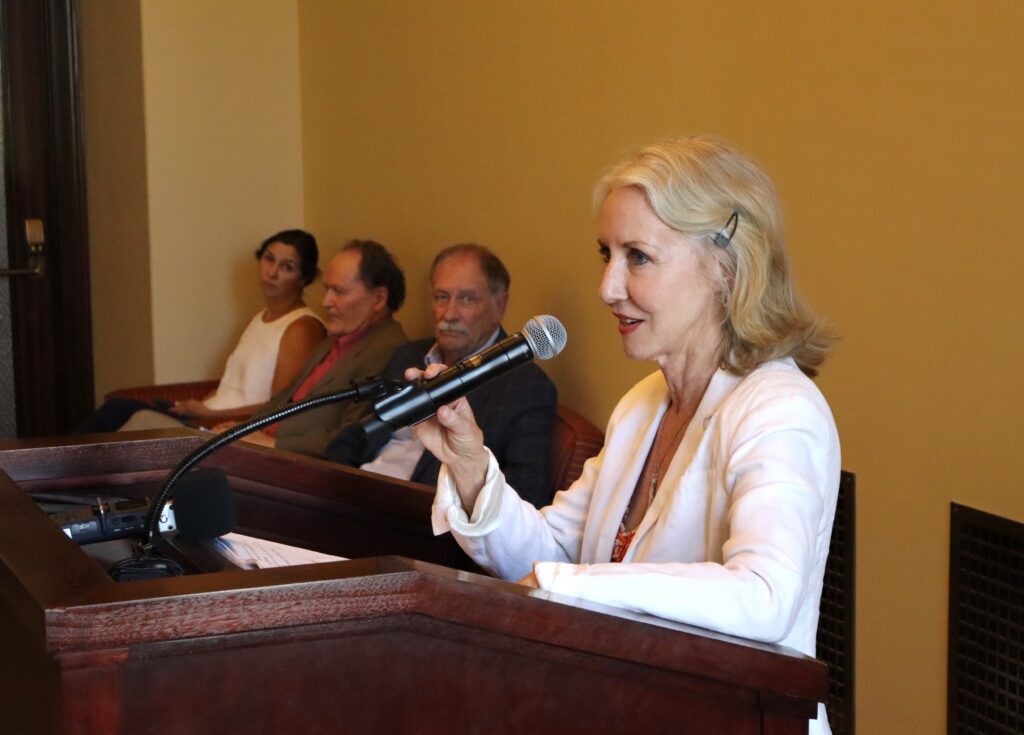

Mary Dickson, a downwinder from Salt Lake City, speaks about an FTC complaint against the state’s pro-nuclear power campaign messaging during a news conference at the Utah Capitol on Aug. 17, 2026. (Katie McKellar/Utah News Dispatch)
Mary Dickson, a downwinder from Salt Lake City who has survived thyroid cancer, said when she first saw Utah’s pro-nuclear billboards earlier this year while driving to Idaho, “I wanted to scream.”
The state-funded billboards with messages like “nuclear energy is cleaner than a candle” and “nuclear plants emit less radiation than bananas” were on display across the state from March to July of this year, directing Utahns to learn more on the Utah Office of Energy Development’s website.
But to Dickson, the messages were irresponsible — a “textbook case of false equivalency” and they “insulted the intelligence of everyone who lives in this state.”
“They are patently offensive. They’re ridiculously offensive,” she said. “They’re outright misleading. To compare nuclear energy and nuclear waste to things like candles … is so utterly offensive to me as someone who has suffered the consequences of radiation exposure.”
Dickson, along with other advocates for downwinders and environmental protections, held a news conference on Monday at the Utah Capitol to announce they planned to file a formal complaint with the Federal Trade Commission accusing Utah’s $1.8 million pro-nuclear energy “public education” campaign of using “false, deceptive and misleading” representations.
“How stupid do they think we are?” Dickson said. “Apparently, they think we’re pretty gullible and stupid. We have lived consequences of the nuclear age. We’ve listened to claims of ‘there is no danger’ since they first started testing nuclear weapons. And it’s just preposterous that a powerful nuclear industry has convinced our politicians to do their advertising at our expense.”

The $1.8 million campaign
As part of Utah Gov. Spencer Cox’s Operation Gigawatt — a plan to double Utah’s power production over the next 10 years with an “any of the above” strategy — state energy officials awarded a $1.8 million contract to the firm Envoy Public Labs to “provide a marketing and communications campaign that will educate the public, policymakers, and stakeholders about nuclear energy and the role it could play in Utah’s future energy mix,” according to a call for bids posted on the state’s public procurement website.
Taking issue with that state-backed campaign and its messaging, groups including Downwinders, Inc., the Healthy Environment Alliance of Utah and Utah Physicians for a Healthy Environment are calling on the FTC to investigate whether the campaigns’ messages have been deceptive.
“It’s disturbing and wrong that taxpayers are footing the bill for state-sponsored propaganda promoting this ill-considered nuclear power frenzy,” said Steve Erickson, a volunteer for Downwinders. “Utahns need to hear hard truths about nuclear power, the dangers, tradeoffs, not nuclear industry promotional pablum that distorts or diminishes the reality that nuclear power is not clean and certainly not safe as these ads claim.”
Utah wants help saving Great Salt Lake in exchange for hosting federal nuclear hub
Erickson said the groups believe their complaint has merit and hope federal officials will investigate — but at the same time they won’t be surprised if their complaint falls of deaf ears, since President Donald Trump’s administration has been pushing for a nuclear energy boom.
In response to the complaint, Tracy Rees, deputy director of the Utah Office of Energy Development issued a prepared statement reiterating Operation Gigawatt’s mission and echoing state leaders’ previous statements in support of pursuing nuclear energy development.
“Utah is pursuing an any-of-the-above energy strategy to ensure we have the affordable, reliable and abundant energy our growing state will need for generations to come,” Rees said. “Civil nuclear energy has the potential to play an important role in that future.”
Rees said that as the Office of Energy Development continues that work, it “will continue to share fact-based, science-based information about civil nuclear energy and engage Utahns in an open and accessible way.”
“We welcome a robust conversation about Utah’s energy future and believe that conversation should be grounded in the facts,” Rees said.

Nuclear power plants vs. bananas?
Advocates spent the bulk of Monday’s news conference laying out their arguments for why the campaign’s messaging is far from fact based. One of the claims they zeroed in on was “nuclear plants emit less radiation than bananas.”
The campaign’s “Why Nuclear” website explains that claim by saying: “Nuclear power plants are heavily regulated and carefully engineered, so during normal operations, workers and the public are exposed to almost no radiation. If you live within 50 miles of a nuclear plant, you only receive about 0.01 millirems of radiation.”
Utah to apply with feds for a nuclear campus in remote Tooele County
Meanwhile, the site says “eating multiple bananas would expose you to more than 0.01 millirems. Why? Bananas contain potassium, and a small fraction of all potassium is naturally radioactive. So, eating a banana results in more radiation exposure than standing next to a power plant. The dose of radioactivity from eating bananas is minuscule and does not pose a health risk. Radiation is a normal part of everyday life; it comes from our soil, air, food, and even our own bodies.”
Brian Moench, president of Utah Physicians for a Healthy Environment, said comparing bananas to nuclear power plants is comparing apples and oranges — and downplays risks of radiation exposure from nuclear power plants.
“They’re not the same — at all — for a lot of reasons that they don’t explain in their advertisements,” he said. “People should be thinking about this. Do people really get cancer from bananas? There’s absolutely no evidence of that. Do people get cancer from living near bananas? There’s absolutely no evidence of that. But people get cancer from radiation exposure.”
Moench said “studies done throughout the world show people who live within a few miles of nuclear power plants have higher rates of virtually every kind of cancer, including and especially children’s cancer.”
Governor’s past arguments in support for nuclear
While advocating for Operation Gigawatt — and while announcing the state’s pursuit of a proposed nuclear lifecycle innovation campus in remote Tooele County — Cox and other state leaders have repeatedly said “safety is non-negotiable,” and technological advancements have made nuclear energy safer than ever before.
They’ve also argued Utah must expand its energy development to keep pace with power needs, largely driven by pressure from artificial intelligence and data centers.
While unveiling his budget proposal ahead of the 2025 Utah Legislature — which approved $10 million for Operation Gigawatt — Cox advocated for funding for nuclear site development and geothermal research while also saying the federal government needs to drastically reform nuclear permitting regulations and the National Environmental Policy Act, which he blasted as “stupid” and unnecessarily unwieldy.
Cox announces plans to double energy production in Utah starting next legislative session
“Here’s the problem, folks. We can’t build stuff in this country anymore,” Cox said. “We’ve gotten so stupid as a country. The regulatory overload that’s happened in our nation is embarrassing.”
Cox, however, also added at the time that he understood why NEPA’s regulations were put in place, saying, “We were also making a lot of really dumb decisions in the ’60s and ’70s when it comes to protecting the environment,” he said. “We understand that now.”
Cox said even the “cleanest energy projects, the most important energy projects that are being demanded by environmentalists across this country, cannot be built because we have these stupid, stupid NEPA policies that don’t allow us to build the stuff we need to build.”
“It’s time to stop the madness,” he said. “It’s time to start building nuclear again. It should not take us 15 years to build a nuclear facility that costs three times what it’s supposed to cost.”
Cox also argued at the time that nuclear energy must be part of the picture as a comparatively cleaner energy development source that would be a realistic way to expand Utah’s grid.
“Look, if you’re an environmentalist and you’re not pro-nuclear, I cannot take you seriously. I just can’t,” he said. “If you really believe in global warming, if you really believe that we need to eliminate carbon from the air, you have to be pro-nuclear. You just do. There is no other way possible to do this. We will never, ever build enough solar and wind to solve what we’re being told are the problems.”
Lexi Tuddenham, executive director of HEAL Utah, questioned whether energy development is actually needed to the extent state leaders have been advocating for, while noting that “data centers have certainly thrown a nuclear bomb into our energy system.”
SUBSCRIBE: GET THE MORNING HEADLINES DELIVERED TO YOUR INBOX.
“If this AI bubble continues, if we see data centers continue to grow out … there is a greater energy need than perhaps we even anticipated a couple of years ago,” she said, though she argued state leaders should first look for “much smarter solutions that we already have.”
“If we truly are an ‘any of the above, all of the above’ energy state, then we’d love to see more talk about some of these other energy sources,” she said, pointing to solar for example. “I’m not seeing a $2 million solar energy campaign … and at the same time we also know that just recently solar had the largest share of energy in the state.”
Tuddenham acknowledged that all sources of energy come with risks and impact to the environment, including solar, but she argued nuclear is far from the safest option, especially when considering its waste.
“The fact that Utah was one of the first in line to raise our hands and say we want (nuclear waste) here in the state is really concerning to us because our citizens have not spoken to that,” she said.
Utah is one of five finalist states that could develop the U.S. Department of Energy’s Nuclear Lifecycle Innovation campuses, which would include accepting and disposing of nuclear waste from other states.
Even if the FTC doesn’t take up the groups’ complaint, Tuddenham hopes it starts a “really honest conversation” across Utah about nuclear energy and “what’s real and what’s not.”