Utah News Dispatch
Cox applauds bills taking aim at ‘destructive’ apps and cellphones


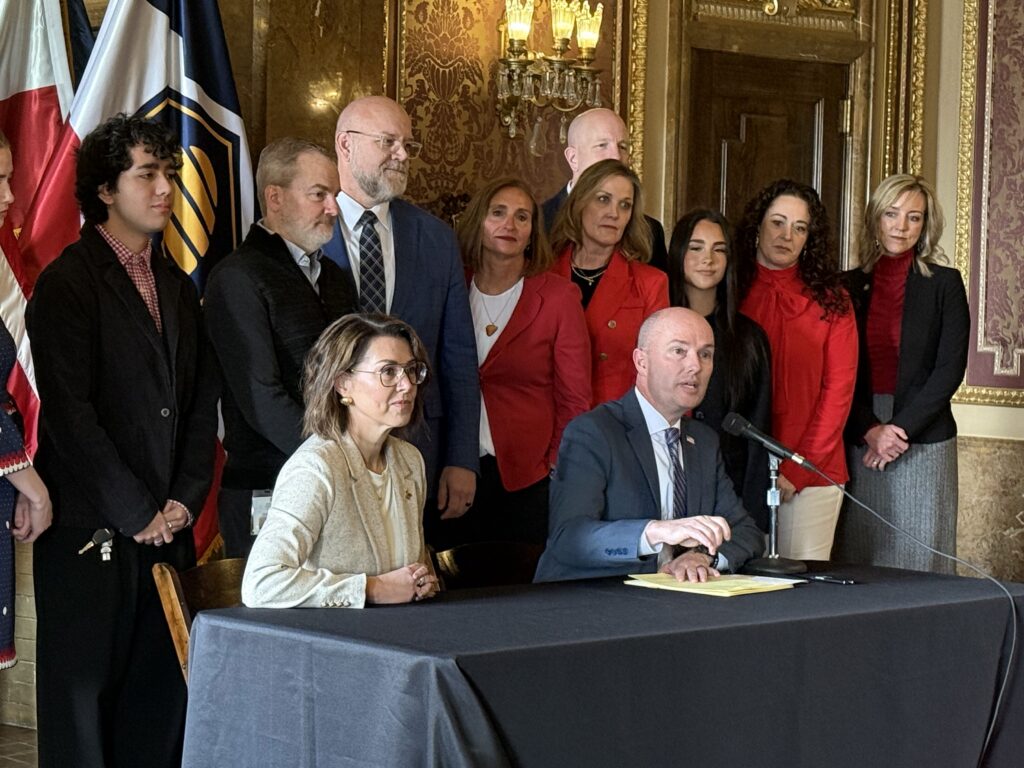


Gov. Spencer Cox and Lt. Gov. Deidre Henderson at a ceremonial signing event on tech safety bills at the Utah State Capitol on April 4, 2025 (Alixel Cabrera/Utah News Dispatch)
In Milan Venegas’ high school in Provo, students are already required to keep their cellphones tucked away in class. If they get caught scrolling their teacher places the phone into a magnetically locked box until the end of the school day.
Despite some initial resistance from his classmates, Venegas said he’s noticed some positive effects since the cellphone ban was established during the second semester of his senior year. He even learned the names of the kids sitting in front of him in his English class.
“They’re really cool. They also had lots of great thoughts about what we were reading in our classes and all that stuff that I wish that we maybe had our first semester if they were not on their phones,” Venegas said after a news conference hosted by Gov. Spencer Cox.
SUBSCRIBE: GET THE MORNING HEADLINES DELIVERED TO YOUR INBOX
The change came after lawmakers unveiled plans to pass a bill establishing a universal no-phone policy for all Utah public schools.
That new policy is set to extend to schools across Utah, as a new law that bans students from using cellphones, smart watches or other emerging technology devices during classroom hours will take effect July 1.
A cellphone ban in Utah schools is closer to reality with overwhelming support in Legislature
In a ceremonial signature event for three tech safety bills, Cox, who has championed efforts to lower social media usage, especially among teens, said the bills have the potential to redefine the online landscape, not only in Utah but in the country.
“I remember getting criticism two years ago for our first social media bills, that we were trying to be a nanny state, to take power away from parents. And it’s the exact opposite,” Cox said on Friday. “What we are trying to do is to give parents and families back the power over these destructive and corrosive apps and cellphones.”
During the event, Cox and Lt. Gov. Deidre Henderson ceremoniously signed SB178, the bill that establishes a statewide cellphone ban policy — unless any school board decides otherwise. They also signed HB418, which directs social media companies to have a common data infrastructure, and SB142, a legislation that would require Google and Apple to verify the ages of their customers before they make app store purchases.
With these new laws, Cox said, the state is aiming to empower Utahns in the online world, which he said is going in a worse direction with artificial intelligence providing even more tools to expand social media’s addictive qualities.
“It’s not just the anxiety, depression and self harm that I mentioned,” Cox said. “But it’s literally tearing us apart and the fabric of our country. It’s making us hate each other as we get addicted to the outrage that is out there.”


A cellphone ban is not done
Sponsored by Sen. Lincoln Fillmore, R-South Jordan, SB178 sets a statewide policy that prohibits students from using their cellphone during school hours. A few schools in Utah had policies banning cellphones, but Utah law didn’t set a default policy, which,Fillmore argued, was itself a policy through inaction that allowed electronic devices.
“(Constant notifications) turn school into, ‘I am constantly under the fear of missing out on what is going on in the virtual world apart from me, I’m surrounded by my peers and friends
in what is the most formative time in my life, and I’m focused on Taylor Swift,’” Fillmore said.
The bill does allow school districts to implement their own phone policies. An earlier proposal initially sought $4.8 million in one-time money to fund equipment, such as magnetic locking pouches for the phones or other types of lockers to store phones during class time.
However, lawmakers ultimately did not appropriate any money for the bill, with legislators expressing little appetite to pay for the equipment.
While the bill still allows some flexibility for local school officials to set their own rules, Cox said it’s one of the most important education policies approved in the state in the last decade. But, he said there’s still some room for improvement.
“We didn’t get ‘bell to bell’ here,” he said about other policies in other states that forbid phones during the whole school day. “I just can’t let this moment pass to say it is a mistake not to do ‘bell to bell.’ All of the research is 100% clear that ‘bell to bell’ does protect our kids so much more than going to recess and getting on your phones, going to lunch and immediately being back on your phones. So I hope we are not done here.”

An unprecedented change for platforms
Cox said Rep. Doug Fiefia, R-Herriman, made quite an impression for passing an unprecedented bill as a freshman.
With HB418, Utah became the first state in the nation to adopt a law requiring social media platforms to have interoperability systems, meaning having the necessary infrastructure so customers can communicate and share data from different platforms, just like how cellphone companies allow users from different carriers to call each other and carry their phone numbers even if they switch companies.
Utah’s latest data and social media laws could ‘change the world,’ Gov. Cox says
“It’s a shifting point. It is the turning point. It’s a moment in history where we choose people over platforms, families over profits, the greater good over an unchecked algorithm. It’s where we shift power back to where it always should remain, with the people with Utah”, Fiefia said about his bill.
Cox, who had already described the legislation as one with the potential “to change the world,” praised the bill again on Friday.
“I don’t think most people understand how groundbreaking this bill is. It is the first of its kind in the country,” Cox said. “And it really does have the potential to change everything, to break up the monopolies, to give us, again, back our identity.”
The bill takes effect in July 2026, which Fiefia said gives companies time to figure out how to achieve interoperability.

Age verification in app stores
Any first-year law school student learns that children can’t legally sign contracts, said Sen. Todd Weiler, R-Woods Cross, who sponsored SB142, titled App Store Accountability Act. However, every time a minor downloads or updates an app, they are accepting binding terms and conditions.
“You might say, ‘big deal,’” Weiler said on Friday. “Well, these contracts … often (give) permission to collect their data, sometimes to access their microphone, even their cameras, to use their data, to sell their data.”
His bill isn’t about controlling content, Weiler added. It’s about contracts.
The bill mostly applies to Apple and Google, which run the country’s two major app stores. Under the law, with some provisions set to become effective in May, the app stores will be required to collect guardians’ information, who will then allow any identified minor to download an app requiring a terms of service agreement.
Meta, X and Snap issued a joint statement supporting the legislation saying, “parents want a one-stop shop to verify their child’s age and grant permission for them to download apps in a privacy-preserving way.”
However, Kareem Ghanem, director of public policy at Google, one of the companies that will bear the responsibility to verify ages, said in a blog post that a series of legislative proposals pushed by Meta “introduce new risks to the privacy of minors, without actually addressing the harms that are inspiring lawmakers to act.”
Weiler’s bill, Ghanem said, opens up the potential for bad actors to sell the data or use it for other “nefarious purposes.”
“This level of data sharing isn’t necessary — a weather app doesn’t need to know if a user is a kid. By contrast, a social media app does need to make significant decisions about age-appropriate content and features,” Ghanem wrote. “As written, however, the bill helps social media companies avoid that responsibility despite the fact that apps are just one of many ways that kids can access these platforms.”