
Utah News Dispatch
Coal production and presence in Utah’s energy portfolio is at its lowest levels

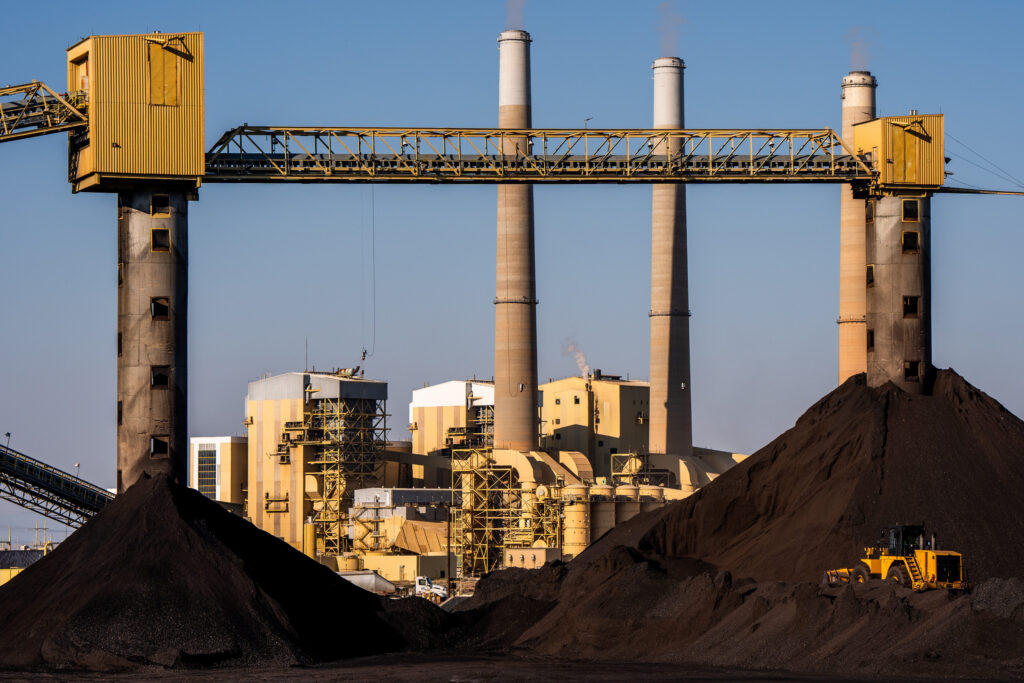

Coal is stored outside the Hunter coal-fired power plant, operated by PacifiCorp, in Emery County on Wednesday, July 31, 2024. (Photo by Spenser Heaps for Utah News Dispatch)
As Utah leaders look more toward energy innovation and creating an abundance of supply, the state faces declining coal operations.
Last year there were five operational coal mines in the state, the fewest in its 150-year-old coal history, according to a new Kem C. Gardner Policy Institute research brief on Utah’s energy sector, part of the institute’s economic report to the governor.
While the opening of the Fossil Rock mine, located in Emery County brought a slight increase in coal production — from 7 million tons in 2023, to 7.5 million tons in 2024 — the number is still well below the average of 24.5 million tons produced in the 2000s and is still 30% lower than what the state averaged two years ago.
“We peaked in coal production in the late 90s, early 2000s, up to 27 million tons a year. And since then, it’s been a pretty steady decline,” Michael Vanden Berg, energy and minerals program manager at the Utah Geological Survey and author of the study said on Thursday during a media presentation of the brief.
The state’s coal exports, both domestically and internationally, have substantially dropped. In the early 2000s, Utah sent up to 16 million tons of coal to other states. That number fell to 377,000 tons in 2024.
The outlook for coal as an electricity generator has also substantially shrank in the state’s energy portfolio. In the year 2000, it accounted for 94% of the generation mix. That number dropped to 46% in 2024, with other resources booming.
Natural gas, for example, went from making up 2% of the mix in the year 2000 to 34% last year. Solar went from nothing to 14% in those 24 years.
Nuclear development and electricity rates to dominate energy discussion this legislative session
Looking ahead, the future of Utah’s energy production is on a trajectory to change even more. This year, Gov. Spencer Cox and lawmakers approved a plan to set up the foundation for another big resource — nuclear.
But, with the introduction of a new resource, Utahns may have to face changes when it comes to paying their utility bills. That could mean higher prices.
Preliminary numbers indicate that Utah kept its spot as a top state with the cheapest residential electricity bills. As state leaders make an effort to attract artificial intelligence, data centers and increased electrification, Utah is also looking at how to keep its energy costs low compared to other states, Emy Lesofski, director of the Utah Office of Energy Development said on Thursday.
However, with nuclear energy carrying a hefty price tag, balancing the need for innovation while keeping rates low is a challenge.
“One of the things about small modular reactors, which is where the state’s focusing its initial interest, is that the idea is for them to be designed to be deployed much less expensively and more quickly, which will help the upfront cost of building nuclear,” Lesofski said.
“And then on the back end, nuclear is very affordable to run once it’s built,” she added. “And so these are difficult questions that we’re gonna have to grapple with, but we definitely know that we need more power. We need it to be reliable, we want it to be clean, and nuclear provides those things.”
Additionally, energy consumption, which includes electricity, gas and other resources, has been on a steady increase of about 1.7% per year, according to the report, so state leaders are looking at how to keep up with demand when the increased need comes in gigawatt figures.
With more local input, Legislature signs on to the beginning of Utah’s nuclear future
While coal production in Utah is at one of its lowest levels, Lesofski believes it is still crucial for the state’s energy outlook.
“I think when the power isn’t needed because there’s other sources to replace it, then that discussion (about stopping using coal) may occur,” she said. “But, we need power now. We need more now, and our coal plans provide that reliable power that we need.”
That message is in line with the Utah Legislature’s actions protecting coal and preventing what lawmakers deem to be coal plants’ early retirement. They often call it an “all of the above” approach.
Despite its decline, coal is still in high demand in Utah, prompting imports from other states. But, that might change a bit in 2026, when the newly opened Fossil Rock mine starts its full-scale mining, adding up to 3 million tons to the mix, according to the report.
Also, some Intermountain Power Plant coal generators will convert to natural gas, removing demand for 2 million to 3 million tons of coal — despite legislation that will keep at least one of its coal-powered units active.
Still, Utah usually produces more energy than it needs. According to the study, during 2021 and 2022, the state became a net energy importer since its production couldn’t keep up with demand. However, that “importer” designation didn’t last long. In 2023 Utah went back to being an energy exporter, a designation that expanded in 2024.