
Utah News Dispatch
Charges dismissed against Salt Lake protester in a ‘significant’ First Amendment win, ACLU says


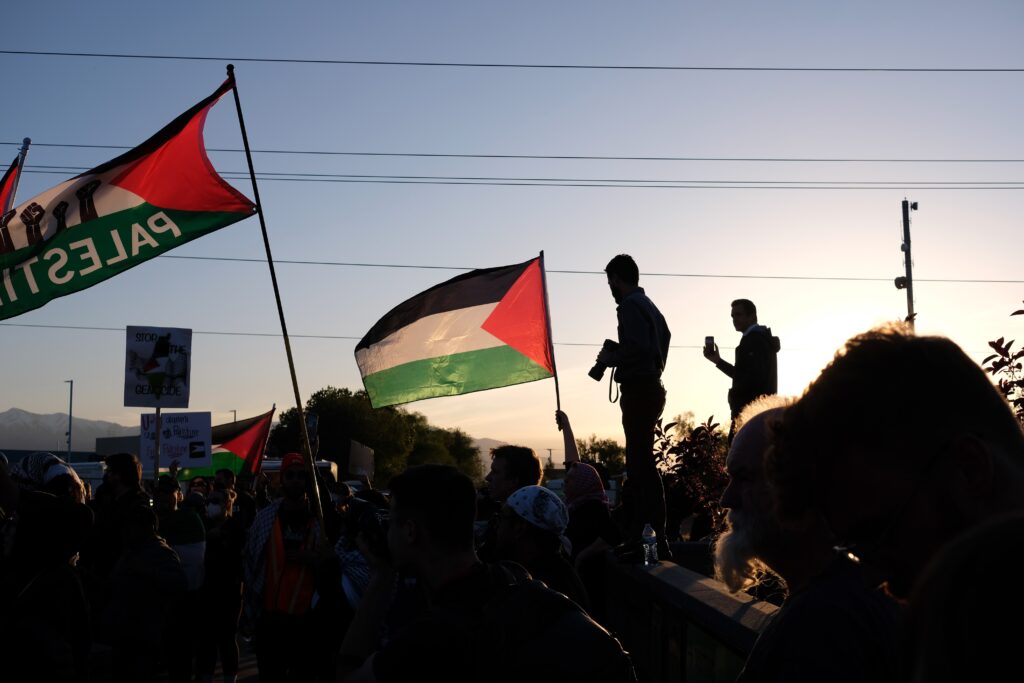


Pro-Palestine protesters gather outside of the Salt Lake County Jail in South Salt Lake after a student organizer was arrested on Tuesday, April 30, 2024. (Kyle Dunphey/Utah News Dispatch)
A Utah judge dismissed a case this week against a woman who was facing charges stemming from a pro-Palestine protest in Salt Lake City last year, in what the ACLU of Utah called a “significant victory” for First Amendment rights.
Liz Maryon, 34, was charged with failure to stop at command of a law officer, a class A misdemeanor, as well as walking in the road with a sidewalk available and disorderly conduct, both infractions, after a Salt Lake City police officer tried to get her to stop during a protest last May.
But the case is now closed following an order signed Tuesday by 3rd District Court Judge Dianna Gibson, dismissing the charges with prejudice, meaning prosecutors cannot refile the same charges.
“The police tried to scare people into thinking we don’t have the right to protest without a permit or to march in the streets,” Maryon said in a statement. “We defended our rights to protest by fighting these charges. This dismissal is a victory for everyone who refuses to be intimidated by the growing crackdown on protest rights.”
Prosecutors asked the court to dismiss the case after learning more about the evidence in a preliminary hearing, says Salt Lake County District Attorney Sim Gill, whose office filed the charges in the first place.
“We felt that we could not meet that burden of proof as we went through the analysis post preliminary hearing,” Gill said on Thursday. “The consensus was, from all of us, that this was a case that needed to be dismissed.”
Maryon was spotted by a Salt Lake City police drone “leading the crowd during the march” near 300 West and 300 South on May 18, according to a probable cause document.
According to charging documents, Salt Lake police officer Steven Wooldridge “attempted to detain Maryon by grabbing her left arm and instructed her to stop. Maryon pulled away and ran south towards the protest crowd.”
The officer, who knew Maryon from previous protests, according to ACLU attorneys, called her by name to stop, but she didn’t.
In January, nearly eight months later, she was charged in Salt Lake’s 3rd District Court. Gill didn’t know exactly why it took so long to file charges against Maryon, but said his office tends to prioritize cases where the accused person is in jail, since there’s typically some kind of court-imposed deadline — non-jail cases tend to take a little longer.
SUBSCRIBE: GET THE MORNING HEADLINES DELIVERED TO YOUR INBOX
The ACLU usually stays away from criminal cases, but because there were First Amendment concerns with Maryon’s charges, decided to represent her. In a briefing filed in June, attorneys said Maryon had no reason to believe she was under arrest when the officer told her to stop. The protest was peaceful, and not deemed unlawful, and “no reasonable person in that situation would believe they were at risk for arrest,” her attorneys said.
“Lt. Woolridge testified that the reason he tried to initiate contact with Ms. Maryon was because he recognized her from other protests, not because he intended to arrest her in that moment. He did not tell her that she was under arrest or detained. He gave her no reason to believe that she was under arrest,” court documents filed by ACLU attorneys read.
Then, on July 29, prosecutors for Salt Lake County filed a motion to dismiss the case with prejudice.
“Cases get filed based on reports, and sometimes those reports may sound much more powerful than they may be, or less powerful. And then you go to a preliminary hearing,” Gill said.
SUPPORT: YOU MAKE OUR WORK POSSIBLE
Jason Groth, legal director for the ACLU of Utah, called the case an example of “charging first and reviewing evidence later.”
“Police and prosecutors need to abide by what our state and federal constitutions demand, not what they think they can get away with charging,” Groth said in a statement.
Gill, in response, called it an example of due process playing out.
“That’s where we get to test out and correct, as necessary, based on the evidence and what we have,” he said. “That’s how the system should work, right?”
Maryon and her attorneys contend the charges were meant to intimidate protesters.
“When law enforcement charged me, it sent a message — one that failed — meant to discourage protesters in Utah calling Israel’s attacks on Palestine a genocide and demanding an end to U.S. support for Israel,” Maryon said.