
Utah News Dispatch
Beyond Utah’s new maps, will mid-decade redistricting be the new normal?

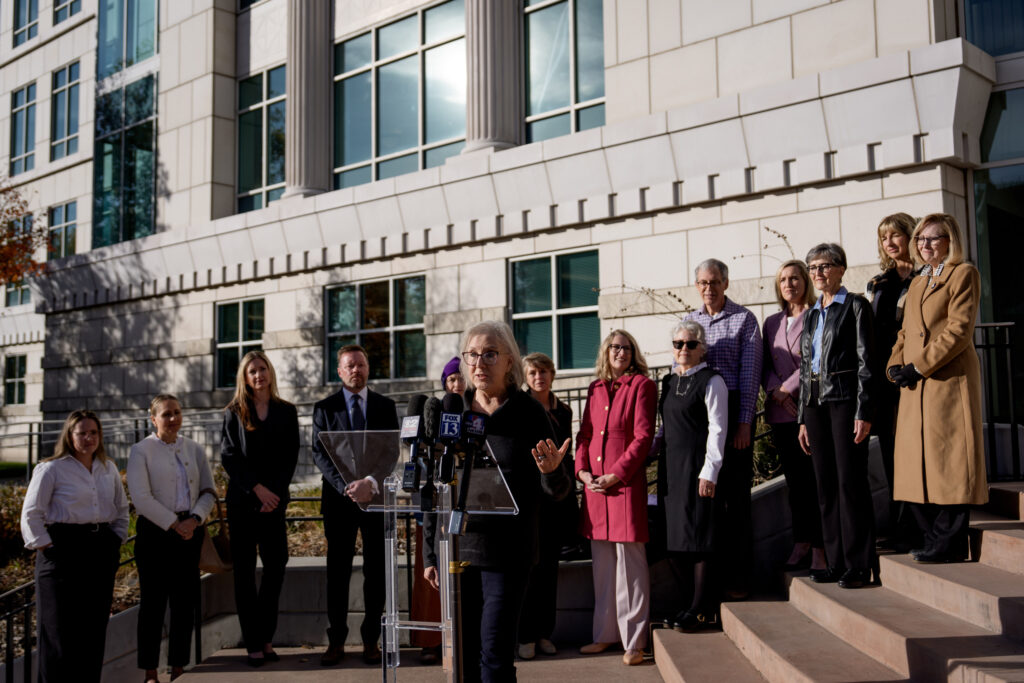

Kathy Biele, president of the League of Women Voters, and other representatives of the plaintiffs who sued the Utah Legislature over their congressional maps, hold a press conference outside the Third District Courthouse in Salt Lake City on Tuesday, Nov. 11, 2025. Late the night before, 3rd District Judge Dianna Gibson ruled in favor of the plaintiffs, choosing their submitted map to be used in the 2026 elections. (Photo by Spenser Heaps for Utah News Dispatch)
Redistricting efforts in Texas and California have grabbed headlines, but similar fights are playing out across the country.
GOP-led states such as Indiana are facing pressure from the president to redistrict. Some states like Missouri, North Carolina, Ohio and Utah already have enacted new mid-decade congressional maps for the 2026 midterms.
However, Utah’s case is unique. Their redistricting fight was spearheaded by Utah voters, who ultimately won.
Show Notes
In Episode 3, Katie McKellar from the Utah News Dispatch breaks down the state’s recent redistricting dispute between anti-gerrymandering groups and the Utah Legislature.
You’ll also meet Katharine Biele, one of the plaintiffs of the winning case. She’s president of the League of Women Voters of Utah.
But is all this mid-decade redistricting normal? Brennan Center for Justice’s Kareem Crayton, who holds a doctorate in political science, helps us answer that.
Finally, Evening Wrap newsletter author Danielle Gaines shares the top stories she’s watching.
Episode produced and edited by Mallory Cheng. Music for Stories From The States composed by David Singer.
Got questions? An episode idea? Email us at podcast@statesnewsroom.com.
Subscribe to Stories From the States on Apple Podcasts, Spotify and Youtube.
Stories From The States is a production of States Newsroom, the nation’s largest state-focused nonprofit news organization, with reporting from every capital. At this pivotal moment in American democracy, our veteran journalists from all 50 states are reporting the consequences of government decision making. By zooming into one story each week, Stories From the States contextualizes and gives a human voice to what is happening now.
Audio Transcript
Transcript was created using an automated software.
Chris Fitzsimon
This is Stories From The States. I’m Chris Fitzsimon. Here at States Newsroom, we know there’s a lot going on around the country every week, in every state. This week, we’re talking about mid-decade redistricting. Texas and California have grabbed most of the headlines in the battle. Now, GOP led states like Indiana are facing pressure from the president to redistrict. All while some states like Missouri, North Carolina, Ohio and Utah already have enacted new maps for the 2026 midterm elections. But Utah’s case is unique. That redistricting fight was spearheaded by Utah voters who ultimately won. Firstm that’s where we’re heading, and we’ll hear from one of the plaintiffs in the case.
Katharine Biele
All you have to do is make a map that is fair to everyone. Everyone’s voice should matter.
Chris Fitzsimon
Then we’ll check in with the Brennan Center for Justice to find out if all this mid-decade redistricting business is actually normal. Up first is a Utah News Dispatch reporter. We’ll hear from her in just a moment.
Chris Fitzsimon
A Utah judge recently approved a redistricting map that would give Democratic candidates a good chance at winning one of the state’s US House seats in the 2026 midterm elections. This redistricting dispute started back in 2018 though, way before the Trump administration started pushing for mid-decade redistricting to rig the maps to try to keep control of the US House in 2026. Katie McKellar, a senior reporter from the Utah News Dispatch, has been closely covering this for years. She joins us now. Hi, Katie.
Katie McKellar
Hi. Thanks for having me.
Chris Fitzsimon
Thanks for being with us. All right, let’s jump in. Tell us about this. This case, it nowhere near started just this year. Give us a little bit of background on what’s at stake here.
Katie McKellar
Oh yeah, there’s a long history here in Utah. So back in 2021, that year, the Republican majority Utah legislature repealed and replaced a ballot initiative that was narrowly approved by Utah voters in 2018. And that ballot initiative driven by anti gerrymandering groups called Better Boundaries, sought to implement an independent redistricting process here in Utah, meant to guard against gerrymandering, and they argued that there were too many Democratic, independent and even more moderate Republican voters here that were being dispersed or cracked through the redistricting process. And so they put Proposition 4 on the ballot for voters to decide whether it should become law, and it passed. But Republican leaders here have long believed that they have the final say when it comes to ballot initiatives, and so they repealed and replaced Prop Four with a law known as SB 200 and essentially, what that law did was water down Prop Four and turn the independent redistricting commission that was supposed to draw the state’s maps into an advisory body that could ignore those maps.
Chris Fitzsimon
So basically, the voters decided they wanted to do this with the independent commission. The Republican legislature said, ‘No, thanks’. We’re going to turn this into an advisory commission, even though the voters didn’t want that?
Katie McKellar
Exactly, exactly. And so instead, they repealed and replaced that law with one that that turned into an advisory body that they could ignore. And so even though that independent commission drew a set of maps that year, lawmakers do their own and they adopted those maps and that congressional map and that set created four solidly Republican congressional districts, and that prompted pro democracy groups like the League of Women Voters of Utah, Mormon Women for Ethical Government and a handful of Salt Lake County voters who felt disenfranchised by that new congressional map to get together and sue. And they alleged that that 2021 map was a blatant gerrymander, and that lawmakers violated their rights to reform their government through a ballot initiative.
Chris Fitzsimon
So really, the lawsuit was about the ballot initiative as much as it was the districts. Sounds like.
Katie McKellar
Absolutely it was about both. It was about gerrymandering and lawmakers overstepping on a ballot initiative. And so after that case spent several years winding through the courts. Ultimately, the Utah Supreme Court, on an appeal, sided with the plaintiffs on the claim that lawmakers violated their right to alter and reform their government, and that led a district court judge to deem the 2021 map the result of an unconstitutional process. So she didn’t rule, she didn’t weigh in on whether it was a gerrymander, but she did say it was an unlawful map because it was the result of repealing and replacing a ballot initiative. And so she she voided that 2021 map and ruled that Utah must go through a court ordered redistricting process to put in place a lawful congressional map to be used next year in the 2026 elections, and that’s how we got where we are today.
Chris Fitzsimon
Thank you. It’s not a simple topic. I think you did a great job explaining it for us. And so tell us when the Trump administration got involved and people thought that they were going to have some role in this.
Katie McKellar
So while mid, mid decade redistricting is is a debate happening all over the country right now, Utah’s mid-decade redistricting process right now is unique, because this was court ordered this was a judge saying Utah lawmakers overstepped, we need to fix it. And so it’s very unique compared to the other conversations happening in states like California and Texas.
Chris Fitzsimon
Right. And so now tell us what happened. The map that was chosen does appear to give Democrats a chance at winning one of these districts. From what I’ve read, a lot of this revolves around Salt Lake County, which is the most populous county in the state.
Katie McKellar
Yeah, so over the last several a couple of months, really, this court ordered process took a long time. The judge took several weeks to hear from both sides, the legislative attorneys and attorneys for the plaintiffs and each side. She gave an opportunity to submit some maps to consider. So the legislature voted on a map known as map C that lawmakers contended abided by Proposition Four’s criteria, and that would be fair. And you know, looking at that map compared to the 2021 map, it is true that it was a bit more competitive for Democrats, but it would still result in four pretty solidly red congressional districts, and then the plaintiff submitted two options. One map was a lease change map based off of the map that the lawmakers approved to just kind of tweak the boundary so it didn’t split as many cities. Or they also submitted another one that was drawn with an algorithm that was created based off of Proposition Four’s criteria, and that map is the one the judge ultimately picked. And in that map, there’s the first congressional district is concentrated around the northern part of Salt Lake County, which is a very populated part of Utah. And the result is three pretty, like, really safe Republican districts, and one pretty safe Democratic district.
Chris Fitzsimon
Somebody described to me that the old maps that they were under and some of the proposals that weren’t adopted look like a pizza cutter had done them that they divided up most of the population into into pizza slices so the Republicans could maintain control.
Katie McKellar
Oh yeah, that has been a strategy for a long time. And you know, the plaintiffs in the lawsuit alleged was blatant gerrymandering Republicans here, they like to describe it as pizza slice, or mixing urban and rural voices, so that urban and rural voices in each district are represented on the federal level. Well, the plaintiffs allege, you know, that’s just cover to crack Salt Lake County into four different pieces so that there would not be a Democratic district.
Chris Fitzsimon
And what was the reaction there, when the court chose the map that gives the Democrats a chance to claim one of the districts?
Katie McKellar
Oh, the the plaintiffs in the case were thrilled. They thought that was a great win, because that map, to them, was based wholly off of Propositions Four’s criteria. Democrats were thrilled, Republicans were angry. There’s been a ton of backlash from Republicans. I mean, even before the judge picked that map, some Republican lawmakers began saying, if she didn’t pick their map that they submitted to the court map see that they would argue it would amount to malfeasance, because they still firmly believe, despite all the court rulings, that the Utah constitution ultimately gives them and only them, the ability to pick maps in the redistricting process. And so couple of things have been happening. Republicans and a group called Utahns for Representative Government are pursuing another ballot initiative to repeal Proposition Four to go on the ballot in 2026 for voters to consider. And in the meantime, I think we can still expect plenty of court appeals, legislative attorneys saying they’ll be willing to take it all the way to the US Supreme Court if necessary. But you know, barring some crazy upset, because we’ve already hit the deadline for a map to be used in 2026 even if they went on appeal. I don’t know if there’s even time to put a different map in place for 2026 but 2028 who knows? We’ll just have to see.
Chris Fitzsimon
The judge has been attacked, right? And there’s even been like talks of impeaching the judge. It really has gone to a new level it seems like.
Katie McKellar
We’ll have to see if those threats are just threats, or if, if lawmakers actually try to carry that out. One lawmaker has said he’s open a bill file to do articles of impeachment, but I haven’t been able to get the senate president or the house speaker on record solidly saying yes, we’re going to try to impeach her, so we’ll have to see.
Chris Fitzsimon
Right. Well, we will check back with you. Katie, thanks for all your great reporting there, and thanks for being with us. Thanks. Chris. Katie McKellar is a senior reporter at the Utah News Dispatch. That outlet is a part of state’s newsroom. Since chatting with Katie, the Utah judiciary has issued a statement addressing threats to Judge Diana Gibson, who ruled on the maps. They addressed the heated political reaction as well as the threats of violence to Judge Gibson saying, “threats of violence against judges or court personnel are unacceptable, dangerous and may violate state of federal laws”. As Katie mentioned, the approved map drawn by the plaintiffs of Utah’s redistricting lawsuit was a collective effort of nonpartisan groups, faith based organizations, a legal center, and a handful of Salt Lake County voters who all said they just wanted fair maps. In a moment, we’ll meet one of the plaintiffs from that case. We’ll be right back.
Moses Esheit
At a time when so many communities are losing their local news outlets. States. Newsroom is filling a gap. We are now the nation’s largest state focused nonprofit news organization with reporters based in every state capital and Washington DC. But we can’t do it without your support. Your contributions allow us to produce award winning journalism and deliver it to you for free. No pop ups, no pay walls. This is a crucial time to support local journalism, and every bit helps to give go to states, newsroom.com/donate,
Chris Fitzsimon
After almost seven years of a legal battle against a GOP led state legislature in Utah, a broad coalition of plaintiffs finally had their congressional district map approved by federal judge. It wasn’t easy, and has involved a referendum that lawmakers ignored, legal machinations and now calls to impeach a judge. Joining us now with one of the people who was part of this redistricting fight, Katharine Biele is the President of the League of Women Voters of Utah. She joins us now. Hello, Katharine. Thanks for being here.
Katharine Biele
Thank you so much Chris.
Chris Fitzsimon
So Katharine, your group was one of the plaintiffs in this case, and now a judge has approved the maps you and other Utahns had sought, right.
Katharine Biele
They did. I mean, we were thrilled.
Chris Fitzsimon
You were thrilled. I was gonna ask your reaction. Were you surprised?
Katharine Biele
Not completely. We had very good arguments. I mean, our arguments were based in the Utah State Constitution, Article One, Section two, which gives the citizens the right to change the form of government. So we had a very good argument. We were never trying to leave the legislature out of it. We totally expect the legislature to draw the maps. All we require is that they draw them fairly.
Chris Fitzsimon
Just to be clear, the maps that had been drawn or that were drawn by the General Assembly, or the ones that they were were promoting, really, I always hear it as an outsider to Utah, hear it described as like pizza slices, which keeps sort of all the parts of Salt Lake City separated in effect.
Katharine Biele
And it’s not just Salt Lake City, but Salt Lake Salt Lake County. This is where the hub of the population lives. They divided the county into four slices going down to the very tip of Southern Utah, St George, so we in urban Salt Lake have the same representative as those down in southern Utah.
Chris Fitzsimon
And what was the reaction from the legislature and the proponents, or the I guess the people who wanted to continue to draw the maps the way they had been drawn.
Katharine Biele
The legislature is up in arms. They will not stop this should have been easy. I mean, how hard is it to draw a fair map? It’s not a partisan thing. It is. Just look, this is these are communities of interest. Salt Lake County is one community of interest. Southern Utah is another. The rural, rural areas are another. So it’s just really not that hard. They were furious because they thought we were taking away their responsibility, which we are not.
Chris Fitzsimon
You know, Utah has a reputation, I think, from afar, and I think I’m sure it feels that way a lot of times in Utah you have Republican governors in the past have reached across the aisle. There’s been a lot of national publicity. They’ve been the leaders in sort of a different kind of campaigning. So I think there’s a perception that politics in Utah hasn’t gotten to the bitter level that we’ve seen around the country. And yet it feels like in this case, maybe that has changed some.
Katharine Biele
I will say that it may be changing a little. This is all based around the national politics and the kind of national politics that are coming down to Utah. There are many people here, many legislators who think that whatever Trump says and whatever he does, they should do however. We also have enough. I mean, we respect the legislature, and the legislators do have good intentions. They just have to get away from the whole idea that only Republicans can be in charge of everything.
Chris Fitzsimon
Do you have trouble as a citizen activist or a member of an organization, getting some voters to understand really what’s at stake. I think sometimes, even when I’m talking to folks about redistricting battles, and we’ve had a lot of them in states that I’ve been in, people sometimes their eyes glaze over and they want to talk about a lot of other issues. But this feels like a in some cases, a technical thing.
Katharine Biele
Well, and this is it’s hard, it is very difficult, and I think the legislature has made it even. More difficult on purpose. They want the citizens to be confused and to say, ‘Okay, we’re going to leave it to the legislature, because we don’t get it.’ It’s not that hard. All you have to do is make a map that is fair to everyone. Everyone’s voice should matter. We don’t all win. We just need to have a voice. I have heard as a league of women voters. We register voters all the time. What they say to us is, why should we vote? We know what the outcome will be. This at least gives those voters a chance. Is it over? No, it probably will never be over. I mean, the legislature has talked about appealing. You know, if they appeal to the Supreme Court, that is really a delaying tactic, because our Supreme Court ruled unanimously in our favor. So it’s unlikely that they would do anything different. But I can’t say I’m not a lawyer. They have talked about running an initiative, which is ironic, a citizens initiative to overturn a citizens initiative. And that is exactly what you said. It’s because people are confused, and they think, Oh, well, we can confuse them more, and they will just vote our way to get rid of Proposition Four.
Chris Fitzsimon
Well, I really appreciate you being with us, and thanks for all your efforts for democracy there in Utah. Thank you very much.
Katharine Biele
Thank you too.
Chris Fitzsimon
This week, a federal court blocked Texas from using their new congressional maps for the 2026 election. Texas was the first state pushed by the President to take part in this unusual mid-decade redistricting scheme. This move has led state lawmakers across the country to talk about redistricting when they only discuss it every 10 years. Is all this mid decade redistricting now going to be the new normal nationally? Coming up, an expert from the Brennan Center for Justice will help us figure that out. Then Evening Wrap newsletter author Danielle Gaines will join us about the story she’s looking out for. We’ll be right back.
Nelle Dunlap
Hi, it’s Nelle Dunlap, product and engineering director at states newsroom. At states newsroom, we believe journalism should be fair, fearless and free, with reporters working on the ground in all 50 states and Washington DC, we provide non partisan coverage of the state issues that matter most to you. You can subscribe to our work by going to states newsroom.com/subscribe
Chris Fitzsimon
Congressional district maps are generally redrawn every decade after the US Census, unless a court intervenes and orders state lawmakers to redraw them to settle a lawsuit. But the Trump administration has been pushing GOP led states to redistrict this year, purely for political reasons, to make it harder for Democrats to take over control of the House in the 2026 election. What are the long term effects of the break from precedent, and what happens if it becomes the new normal and maps are drawn every two years instead of every 10? We spoke with Kareem Crayton. He’s the vice president of the Brennan Center for Justice’s Washington DC office, and he has a doctorate in political science. Just a note. We spoke with Kareem before the news broke in Texas this week where a federal court blocked Texas from using their new congressional maps for the 26th election. Now they have to go back to their 2021 maps, which, by the way, are already gerrymandered by the Republican controlled General Assembly. He joins us now, Kareem, thanks for being here. Delight to be with you. Thank you. Well, what do you make of this overall? I think if we were sitting here a year ago, it’s hard to imagine the pressure being brought on so many states to dramatically change the way they draw district lines.
Kareem Crayton
Yeah, about a year ago, I think most of us thought that the only movement was going to be in the courts, with things that were already on the table. I think it is hard to have predicted such a massive number of states jumping into the pool and that most of the disruption and chaos is coming really at the instigation of the White House.
Chris Fitzsimon
It puts a good government advocates like folks at the Brennan Center in a bit of a tough place at the beginning of all this national mid-decade redistricting discourse, after Governor Greg Abbott announced that he was doing that in Texas, there was a lot of discussion about, should states that have commissions or states that are committed to trying to drawing on gerrymandered districts also play what did you make of that sort of the machinations there?
Kareem Crayton
Well, I would say the tough position that we’ve been in is actually one that preceded Governor Abbott’s move, and it is where the Supreme Court of the United States failed to adopt a national standard. In the absence of that, notwithstanding the fact that the Supreme Court said it had no particular opinion about political gerrymandering, number of states saw that as an invitation. And I think what we’re seeing is the result of that. So both. For what Texas has done, and California and other states have done, in reaction, is in some ways not surprising, if also quite lamentable.
Chris Fitzsimon
To have a legislature, for example, Texas, who already gerrymandered the districts with their own majority come back and, in effect, re gerrymander them. Is this? What is this unprecedented? Had you seen anything like this before?
Kareem Crayton
I think, writ large, it is unprecedented. It is fair to say that states have gone back to the well in the past, first time where we’ve seen, you know, the legislature in Texas at least go back and say, Oh, we didn’t gerrymander enough. And certainly, when you add to that, the National reaction where some states are going back to say, the public, we want to do a re gerrymandering of this state, is that okay, in light of all the other things that you’ve seen, and in California, the people said, Yes,
Chris Fitzsimon
I covered redistricting in North Carolina for a long time. And what do you make of this? For the voters? I think it’s already sort of hard to explain to folks who don’t do this for a living, who are just living their lives trying to make ends meet, and now they can’t vote for the person they used to their districts are different. How do you communicate this effectively, the importance of this to folks who aren’t really involved in the political process.
Kareem Crayton
The people that are supposed to be served by the redrawing of districts are the people who are supposed to be represented, and those are voters, and not the electeds. And what you see with these changes, in the absence of a national standard is that people who live right next to each other, who share the same city, who understand the same sets of issues that affect them all are now divided by essentially arbitrary lines, and they’re done really for no other purpose than to serve a political interest, and in fact, an interest that might not even be in the state that’s supposed to be represented. So I think all of these, you know, line drawing and re line drawing efforts are bringing people farther and farther away from power and democratic system. People aren’t supposed to be, particularly in elections, the source of power, and that’s of real concern.
Chris Fitzsimon
We also had some news recently from the Indiana Capitol Chronicle, despite visits from the vice president and pressure from the president, many Republicans there are choosing not to participate in this mid cycle redistricting.
Kareem Crayton
Well, we’re seeing a lot of folks, I think, look at this and say, one, what does it cost us to try to do this? Yes, maybe the White House really wants us to do it, but what do we lose by going back to the will and redrawing the map? And frankly, it is probably not off of anybody’s mind. The fact that we had elections in November that I think, surprised a lot of people. And so if you’re doing these redraws, you’ve got to think about the world, not just as it exists right now, but what it’s going to look like a year from now and beyond. And in places where, if you’re a Republican you’re looking at, you know, what was pretty much a clean sweep behind the Democratic Party. And you got to wonder, is there a line at which and pardon the pun, but yes, if you cross that line in drawing new district maps, do you make yourself less likely in a democratic wave year to be competitive? Again? This is sort of done from the perspective of partisanship. But what is lost in all of this is the people ultimately are going to want to choose. And I think the real challenge that a lot of people are grappling with is, well, look, we might want a certain political outcome, but if the public overwhelmingly sees us as grabbing more power than we’re due, it might be that there’s a wave so big that we can’t gerrymander our way out of it.
Chris Fitzsimon
You mentioned a national standard. Is there some, some world, ideal world, where all this publicity and frustration leads us back to a conversation about how everybody should do redistricting in some fair and open and honest way?
Kareem Crayton
Well, I certainly hope so. The Congress of the United States still has the ability to say to the public, you know what? We hear you. And there should be a national standard, and we’re going to carve one. To carve one out that might not be true, that may or may not be true of this existing Congress, but the public is frustrated enough. It’s entirely possible that, you know, the public votes for people who will step into the breach. And by the way, it’s important to note you now hear both Republicans and Democrats, often, many of them on the losing end of a redistricting fight. Say, though there should be a national standard. So I think the more that becomes, as you point out, a priority for the public as a whole, but also for the elected to recognize. You know, in the main, this may or may not be a matter of whether or not I gain from a particular line drop, or whether the country gains overall from a system that makes sure that people at the forefront of how districts get drawn
Chris Fitzsimon
Well more to come, for sure. Dr Crayton, thank you very much for being with us. We appreciate your insights.
Kareem Crayton
Great pleasure. Thank you for having me
Chris Fitzsimon
Coming up. We’ll check with evening rap newsletter writer Danielle Gaines, stay with us.
Chris Fitzsimon
Joining us now is Danielle Gaines. She writes States Newsrooms, daily newsletter called The Evening Wrap Danielle, it’s great to see you. Let’s let’s jump in. Talk about the big things this week and what’s coming up. First of all. What big stories Did you notice this week?
Danielle Gaines
Well, we’ve had some coverage about the changes that are coming to programs in the United States who have typically assisted refugees when they arrive here, and so our reporter in Rhode Island spent some time at the refugee Dream Center there, and she was talking with women in a class that’s meant to improve their English skills, but it’s also about so much more for them. So it’s like cultural, emotional, social. It was a really beautiful story just getting to know the women, but it also kind of touched on the fact that this was a place that is meant to be filled with love help these people feel at home, and instead, a lot of the emotion there has been replaced with fear, which is all too familiar to this group of people and uncertainty the folks who go there are among hundreds of 1000s of lawful immigrants who will soon lose food benefits in the US, as provisions of the one big, beautiful Bill act take effect. And in addition to food benefits, there are other things coming up that are big changes for programs that we established to help people get on their feet so the work requirements and Medicaid are going to be a problem. These are folks who aren’t working because they’re trying to gain proficiency in English so they can work, and they’ll lose support during that process. The story also had an economic analysis of refugees and immigrants in Rhode Island that I found really interesting. So 15% of the state are immigrants, and $5.5 million in annual food benefits will be gone under these provisions, and soon child tax credits will be gone as well, to the tune of $30 million so it’s a big shift on a family level, but also, you know, on a state economic level,
Chris Fitzsimon
Yeah, I think that bill still feels like it’s hanging over so many people. When the when those provisions take effect?
Danielle Gaines
Yeah, one of the coordinators there said that’s going to be, quote, disastrous, once it all kind of takes shape together.
Chris Fitzsimon
What about coming up next? What about things to look for?
Danielle Gaines
Yeah, so this week, I’ve been featuring a special mini series from our reproductive rights reporting team on the state of state shield protections for abortion medications. And so there’s a lot that has been going on with that, and a lot that is going to be going on with that. So over the series of stories, our team looked at the status of state shield laws as well as efforts to puncture them, as well as challenges to mifepristone in lawsuits and the federal regulatory level. So there is an ongoing lawsuit related to the federal regulations The ACLU is seeking information, kind of just looking at what is the Trump administration’s FDA actually looking at with these long established medications, and who are they talking to as they’re looking at it. So that’s a lawsuit to be on the lookout for. And then on the state side of things, shield laws that protect abortion providers have been established in lots of states to protect them from out of state lawsuits, but a new bill is taking effect in Texas, and that aims to kind of puncture the durability of those laws. It’s was described as the first bill in the country to explicitly target shield laws and shield providers, and it gives any Texan the power to sue anyone involved in mailing an abortion pill to the state. So we’ll have to see what unfolds there.
Chris Fitzsimon
It seems like then, I mean, it’s been ongoing, but the next frontier of the whole abortion debate seems like the battle over these, this medication and access to it. Yes, agreed. Well, what about one last thing? What shall we leave us together with?
Danielle Gaines
Well, just a time for Thanksgiving. I figured that we’d talk about food waste, not to be a downer, timely, but our friends at the Iowa capital dispatch covered a study by the State Department of Natural Resources, and that study found that Iowans throw away, on average, 200 pounds of food each year. When you account for industrial food waste. On top of that, it’s about 300 pounds. Wow. And that’s actually less than what the EPA estimates for the country as a whole, which is between 492 pounds and more than 1000 pounds. So this study was just a way to look at how to cut down on food waste, how food waste can be diverted, how to avoid it in the first place. So I thought I’d share some of the tips that I gleaned from it. You know, the first one is to purchase your food thoughtfully, and then, in terms of disposal, you can seek ways to donate something that you don’t want, share it with a neighbor, a friend, compost it instead of sending it to the landfill. My personal favorite is to just immediately freeze. So if you have a veggie tray at Thanksgiving, like, don’t just shove it the back of your fridge to let it waste away. Cut it up right away, put it in a baggie, and then some night, you’ll want soup, and it’ll be right there, ready cut up for you.
Chris Fitzsimon
That’s a great idea. It does seem at every party, the veggie tray is the last to go.
Danielle Gaines
I know it’s such a shame. I also think you could waffle iron just about anything. From Thanksgiving, which is a great way to use up leftovers.
Chris Fitzsimon
Wow, I haven’t thought of that one. I might try that. Do I really appreciate you as always you being with us.
Danielle Gaines
Yes, thank you so much.
Chris Fitzsimon
Thanks for listening to Stories From The States. I’m Chris Fitzsimon. Mallory Cheng produced and edited this podcast. David Singer produced our theme music. If you liked what you’ve heard today, please leave a rating and review. It means a lot to us to hear what you think about this podcast. We’ll talk to you soon.