
Utah News Dispatch
As Utah faces partial SNAP payments, GOP leaders deny Dems’ request to fill the void

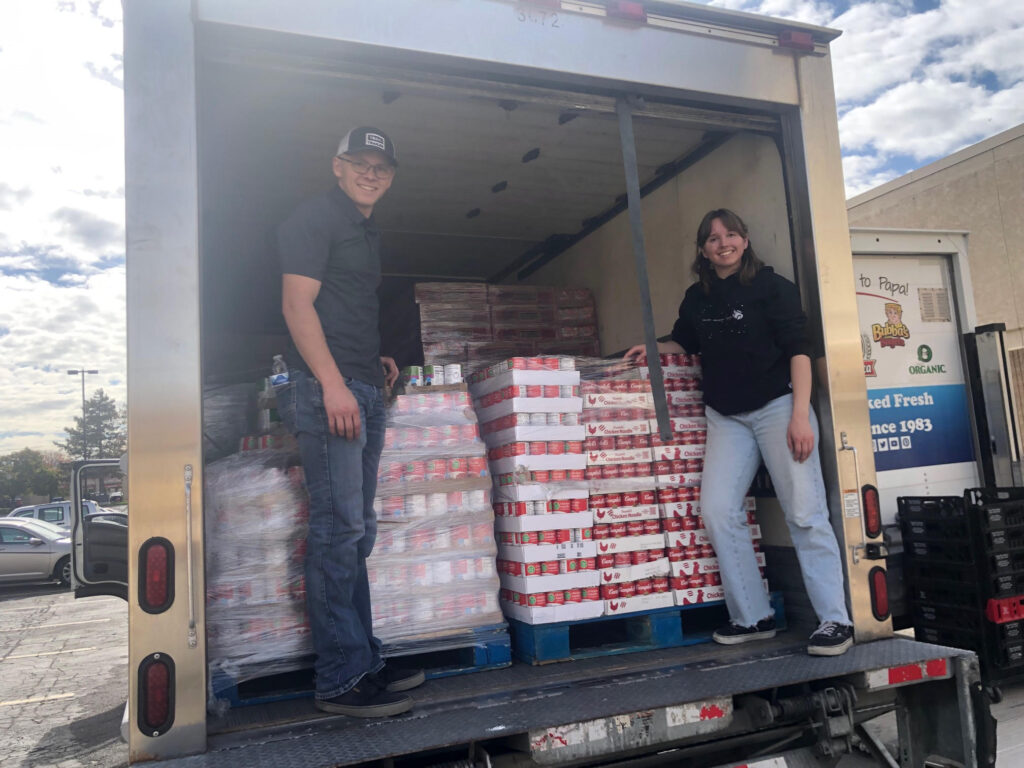

Volunteers pose at the Bountiful Food Pantry. (Courtesy of Bountiful Food Pantry)
As about 87,000 Utah families relying on the Supplemental Nutrition Assistance Program prepare to go without much of their November payments, food pantries in the state are already feeling a bump in users and confusion lingers amid legal battles and conflicting messaging from the White House.
The U.S. Department of Agriculture sent regional SNAP directors a letter Tuesday morning with guidance to make court-mandated partial SNAP payments this month, as the government shutdown went beyond a month.
November payments, according to the letter, will be calculated by reducing the maximum possible SNAP allotment amount to 50% for all households, and then deducting 30% of households’ net income.
SUBSCRIBE: GET THE MORNING HEADLINES DELIVERED TO YOUR INBOX
That’s an “overly complicated” formula, said Gina Cornia, executive director of Utahns Against Hunger. In some cases, it may also leave some recipients with barely any funds while the shutdown is in place, she said.
A table from the Department of Agriculture lists a range of maximum allotments, for people receiving from $149 for a one-person household, to $894 for an eight-people family.
SNAP_November_2025_Benefit_Guidance_Reduction_Tables
A spokesperson at the Utah Department of Workforce Services, which administers the food assistance program in the state, confirmed the office had received federal guidance on issuing partial November SNAP benefits. The department is working through the process and will have more information about what this will mean for users this week.
A defiant Trump vows no SNAP payments until Democrats cave on shutdown
It is also unclear when the payments will be available. While Cornia knows the Department of Workforce Services would like to get them out as soon as possible, the process will likely take at least a week, she estimated. So, despite the court order, people scheduled to get SNAP funds loaded into their cards on Wednesday will still see a delay.
“It’s just disappointing all around that Congress is allowing this to be such a political football,” Cornia said, “and that we are allowing people to go hungry because Congress will not do their job.”
Democrats ask for special session
Advocates are still fighting in court to get the federal government to make full SNAP payments this month. However, two rulings so far have blocked the Trump administration from cutting the program and the White House committed to partially fund the program
Since the committed funding is still partial, the Utah Senate Democratic Caucus urged Gov. Spencer Cox, Senate President Stuart Adams and House Speaker Mike Schultz to call for a special session to use the state’s rainy day funds to support SNAP recipients.
“The timing is imperative for the state to cover the remaining amount to ensure families receive uninterrupted support while efforts continue to resolve the shutdown,” the senators wrote.
Utah uses on average $33 million in federal funding a month to administer SNAP. While state leaders recently committed up to $4 million to support the Utah Food Bank during the government shutdown, there are still challenges to deliver food to those who need it the most, the Democratic senators said.
The districts with the highest SNAP usage are represented by the caucus, in addition to rural areas, the letter says, places where food insecurity and transportation challenges are more severe.
‘Hopeless’: Utahns say shutdown’s pause on food stamp funding carries a steep cost
“Food is not a privilege, it’s a basic human right,” Senate Minority Leader Luz Escamilla, D-Salt Lake City, said in a statement. “Every family deserves the security of knowing they can feed their children. Utah has the means to step in and ensure no one goes hungry while we wait for federal action.”
Despite the plea, a special session is unlikely. In a joint statement, Cox, Adams and Schultz said Congress has the solution to solve this issue and “the state is not structured to bail out Washington.”
“Rainy day funds are intended by law to provide relief during natural disasters and severe economic downturns, not to compensate for dysfunction in Washington, D.C.,” the officials said. “Using state funds to compensate for federal inaction would rapidly drain reserves and undermine Utah’s long-term fiscal stability.”
While reiterating their $4 million commitment to help support local food banks, Cox, Adams and Schultz also criticized the shutdown, saying that “congress is playing politics with people’s livelihoods, putting working families, veterans and essential personnel at risk while leaving critical services unfunded.”
Pantries see increased need
This week the Bountiful Food Pantry has been “bananas busy,” Rebekah Anderson, executive director of the pantry said. On Monday, 75 families received food assistance from the site in a two-hour shift. That’s up from a regular weekday, in which the center provides resources to about 55 households.
With those larger numbers, the pantry had to change how it operates as well.
Usually the pantry works like a mini grocery store, where people can shop for their own food. “Yesterday, though we were feeding so many people, we weren’t able to do that,” Anderson said. “We had to just have volunteers go in and pick out groceries on behalf of people who needed help. So it’s a lot. There’s a lot of people who need help right now.”
The Bountiful pantry is well stocked at the moment thanks to “extremely generous” donations from the community, churches and businesses, Anderson said. But, if the current service levels persist, food is going to start to dwindle in about two weeks.
Many other pantries have been seeing a surge in demand in the last weeks, Cornia said, a fact she thinks may be tied to SNAP recipients preparing to not receive their benefits this month.
“It’s great that the community is responding. But for every meal that is provided by a pantry, SNAP provides nine,” Cornia said. “And so there is just no way that our charitable sector, as hard as they work and as generous as Utahns are, that they will be able to fill that gap.”