
Utah News Dispatch
As uncertainty swirls around Utah’s homeless campus, Democrats propose guardrails

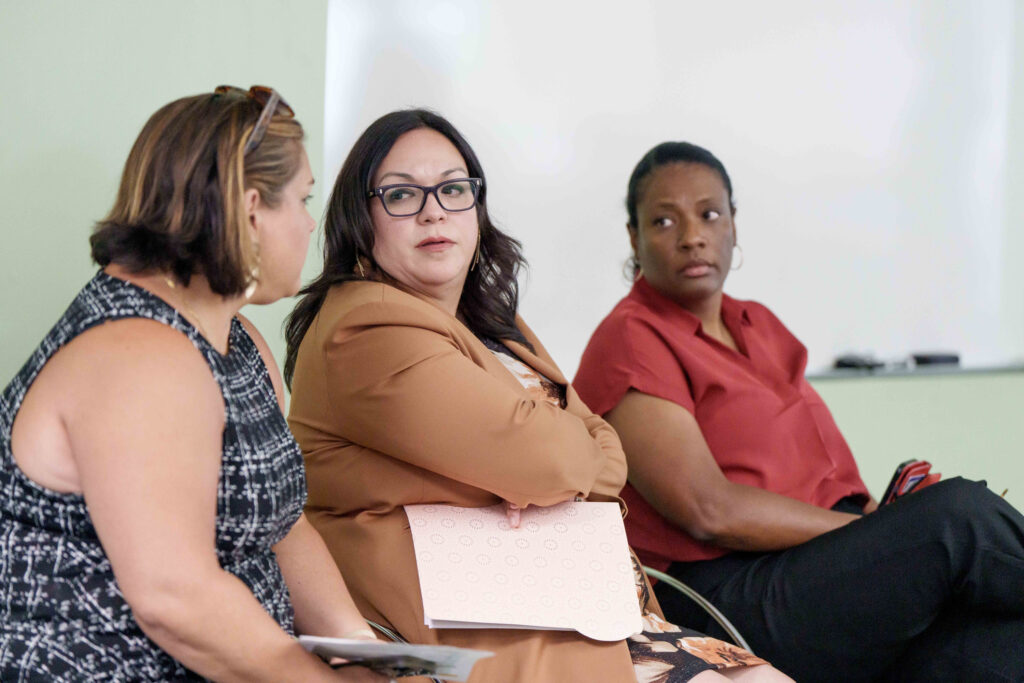

City councilwoman Victoria Petro, State Sen. Luz Escamilla, D-Salt Lake City, and State Rep. Sandra Hollins, D-Salt Lake City, sit together at a meeting with community members at the Day-Riverside Branch library in Salt Lake City on Wednesday, Sept. 3, 2025 to discuss the newly announced site for a homeless services campus. (Photo by Spenser Heaps for Utah News Dispatch)
Two Utah Democratic lawmakers representing Salt Lake City’s west side highlighted three bills they’re running meant to offset impacts of a 1,300-bed homeless campus that’s been proposed in their community.
Senate Minority Leader Luz Escamilla and Rep. Sandra Hollins held a news conference at the Utah Capitol on Wednesday to highlight their bills, while also acknowledging that uncertainty swirls around whether the proposed campus will become a reality since it currently lacks funding.
Still, Escamilla told Utah News Dispatch that she and Hollins are encouraging lawmakers to consider ways to put guardrails around the campus now, even as it’s unclear whether the Republican-controlled Utah Legislature will provide any funding for the campus this year.
“Anything could happen” during the Legislature’s 45-day session, Escamilla said. “So for us, our responsibility is to be responsive to our constituents. … I hope (these bills) will provide a mechanism moving forward to better policy when it comes to this type of facility.”
Utah officials unveil site for 1,300-bed homeless campus after long, secretive search
The bills being sponsored by Hollins and Escamilla include:
- SB239, which would require the state homeless coordinator leading the Utah Office of Homeless Services to create a “comprehensive plan for homeless services campus residents and the surrounding community” for safety, transportation, and the services provided on the campus. Among other provisions, the bill would also allow the state’s homeless services ombudsman to investigate the campus, as well as recommend it “cease operations” in response to complaints, violations or safety concerns.
- SB246, which would change the makeup of the Utah Homeless Services Board by requiring “within one month of the announcement of a campus” that a seat on the board be added for a resident who lives within five miles of the campus or, if it’s located on the west side of Salt Lake City, appointed by the advocacy group West Side Coalition.
- SB279, which would enact an income tax credit for property owners within a one-mile radius of the homeless campus equal to 50% of their property taxes.
Both Escamilla and Hollins have expressed concerns about the proposal to site such a large shelter on about 16 acres of Salt Lake City-owned land located on the northwest border of the city. The west side, they have previously said, already carries a “disproportionate share of the state’s social and environmental burdens.”
“We are not a ‘not in my backyard’ community,” Hollins said. Rather, “our backyard is full.”
They argued if the campus is ultimately built in the city’s west side, someone from the community should have a voice on the Utah Homeless Services Board, which is a powerful body that oversees the state’s homeless system and distributes funding.
Since state officials announced in September that they were under contract to buy a property in northwest Salt Lake City for the campus “we have heard a lot of concerns from our constituents,” Escamilla said. The site is in an agricultural neighborhood out of reach of existing public transit.
At the same time, she acknowledged that there is also a need to expand the state’s homeless system as Utah also faces a growing homeless population.
“We recognize there’s a need for more services,” she said. “We want to make sure resources are being put into those needs, but we don’t think that a 1,300-bed facility is the answer.”
Instead, Escamilla said they’d be more supportive of a smaller facility — and more investment in the current system.
She also pointed to how expensive and difficult it was to build the state’s new prison west of the Salt Lake City International Airport in wetland areas, which cost more than $1 billion for 3,600 beds.
Utah homeless leaders look to focus funding on ‘high utilizers’ while not ‘backing away’ from campus
Building a large facility on a parcel with wetlands, like the one state officials are currently under contract to acquire from Salt Lake City, Escamilla said, “is a very bad deal.”
Previously, state officials have estimated the proposed campus would cost at least $75 million in one-time money to build, plus more than $34 million in ongoing funding to operate. But Escamilla said it will likely cost much more than that — probably “hundreds of millions” of dollars.
Operations, she said, must also be adequately funded so people living on the campus can receive services to help them out of homelessness.
“Because if not, then it’s warehousing people,” she said. “And I think all of us collectively disagree with that type of policy.”
Faced with the likelihood that it will take years of investment before the proposed campus would become a reality, leaders of the Utah Office of Homeless Services have said they are focusing their funding requests from lawmakers this year on “high utilizers” — or programs designed to help people who are arrested multiple times or who repeatedly cycle in and out of shelters. At the same time, though, state leaders have said they’re not “backing away” from the campus.
Escamilla and Hollins’ bills are expected to receive a committee hearing, but they face an uphill battle to win support from the Republican-majority Utah Legislature. Even if they fail this year, though, Escamilla said she wants to start the conversation now, before a campus is built.
During a media availability with reporters earlier Wednesday, Senate President Stuart Adams, R-Layton, did not weigh in on Escamilla and Hollins’ bills, but said they will “go through the committee process.” He and Senate Budget Chair Jerry Stevenson, R-Layton, also did not give any definitive answers on whether the campus will receive any funding this year, citing an ongoing budget process.
Blaming broken promises for Great Salt Lake, lawmaker threatens to block homeless campus
Since 2017, the state has spent “close to a quarter billion dollars” on homeless issues, Stevenson said.
“My guess is we’re going to continue on and try to get it right,” Adams said. “I applaud those that are involved. … I suppose we’ll probably be trying to find the right mix for a long time.”
Adams said whatever lawmakers do, they’ll likely prioritize a “holistic approach.”
“I think you’re going to have to have a partial threat of incarceration, you’re going to have to have maybe some justice reform … and I think you’re going to have to have some funding for treatment … along with housing,” Adams said. “So it’s going to be a holistic approach. Then you’ve got to decide size, whether you want a mega unit or a small unit. And where it’s located, those are still things we’re going to be dealing with.”
Meanwhile, a lack of funding isn’t the only issue standing in the way of the proposed campus. Unresolved land issues are also complicating the effort.
Earlier this week, House Majority Leader Casey Snider, R-Paradise, filed a bill that would block state officials from using state funds to build a homeless shelter larger than 300 beds. He said he filed it out of frustration over unkept promises for land swaps meant to pave the way for the campus but also create a larger buffer zone to protect the Great Salt Lake from encroaching development.
“We love the bill,” Escamilla said of Snider’s HB523, adding that she’s in favor of “capping” the facility’s size to no more than 300 beds.
“We shouldn’t have facilities of 1,300 beds,” she said. “That just ends up warehousing humans, and that’s not the right approach. Those individuals deserve to be treated with respect and integrity as well.”