Utah News Dispatch
Almost half of Utah’s third graders don’t read at grade level, report says

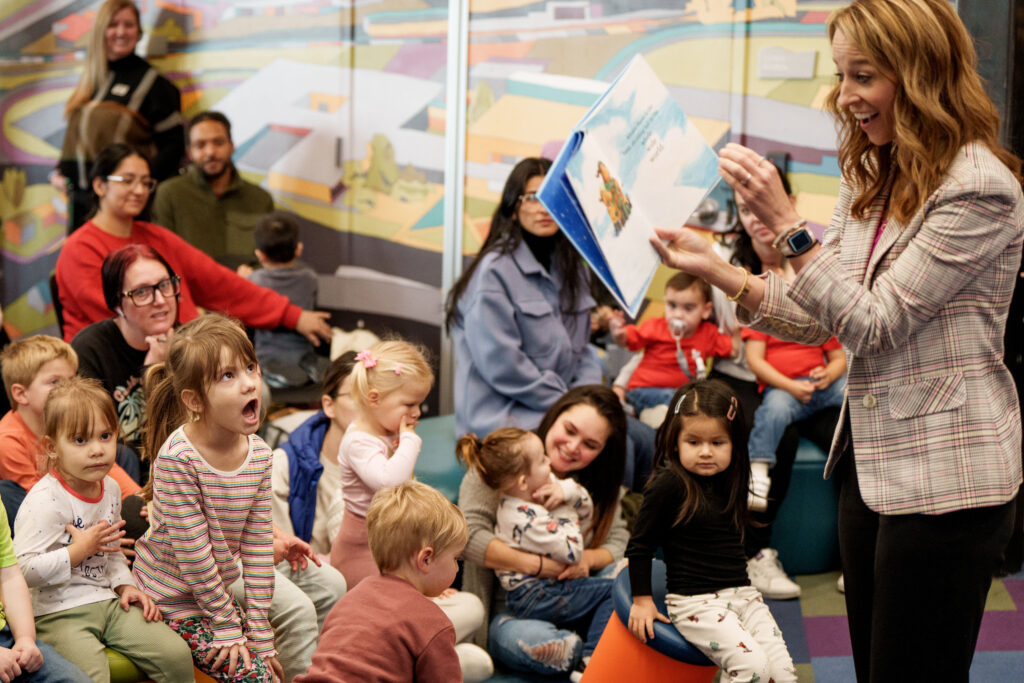

First Lady Abby Cox reads to children gathered for a story hour after she and Gov. Spencer Cox held a press conference to present his budget proposal at the Salt Lake County Library in Kearns on Wednesday, Dec. 3, 2025. (Photo by Spenser Heaps for Utah News Dispatch)
Nearly half of Utah’s K-3 students are reading behind their grade level, even though almost five years ago Utah lawmakers set a goal for 70% third-grade reading proficiency by 2027.
That’s according to a new report released Monday by the University of Utah’s Kem C. Gardner Policy Institute that was commissioned by the Clark and Christine Ivory Foundation.
According to the report,only 50.3% of Utah third graders in 2025 had grade-level proficiency in readying. Earlier grades saw similar rates.
Reading proficiency also varies widely, the report says, from below 30% to above 70%. “Large gaps” exist for English-language learners, students with disabilities, Hispanic and Latino students, and economically disadvantaged students show significantly lower proficiency rates, the report says.
SUBSCRIBE: GET THE MORNING HEADLINES DELIVERED TO YOUR INBOX
Last month, Gov. Spencer Cox and first lady Abby Cox highlighted a need for improved reading and literacy for young learners. Cox made it a centerpiece issue in his budget recommendation, which he announced at the Salt Lake County Library in Kearns.
As part of his budget proposal to the 2026 Utah Legislature, Cox recommended using $80 million for paraeducator grant programs. That includes $60 million for “targeted behavioral interventions in K-3 classrooms” and $20 million for reading support in elementary schools that have not met the statewide proficiency benchmark of 70% of third graders reading at grade level.
During his budget announcement, Cox also urged lawmakers to follow the example of Mississippi, a state that once sat at the bottom of national elementary literacy rankings and now ranks near the top. A policy known as the “Mississippi Miracle” requires third graders to score high enough on a reading test before advancing to fourth grade.

Cox, during his budget recommendation, called on Utah lawmakers to pass a similar law.
“We’ve implemented some of the things that have happened in Mississippi, (but) we need to implement the rest of those things and get everybody pulled together,” the governor said.
The Gardner Institute report included a section on the “impacts of third-grade retention” policies, pointing to states including Mississippi, Indiana and Florida.
“A large body of research has examined these test-based retention policies and show that most retained students experience reading gains, though long-term outcomes are mixed,” the report says. “That said, more recent evaluations occurred in states that provide extensive supports alongside retention, making disentanglement of reading retention and intensive interventions difficult.”
However, “the strongest evidence suggests that the supports students receive when flagged for retention — not retention alone — primarily drive the improvement,” the report said.
By passing SB127 in 2022, Utah lawmakers have set a statewide goal of 70% third-grade reading proficiency by 2027. The bill requires the State Board of Education to administer programs to improve early literacy in K-3 kids, which came with an estimated price tage of more than $9.1 million in ongoing funding and $9.4 million in one-time money to hire staff and provide training, according to its fiscal note.

“State and district implementation of SB127 continues in phases, reflecting the time required for the state board of education, schools, districts, and preparation programs to adopt new materials, strengthen training, and build capacity,” the Gardner Institute report says. “Research shows that the impact of early literacy reforms depends not only on policy design but also on consistent, high-quality implementation, underscoring the importance of continued attention to fidelity, monitoring, and support.”
Cox, however, also said “70% is too low of a goal.”
“It should be 100%. We know we can get there,” he said. “We’re seeing it in places like Mississippi.”
The report’s author, Andrea Thomas Brandley, senior education analyst at the Gardner Institute, wrote in the report that research shows strong early literacy skills help “build the foundation needed for lifelong learning.”
“Early childhood literacy is not just an academic benchmark; it is the cornerstone of a child’s future success,” Thomas Brandley said in a prepared statement. “The ability to read proficiently by third grade profoundly impacts a student’s entire educational journey, their economic opportunities, and their capacity to engage fully in civic life.”
The governor, first lady Abby Cox and Lt. Gov. Deidre Henderson are scheduled to hold a Literacy and Reading Symposium on Tuesday in Ogden, aimed at discussing “practical ways to strengthen literacy and get more kids and adults reading,” according to the governor’s office.
Last month, Abby Cox said social media has created a “big hole” in kids’ and adults’ lives that needs to be filled with books.
“It’s not unconnected to social media,” Abby Cox said. “The issues that we’re having with literacy is a direct result of us not reading and children not having access to books and not being read to.”