
Utah News Dispatch
After veto, Cox is one step closer to being able to appoint chief justice


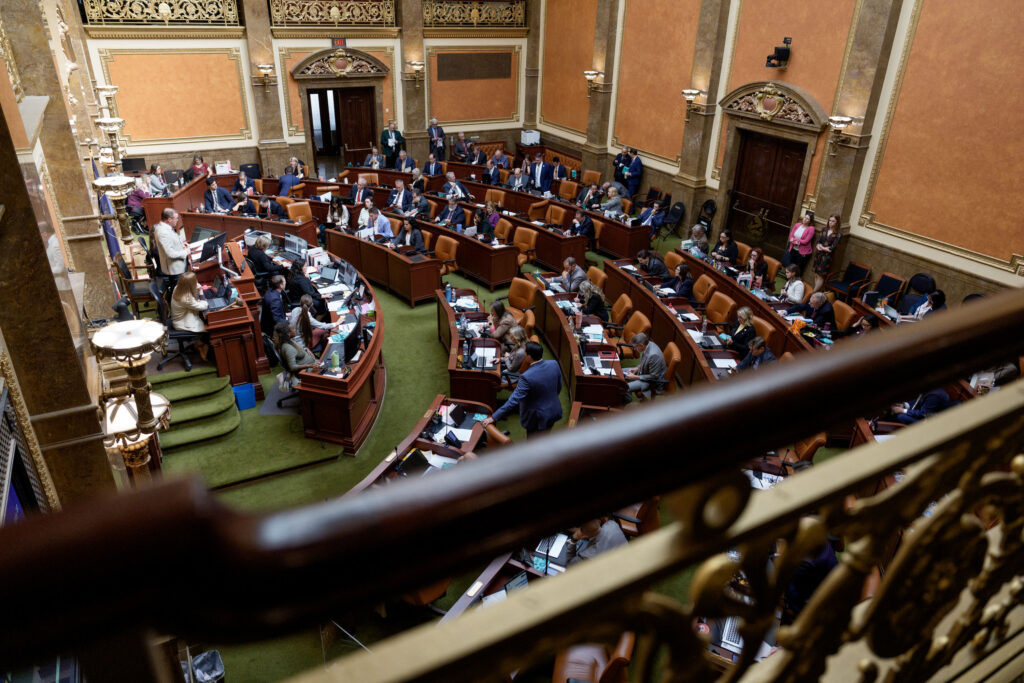


Legislators in the House Chamber meet during a special legislative session at the Capitol in Salt Lake City on Monday, Oct. 6, 2025. (Photo by Spenser Heaps for Utah News Dispatch)
After an initial veto of a bill that would have allowed Gov. Spencer Cox to appoint the chief justice of the Utah Supreme Court, the Legislature voted to approve a compromise during a special session Monday.
If Cox signs the bill, the governor will have the power to appoint the chief justice, but this time, instead of going through the selection process every four years, the role will be subject to a single, eight-year term.
The Senate voted 22-7 to pass the bill, with all Democrats and Sen. Daniel Thatcher of the Utah Forward Party voting against. The House also approved it with a 58-15 margin with all Democrats and Kearns Republican Rep. Anthony Loubet voting nay. The proposal now heads to Cox’s desk for his signature.
SUBSCRIBE: GET THE MORNING HEADLINES DELIVERED TO YOUR INBOX
“The governor has agreed to a compromise, which extends by four years the term that the chief justice can serve,” House Majority Leader Rep. Casey Snider, R-Paradise, said on the House floor.
The appointment would mirror the process used by the U.S. Supreme Court, with the executive nominating the chief justice and the Senate confirming, Snider said.
Like during the general session, Sandy Democratic Rep. Andrew Stoddard unsuccessfully attempted to make the Supreme Court justices elect the Senate president and speaker of the House.

“To use a phrase that I repeatedly tell my kids, just because we can, does not mean that we should,” Stoddard said. “So this keeps that balance going and gets the power back to both branches.”
Ultimately, Stoddard said, his opposition to the bill was about having “a truly independent judiciary.”
“These justices are already confirmed by the Legislature. The Senate gets to give input on them, appointed by the governor. They’ve already gone through this process,” Stoddard said. “I think by requiring another layer to pick the chief justice, we’re just submitting them to more political pressure.”
The original proposal was part of a judicial reform series of bills Republican legislators sponsored during this year’s general session after publicly disagreeing with two major rulings from the high court — an opinion favoring plaintiffs in an anti-gerrymanding lawsuit challenging the Legislature’s 2021 redistricting process, and a ruling upholding a district court decision to block a nearly-total ban of abortions in the state while it is adjudicated.
Lawmakers argued the changes weren’t in retaliation for the decisions, but were efforts to make the judicial system more transparent and responsive to the people.
Cox vetoes bill that would have given governor power over appointing Utah chief justice
After weeks of contention, Legislative leaders and the judiciary reached an agreement, killing most of the proposed bills, but keeping the bill changing the chief justice’s selection.
In his veto letter, Cox said no one from the judicial branch had asked for the veto, and while the prospect of having more power over the Utah Supreme Court was tempting, he remained skeptical on the reappointment process, which he described as “a very meaningful and problematic additional step.”
“The Bar reaffirms its commitment to the rule of law and to an independent, impartial judiciary as essential to public trust in our system of justice,” the Utah State Bar said in a statement after the
Monday votes. “Each branch of government has distinct constitutional responsibilities, and the judiciary must remain free to exercise its duties without undue influence or political pressure.”
Lawmakers also approved other bills during the special session, making technical changes to streamline code, and tackling issues like berm management of the Great Salt Lake amid its alarming low levels; and modifications to election records law.

The election records amendment bill sponsored by Rep. Norman Thurston, R-Provo, defines election records that may not be destroyed for at least 22 months in case of questions or contests to results. It also increases transparency, Thurston said.
Now, election officials will be required to post a cast vote record report detailing how the tabulating equipment tallies every vote.
“Think of a gigantic spreadsheet where every row is a ballot, and then it just has some sort of a non-traceable serial number was counted for X person, Y person,” Thurston explained. With that document, anyone can add up ballots and make their own audits, he added.
The bill also will limit access to video records from cameras near drop boxes to people with a legitimate need to watch them.