
Utah News Dispatch
A Utah monument that transcends geopolitical boundaries


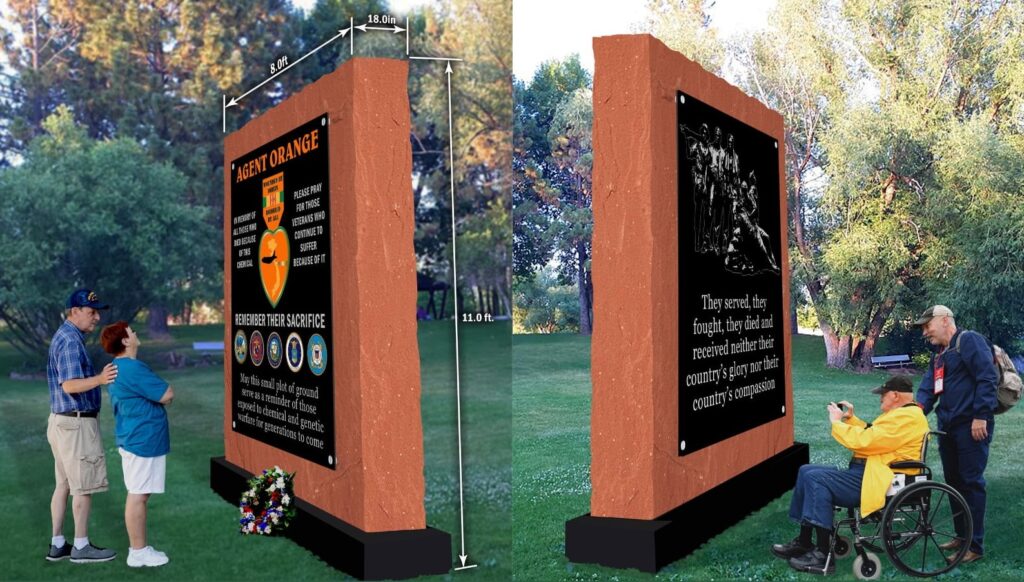


A rendering depicts the proposed memorial honoring Vietnam veterans who died or were affected by exposure to Agent Orange. (Courtesy of the Utah Agent Orange Veterans Foundation)
When Vietnam veteran Larry Kerr founded the Utah Agent Orange Veterans Foundation (UAOVF) in Davis County nearly two years ago, he probably didn’t envision building a memorial that would resonate with people well beyond the borders of the Beehive State.
Although that monument, the Agent Orange Memorial, has not yet been dedicated, it has already generated national attention. Pennsylvania resident and Vietnam veteran Patrick Hogan, for example, has donated copies of his book “Silent Spring: Deadly Autumn of the Vietnam War” to the UAOVF to help the foundation raise funds for the construction of their memorial.
Additionally, Hannah Turk, UAOVF vice president of fundraising, recently mentioned to me that some of the messages she has been receiving are from other states. She exclaimed that “our SEO (search engine optimization) on our site is growing! I’ve been receiving messages from all over the country of people supporting our cause!”
It’s little wonder that the Agent Orange Memorial is relatable to so many people in so many different places. After all, a large number of veterans served in Vietnam and other countries where Agent Orange was used. Not to mention the use of other toxic herbicides that veterans were exposed to during the war.
Those herbicides included Agent White, Agent Blue, Agent Purple, Agent Green, and Agent Pink. While these chemicals were used to a lesser extent than Agent Orange, they still caused major health issues for unsuspecting victims who were not aware of how harmful exposure would prove to be.
Not only have the health issues associated with exposure to Agent Orange affected veterans, they have also had an impact on spouses and children of Vietnam veterans. Due to the high death toll, spouses have lost partners and due to generational transmission, some children have been born with serious health issues.
Calculating an accurate figure of veterans who have died from their exposure to Agent Orange is no easy task. One reason is because Agent Orange is not listed as a cause of death. Instead, a health issue caused by exposure to Agent Orange, like some form of cancer, is noted on a death certificate.
Larry Kerr, chairman of the UAOVF, estimates that some 750,000 Vietnam veterans have died thus far from their exposure to Agent Orange. That number is more than 10 times the number of military personnel who were killed in Vietnam and whose names are listed on the Vietnam Veterans Memorial in Washington, D.C.
Support for an Agent Orange memorial in the Beehive State mirrors the keen interest around the country. A group of veterans in Utah County from Chapter LXX (70) of the Special Forces Association, for instance, recently made a substantial contribution to the UAOVF to help fund the memorial’s construction.
If things go as planned, the UAOVF will have their memorial in Layton Commons Park by Veterans Day, Nov. 11, 2025. It will be dedicated on that special occasion and serve as a tribute to veterans who have died from their exposure to Agent Orange. It will also help educate future generations about the tragic cost of using toxic chemicals during the Vietnam War.
As others around the country celebrate Veterans Day, there is little doubt that some of them will also be celebrating the dedication of a memorial in Layton that honors Vietnam veterans. This is because that memorial symbolizes something so profound that it simply transcends geographic boundaries.