Utah News Dispatch
A ‘down’ budget forecast: Utah faces negative revenue estimates, but Republicans still eye tax cuts

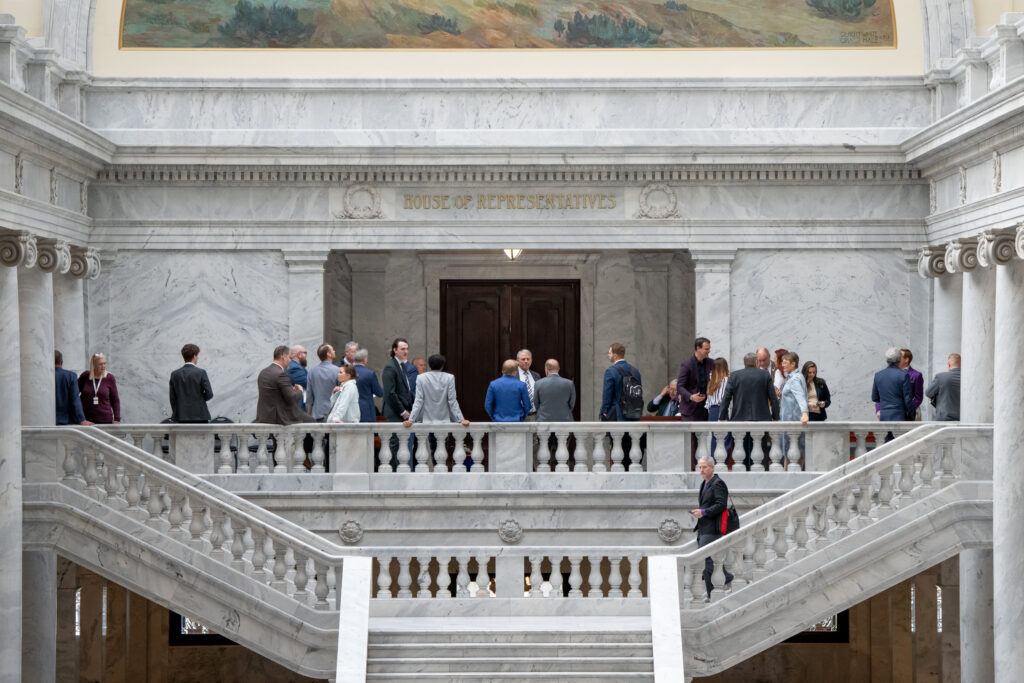

People gather outside the House chamber at the Capitol in Salt Lake City on Thursday, Feb. 6, 2025. (Photo by Spenser Heaps for Utah News Dispatch)
Utah lawmakers will have even less money to spend during the remainder of their 2025 legislative session than they’d originally projected, leaving no additional money left to be spent on new priorities.
And yet Republican legislative leaders are still eager to cut taxes in some way for a fifth year in a row — though it still remains to be seen whether they’ll reduce the state’s income tax rate again or listen to the governor’s recommendation to get rid of the state’s tax on Social Security benefits.
Compared to projections from last fall, the Utah Legislature now has $74 million less in one-time money and $38 million less in ongoing money available from general and income tax revenues, according to consensus revenue estimates released by the Legislature and the governor’s office on Wednesday.
That means about $112 million in additional revenue growth Utah lawmakers had hoped would materialize now will not. The silver lining? Back in December, the powerful budgeting body called the Executive Appropriations Committee already set aside exactly that amount as “high risk” revenue that may not come to fruition. Legislative analysts’ estimates, as it turns out, were spot on, according to state officials.
Utah Legislature poised to cut taxes for 5th year in a row — but how?
When announcing those new revenue estimates on the Senate floor Wednesday, Senate Budget Chairman Jerry Stevenson, R-Layton — one of the top legislative leaders to field budget requests — acknowledged that the new budget forecast was bad news for lawmakers, lobbyists and others hoping for money to fund their budget requests.
It’s “definitely a down” projection, Stevenson said. He added it’s “been a long time” since the state last saw negatives in updated revenue estimates.
After several years of higher-than-expected revenue growth due to a booming economy amid federal stimulus meant to ward off impacts from the COVID-19 pandemic, Utah’s economy has gone from “boom to balance,” as state fiscal analysts have put it.
Last year, the state saw “fairly flat” revenue growth, and at the time Stevenson characterized it as a “socks and underwear” type of year for budget requests. This year, Stevenson sought to set even lower expectations, joking that perhaps legislators should be prepared to “launder” their socks and underwear rather than expect any new pairs.
“I’m not sure we’ll be able to afford the soap, senator,” Senate President Stuart Adams, R-Layton, quipped from the Senate dais.
“I have soap in my office if anyone is in need,” Stevenson joked back.
‘Dampen expectations’ — but tax cuts are still on the table
A little over two weeks remain for the 2025 Utah Legislature to put finishing touches on its budget and decide the fate of new funding requests. But Stevenson told reporters in a media availability Wednesday that it’s likely many bills that need new money will likely “crash for lack of funding.”
“We’re all going to have to dampen our expectations,” Stevenson told Utah News Dispatch.
Last month, lawmakers set the vast majority of the state’s roughly $30 billion budget when they approved a slate of “base budget” bills that funded existing operations and some priorities the Executive Appropriations Committee already decided to pay for. That included inflationary increases to Medicaid and education spending and $145 million deposited into the state’s “rainy day” fund.
Heading into the 2025 legislative session, revenue estimates were already disappointing, starting lawmakers out with a deficit that they needed to plug. But during its December meeting, in addition to setting base budgets, the Executive Appropriations Committee also set aside about $447 million for future consideration during the 2025 session.

That included $165 million in ongoing money and $66 million in one-time money for some type of a tax cut; about $104 million in ongoing money for state employee pay raises, and $112 million in “high risk” revenue. As lawmakers learned Wednesday, that $112 million did not materialize.
That leaves about $335 million left for Utah lawmakers to consider — but based on the Executive Appropriations Committee’s earlier decision, it’s already been earmarked for tax cuts and employee pay raises.
Pressed on whether the lower-than-expected revenue estimates should push lawmakers to maybe reconsider cutting tax cuts, Senate Republican leaders told reporters they won’t be deterred, because even though the estimates were lower than expected, the state is still projected to see 3.5% in revenue growth from 2025 to 2026.
“We’re not faced with a tragedy here,” Stevenson said.
“You could look at this glass as half empty, meaning that our numbers are a little lower in February than they were in December,” Adams said. “Or you could look at it as way full, because we have 3% to 4% growth. So I mean, that’s $300-$400 million … of growth in extra money that we didn’t have last year. You have to put it into perspective.”
Asked whether lawmakers could consider using that money that’s been set aside for tax cuts for something else, Stevenson said “I guess that’s possible,” but it’s something lawmakers would need to debate over the next two weeks.
“We’re still looking at a tax cut,” Adams said, adding that a variety of proposals — including cutting the state’s income tax rate and getting rid of the state’s tax on Social Security benefits (as the governor wants) — are all still on the table, though he didn’t say which one Senate Republican leaders would prefer.
“We’ll be evaluating what the needs are. Tax cuts are still on the table, but they’re maybe a little hard to do right now,” Adams said. He added that tax cuts will remain “on the table until we say they’re not.”
In prepared statements issued alongside the new revenue projections, Utah Gov. Spencer Cox, House Speaker Mike Schultz, R-Hooper, and Adams took positive tones, highlighting in a news release that even though revenue forecasts are down from October estimates, “economic growth remains positive.”
“Utah is consistently recognized as one of the best-managed states in the nation, and that’s no accident,” Cox said. “We work hard to ensure every dollar of state funds is spent wisely and reflects the values and priorities of Utahns. We’ll continue to build a state that serves its people and stands as a beacon of economic prosperity for the nation.”
Schultz, in a prepared statement, said lawmakers are “committed to continuing our longstanding tradition of responsible fiscal management. Our priorities remain clear: keeping Utah affordable, maintaining essential services and ensuring long-term prosperity for generations to come.”
The money Utah is leaving behind by cutting taxes
Over the past four years, the Utah Legislature has cut taxes by more than $1.2 billion, most of which has been to drop Utah’s income tax rate down to 4.55%. This year, Utah lawmakers may add to that total by $165 million — maybe more, maybe less — depending on what tax proposals survive the Legislature.
Republican legislative leaders have argued they want to keep the state affordable for Utahns while also increasing investment in areas including water, education and energy — but critics argue income tax rate cuts largely benefit the wealthy and the cuts are eating into Utah’s ability to fund other needed priorities.
“At a time when many families struggle to afford basics like groceries and childcare, it makes little sense to cut taxes for the wealthiest among us,” Jenna Williams, a policy analyst for the advocacy group Voices for Utah Children, wrote in a Jan. 30 post making the case against more tax cuts. “Another year of income tax cuts will simply continue Utah’s trend of lowest per-pupil education spending, higher education cuts, and insufficient support for essential social services.”
Democrats have also argued against cutting taxes in favor of spending the money on other priorities.

“I don’t think it’s wise that we keep cutting taxes,” House Minority Leader Angela Romero, D-Salt Lake City, told Utah News Dispatch, adding that it’s eating into the Legislature’s revenues.
In December, the Utah Legislature’s chief economist, Andrea Wilko, warned that fiscal analysts have “seen softening, a little bit” of income tax dollars in recent revenue forecasts, encouraging lawmakers to set aside “high risk” revenue they may not be able to count on.
In a long-term budget report given to lawmakers at the time, fiscal analysts said after the COVID-19 pandemic “had quite sudden and significant impacts” on state revenues, the state is now shifting “back towards” a trend of “nearly flat” revenue growth.
“This recent flat trajectory is also reflective of successive reductions to the income tax rate,” the budget report said.
While the report said the state budget is largely “at the mercy of the broader economy,” it also listed several key “demographic, economic and policy-related” factors influencing the state budget’s five-year trajectory, including “the absence of federal stimulus, modest total population growth, age demographics shifts, personal income normalization, income tax rate reductions,” expiration of federal tax cuts, and inflation.
YOU MAKE OUR WORK POSSIBLE.