Utah News Dispatch
Election night results: Cox wins another term as Utah governor

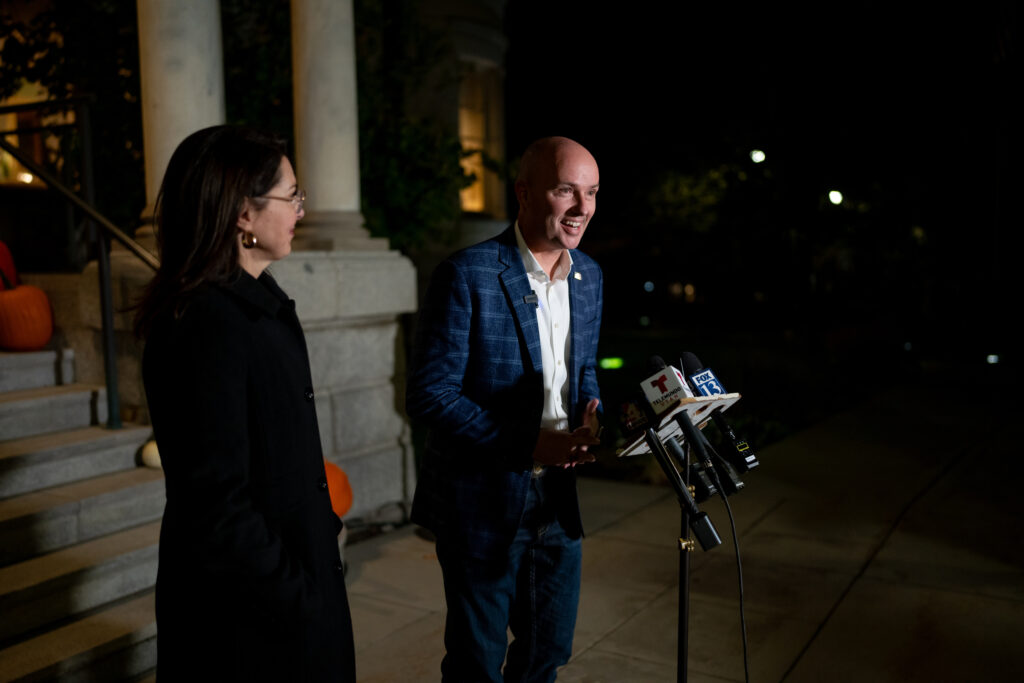

Gov. Spencer Cox and Lt. Gov. Deidre Henderson talk to reporters at the Governor’s Mansion in Salt Lake City on election night, Tuesday, Nov. 5, 2024. (Photo by Spenser Heaps for Utah News Dispatch)
This ongoing report of Utah election results was updated at 12:16 a.m.
After they were delayed more than two hours after polls closed due to long voting lines, unofficial election night results showed Utah Gov. Spencer Cox had a commanding lead over his opponents on Tuesday, positioning him to continue on as Utah’s governor for the next four years.
As expected in a red state that hasn’t elected a Democratic governor since 1980, Cox led with 56.47% of the vote to Democrat Rep. Brian King’s 31%. Libertarian Robert Latham had 2.53%, Independent American Tommy Williams had 1.78%, and unaffiliated candidate Tom Tomeny had 0.37%. Write-in candidate Rep. Phil Lyman — Cox’s Republican challenger who refused to concede after he lost the primary — got 7.82%.
The Associated Press called the race for Cox shortly after the results were released.
Election results aren’t final, however, until the statewide canvass on Nov. 25. Results will be updated in coming days as county clerks count remaining ballots and more votes are tallied. Races leading on election night aren’t likely to flip unless margins are thin.
‘Great night’ for Cox
Cox privately watched election night results while hosting a friends-and-family-only party at the Governor’s Mansion in downtown Salt Lake City late Tuesday night. Reporters were not allowed inside the mansion, guarded by a black iron-wrought gate, until about 8:30 p.m., when media members were sequestered in a small room near the entryway.
When results were posted at about 10:15 p.m., Cox’s partygoers could be heard cheering from the upper floors of the mansion. The governor didn’t address reporters until about 10:45 p.m., when he held a news conference in the frigid cold on the front steps of the mansion.

“Now, this is a great night for us, and obviously lots of people are celebrating. (But) there’s people who aren’t celebrating tonight, who didn’t have as good a night, and I want to thank them as well,” Cox said, pledging to also listen to King’s and Lyman’s supporters in his next term as governor.
“Our promise, as it has always been, is we will work harder than everyone else and we will represent you, we will learn from you,” Cox said. “We have learned so much listening to the people who disagree with us, who didn’t vote for us over the past several months, and we’re better leaders because of that. We look forward to continuing that dialogue.”
King — from an election night party with some fellow Democrats at the Hotel Monaco in Salt Lake City — was quick to call Cox to congratulate him on his win.
“I wish them, him and Lt. Gov. Henderson, all the success that they’re going to need in caring for our state in the future, and we will be there to help them over the next four years,” King said.
Just before the state released its first batch of election night results, the Democrats’ party was booming with loud, upbeat music. But some anxious faces watched a screen with national news anchors discussing former President Donald Trump’s lead in the race for the White House.
King, despite Republican victories in Utah and across the country, still celebrated the hard work of Democrats.
“Hope is running high,” King said. “Look, we’re going to have some wins and we’re going to have some losses. We’re going to have some wins in the Legislature. We’re going to have some wins in important county races. I’d love to see wins in some of our statewide races. (But) those are tougher.”
King said his campaign gave Democrats a voice in Utah, particularly on issues including income gaps between men and women, inaccessibility to health care, housing affordability and bad air quality in the state.

“(Utahns are) not interested in culture wars. They’re not interested in ideological purity tests or political purity tests,” he said. “They’re interested in elected officials who will address their needs on a day-to-day basis.”
Lyman’s campaign account on X, which for months has been posting incessant attacks against Cox, was silent on the governor’s win as of 11:30 p.m.
Cox, in a statement posted on X two hours before polls closed, thanked his most high-profile opponents, King and Lyman, for their “willingness to run.”
“Running for office is hard and I’m grateful to everyone who is willing to run in any capacity. Utah is a special place and I admire the passion of every candidate and voter who works to make it better,” Cox said.
As long lines delay results, AP calls Utah for Trump, predicts Curtis will win in Senate
With all eyes on the presidential race, the governor also urged Utahns to “remember that our country is bigger and stronger than any one person. No matter what happens tonight, the United States will continue to be the greatest nation in the history of the world.”
How will Cox work with the next president?
With Trump leading Vice President Kamala Harris in the tight presidential race, Cox said regardless of who takes the White House, “Utah will be successful.”
“We have a track record showing that we were incredibly successful during a Trump administration, and we were incredibly successful during a Biden administration,” Cox said.
Even though Cox has been outspoken about his misgivings about Trump — only deciding to change his mind to vote for him after the former president’s first assassination attempt — the governor said if he wins, “we will have a very positive working relationship.”
Cox acknowledged he and Trump have a different “style,” but Trump’s “seems to work.”
“We’ll see what the final results come to be, but my hope is to be able to work with him and our party across the country to help bring our tone to the rest of the country,” Cox said. “I believe that one of the reasons we’re so successful is because of the way that we treat each other, and I believe we can be more successful if we’re able to work together with people who disagree with us.”
A bitter election
The outcome of Utah’s gubernatorial race isn’t unexpected after Cox emerged the victor from a bitter primary in June that divided the Utah GOP. In that election, Cox beat Lyman by nearly 9 percentage points or 37,525 votes. Lyman, however, refused to accept those primary results, and he continued his bid as an unaffiliated write-in candidate.
While Lyman’s write-in bid was a long shot, his scorched-earth campaign did continue to resonate with his most ardent supporters, and he captured over 7% of the general election vote. That hands Lyman one of the most successful write-in campaigns Utah has ever seen. Typically, write-in candidates only garner a fraction of a percentage of the vote.
Still, Cox and his running mate Lt. Gov. Deidre Henderson are on track to win a second term after first being elected to the Governor’s Office in 2020. When campaigning for their first term, Cox pledged to run for no more than two terms — so if he keeps that promise, Cox will remain governor no later than the close of 2028.
Hailing from the rural community of Fairview where his family owns an alfalfa farm, Cox has worked as an attorney and served as a city councilman, a mayor, a county commissioner, and a legislator in the Utah House before former Gov. Gary Herbert appointed him as his lieutenant governor.
Cox and Henderson focused their campaign on their administration’s accomplishments, parading their support for more than $1 billion in tax cuts from the Utah Legislature over the last four years, increased teacher pay, support for a new “school choice” voucher program, efforts to protect kids from social media harms, and legislation aimed at increasing supply of affordable starter homes.
The Cox campaign, however, fielded attacks from multiple angles this election cycle.
King, who has served in the Utah House for 16 years, campaigned on Democratic policies while accusing Cox of being “unwilling to stand up for what’s right, preferring instead to rubber-stamp the culture war agenda coming out of the Legislature.” King also spoofed Cox’s own “Disagree Better” campaign in a joint ad alongside Lyman, saying that while they disagree on many policies, both agreed “Spencer Cox should not be our next governor.”
Compared to King, though, Lyman waged a more attack-heavy campaign against Cox, accusing him of not being a true conservative while also pulling from the Trump playbook, alleging “corruption” and attempting to cast doubt on Utah’s elections. He catered especially to Republicans who favor the caucus-convention system and have long detested the passage of SB54, a 2014 law that allows the dual path to the primary ballot via signature gathering and not just through a convention nomination.
Lyman repeatedly but unsuccessfully attempted to challenge Cox’s signature gathering qualification, losing records requests seeking voter records that are classified as private under Utah law, and even going as far as attempting to contest the election in court. The Utah Supreme Court in August tossed his demand to annul the results, rejecting Lyman’s assertion that a political party’s internal nomination should trump state election law.
As a last-ditch effort, Lyman also filed an appeal to the U.S. Supreme Court to toss out the primary election results and make himself the Republican Party nominee. The court, which accepts 100 to 150 of the more than 7,000 cases it is asked to review each year, did not take up the case before Election Day.
One of the biggest moments during this year’s election came in July, when Cox flipped his stance on Trump after the former president’s assassination attempt and pledged to vote for him after previously not voting for a major presidential candidate since 2012, when Sen. Mitt Romney ran for the office.
That move prompted outcry from Democrats in Utah. King accused Cox of caving to “outside pressure, special interests, donors and extremists.” Cox defended his endorsement of Trump, telling The Atlantic he was left with a “sick-feeling pit in my stomach” after the assassination attempt. Cox also wrote a letter to Trump, in which he quoted religious scripture and urged the former president to “turn down the temperature and find ways to come together again before it’s too late.”
Cox’s win — especially his primary victory over Lyman, who employed a populist campaign that in several ways mirrored Trump — shows that many Utahns continue to balk at MAGA-style politics. However, the election showcased the fact that the Utah GOP continues to face deepening divides as Trump’s influence permeates national and local politics.
Cox’s challenge as he heads into his second term will be healing those divides. But it’s possible Lyman’s campaign has done lasting damage and Cox may never regain some of Lyman’s most ardent supporters.
Throughout Lyman’s write-in campaign, some pundits wondered whether his bid would actually give King the edge he’d need to pull off an unexpected upset, but in the end Lyman’s campaign only fractured some of the vote.
Cox, when asked how he planned to build bridges with other voters even within his own party after such a bitter election, told reporters “elections are always contentious” and what he went through is nothing new.
“I think the way we do that is to listen and be responsive,” he said. “The people have spoken. They like what we’ve accomplished over the past four years, and we have more to do. I think by solving those problems — working together, working collaboratively with those who disagree with us — will certainly help to mend some of those fences.”
Contributing: Alixel Cabrera
YOU MAKE OUR WORK POSSIBLE.