
Utah News Dispatch
Utah Senate president calls on Kevin O’Leary to scale back data center by 75%

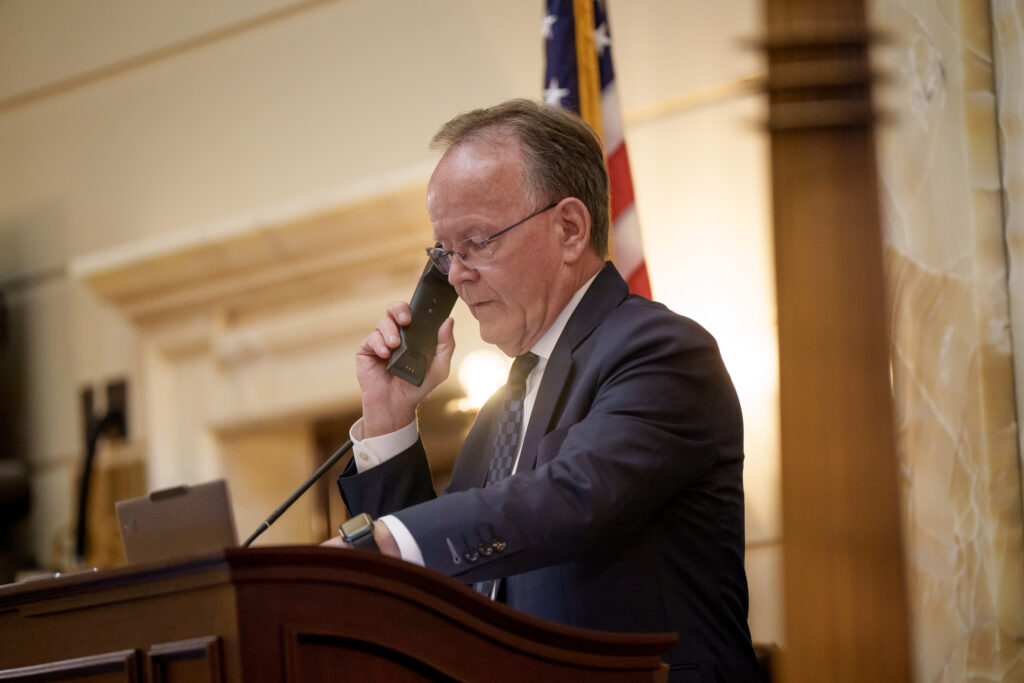

Senate President Stuart Adams, R-Layton, oversees work in the Senate Chamber at the Capitol in Salt Lake City on the final night of the legislative session, Friday, March 6, 2026. (Photo by Spenser Heaps for Utah News Dispatch)
Amid ongoing outcry over a massive, 40,000-acre data center campus being planned in northern Utah, Utah Senate President Stuart Adams announced that he’s calling for the project to be scaled back dramatically.
“I’ve sent a letter directly to Kevin O’Leary calling for a 75% reduction in the proposed data center project area, from 40,000 acres to approximately 10,000 acres,” Adams said in a prepared statement issued Monday. “I am also requiring that any excess water be treated and dedicated to the Great Salt Lake, even though none of the water currently used in that area flows to the lake.”
Adams — who is running for reelection against two Republican challengers in the upcoming June 23 primary — is a longtime board member of the Military Installation Development Authority, known as MIDA, which is a powerful special district that’s overseeing the project’s development in Box Elder County and has given it an initial nod.
New website sheds light on MIDA amid data center controversy. Here’s what it shows
The proposed data center — being pushed by celebrity investor O’Leary — prompted intense public backlash after its plans began moving forward last month, at first with little public awareness. Since then, outcry over its scale, energy consumption, emissions and potential water use has grown to one of the biggest controversies Utah has ever seen.
In response to Adams’ letter, O’Leary told The Salt Lake Tribune on Monday he’s “not walking away” from the data center plans, but he called Adams’ demand to reduce its footprint by 75% “outrageous.” He likened it to selling someone a house and then telling them they can live in the upstairs toilet, the outlet reported.
“I made that deal with Adams,” O’Leary told the Tribune. “We looked each other in the eye. It means a lot to me.”
Adams also said Monday that he’s “demanding greater transparency, stronger conservation commitments and enhanced protections for Utah’s natural resources as this project moves through the review process.”
“Utah can pursue economic opportunity while protecting our water, air, wildlife and communities,” he said. “We can and must do both.”
The letter addressed to O’Leary, included in Adams’ news release, called on the “Shark Tank” reality TV star’s development team to “adequately and transparently meet the following conditions and incorporate them into the final agreements prior to their execution:”
5 things to know about MIDA as it works to usher in a massive data center
- 75% reduction in project area footprint: Materially reduce the overall project area by at least 75% to limit impacts on the region and broader environment. This would decrease the proposed project area from 40,000 acres to approximately 10,000 acres.
- Water stewardship and Great Salt Lake commitment: Commit to implementing the latest available technology that minimizes water consumption and to using only the water reasonably necessary for its operations. Any excess water must be treated and dedicated to the Great Salt Lake at the developer’s expense, even though none of the water currently used in that area flows into the Great Salt Lake.
- Land conservation: Enter into a Memorandum of Understanding with the Utah Department of Natural Resources outlining the conservation of the land within the reduced project area to ensure that wildlife and agricultural uses are preserved and protected.
- Heat capture and environmental impact mitigation: Incorporate heat-capture technologies and provide independent scientific and engineering analyses for the project.
- Provide additional transparency and public engagement in the process: Cooperate with state agencies to create a transparent, public-facing website with all information associated with the additional or future approvals, including water and air quality permits.
- Environmental Performance Standards: Work with the relevant state and federal agencies to ensure that the project area utilizes the best available technologies and meets or exceeds all environmental performance requirements. The project area must demonstrate industry-leading environmental stewardship and protection.
Adams’ letter to O’Leary comes after Gov. Spencer Cox issued an executive order last week directing state agencies making decisions about data centers to prioritize the health of the Great Salt Lake and safeguards to Utah’s air and water quality.
Environmental advocates, however, worried the order didn’t have enough teeth to stop projects — and it doesn’t apply to MIDA, an independent state entity, but rather agencies under Cox’s administration. But Cox’s order does require state agencies like the Department of Environmental Quality to “communicate and coordinate frequently” with MIDA.
Cox orders ‘higher bar’ for data centers, says public input ‘absolutely matters’
Box Elder County — where a three-person commission gave consent for the data center project area to be created by MIDA after a raucous public meeting, where many urged county commissioners to vote no — issued a statement Monday in response to Adams’ call for the project to be scaled back.
“It is important to clarify that Box Elder County has not approved, permitted, or authorized the construction of a data center,” county officials said. “Because the Stratos Project is being overseen by MIDA and a private developer, any questions relating to formal changes to the proposed project area, project conditions, environmental requirements, or public engagement process would need to be directed to MIDA or the Developer.”
County officials also noted that “as the project continues forward, it will be required to move through state, legal, regulatory, and public processes” under Utah law.
“Box Elder County supports transparent public engagement and will continue to share updates as information becomes available,” county officials said, pointing to the county’s website for future updates.
In Monday’s news release, Adams’ office noted that “Utah has already taken significant steps to strengthen oversight of large-scale development projects, including increasing transparency regarding data center water use, investing more than $1 billion in water conservation and infrastructure and ensuring that energy infrastructure costs are paid by project developers, not Utah ratepayers.”
“In addition, multiple legislative interim committees, including the Natural Resources, Agriculture and Environment Committee; the Economic Development and Workforce Services Committee; and the Public Utilities, Energy and Technology Committee, are actively examining the impacts of large-scale development on Utah’s water resources, energy infrastructure, land use and environment,” Adams’ office said. “These reviews will help identify additional opportunities to strengthen transparency, accountability and protection of Utah’s natural resources while ensuring responsible economic growth.”