Utah News Dispatch
Utah lawmakers move to boost ongoing funding for homeless with help from ZYN tax

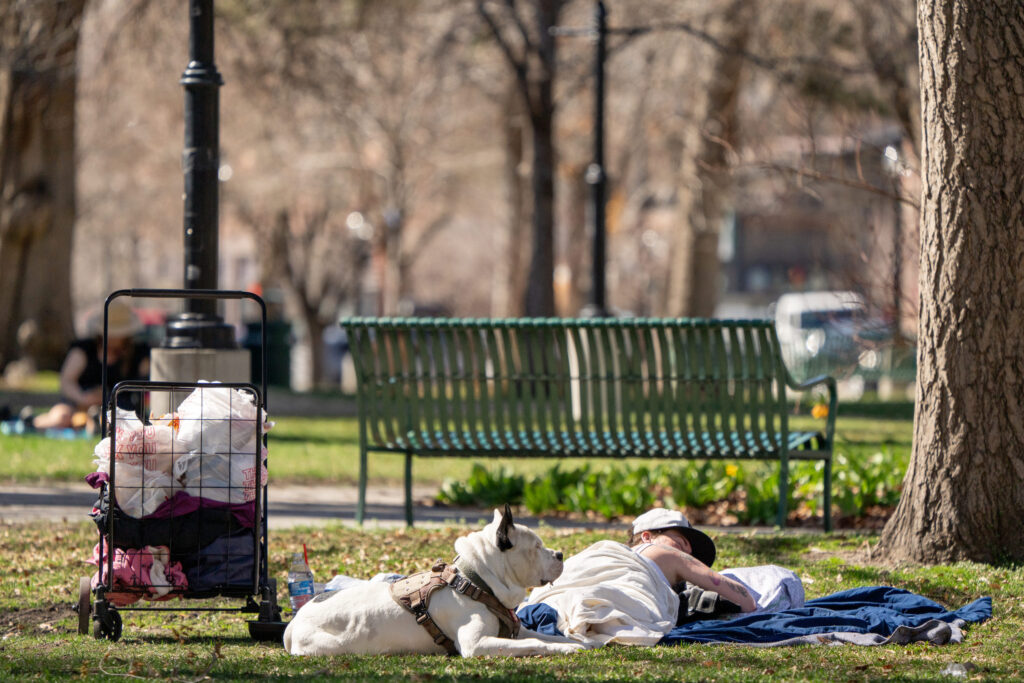

A person and a dog lay in the grass outside the City-County Building in Salt Lake City on Wednesday, March 26, 2025. (Photo by Spenser Heaps for Utah News Dispatch)
As they usually do each year, crucial decisions for homelessness funding are coming down to the wire with less than five days left until the end of the 2026 Utah Legislature at midnight on Friday.
Late last Friday the Legislature’s powerful budgetary body, the Executive Appropriations Committee, signaled Utah’s Republican legislative leaders have given a green light to a significant infusion of new ongoing money for homelessness programs — after homelessness advocates have spent years asking state leaders to boost a reliable source of funding.
Notably, lawmakers have not included money to build a controversial homeless campus that state leaders have proposed on a property in the northwest corner in Salt Lake City. State leaders say the idea hasn’t been abandoned — but rather they’re spending more time on formulating “high utilizer” programs to inform the campus concept before funding the project’s construction.
Additionally, a big chunk of that new ongoing money — nearly $12 million, along with about $14.4 million in one-time money — comes with a catch. It can only be spent alongside a one-to-one match “from local governments,” according to the budget recommendations’ intent language.
SUBSCRIBE: GET THE MORNING HEADLINES DELIVERED TO YOUR INBOX
In combination with funding from cities and counties, that could bring the total to about $24 million in ongoing funding and $28.8 million in one-time money for homelessness. But it remains to be seen specifically where that local government funding would come from and if they’ll achieve the full match.
“It’s a new approach that we’re taking with our partners, our local partners,” House Speaker Mike Schultz, R-Hooper, told reporters Monday when asked about the match requirement. “Everybody comes to the state and wants the state to take over their issues and their problems. We certainly want to be partners in helping solve the homelessness issue, however we also need the city and the counties to step up and do their part as well.”
Schultz said the match shows state leaders are “putting their money where their mouth is, and as long as we get local participation from the cities and counties, then that will get funded and we’ll move forward.”
Meanwhile, legislators are moving forward with a new tax on alternative tobacco products — including nicotine pouches like the popular ZYN brand — in order to generate about $40 million a year in new money, some of which could be used for homelessness. That bill, however, still needs to be considered by the Senate, and it could change or not pass at all.
Here’s where lawmakers’ efforts around homelessness stand, at least for now:
Money for homelessness, but not for shelter campus (yet)
Cox, in his budget recommendation to lawmakers last month, proposed using $25 million in one-time money for capital and $20 million in ongoing funding for “homelessness and criminal justice utilizers” as part of a proposal to build a 1,300-bed homeless campus.
Last month, Nick Coleman, the state’s interim homeless coordinator, shed light on the specifics of the governor’s budget recommendation. He told Utah News Dispatch that instead of lobbying for money to build the campus this year, they first focused the governor’s funding requests on programs — within existing state facilities or local providers — aimed at targeting “high utilizers” of the state’s criminal justice and homeless systems.
Utah officials unveil site for 1,300-bed homeless campus after long, secretive search
At the same time, though, he said state leaders weren’t abandoning efforts to build a campus. But rather by focusing first on these “high utilizer” programs, they’re hoping what they learn could potentially help inform programs and operations for the future homeless campus.
Ultimately, the governor didn’t get everything he asked of lawmakers — but when it came to ongoing funding, Coleman said his requests were “just about fully funded,” with more than $17.5 million in new money set aside.
That includes about:
- $2.5 million in ongoing funding and $9.4 million in one-time funding for emergency shelter and housing
- $4.6 million in ongoing funding and $2.7 million in one-time money for a program to address “high utilizers” of the criminal justice system
- $1.1 million in ongoing funding and $7.8 million in one-time money for mental and behavioral health
- $9.4 million in ongoing funding and $5 million in one-time funding for “phase two” investments as the state’s homeless leaders build future programs
- $1 million in ongoing funding for expansion to The Other Side Village, a tiny home community in Salt Lake City for the chronically homeless
Yes, lawmakers greenlit nearly $25 million in one-time money for homelessness — but only after re-appropriating nearly $23 million in one-time money the Legislature set aside last year for expanding the state’s “low barrier” emergency shelter. And instead of $5 million the governor asked for to expand The Other Side Village, lawmakers only set aside $1 million.
Still, Coleman called the budget recommendations a “tremendous vote of confidence” in the Cox administration’s strategy to focus on funding for “high utilizer” programs, along with efforts to expand capacity for emergency shelter, supportive housing and mental and behavioral health.
Utah homeless leaders look to focus funding on ‘high utilizers’ while not ‘backing away’ from campus
So even though the budget doesn’t include money specifically for the campus, Coleman said they hope the programs lawmakers fund this year could lay the groundwork for it.
“These are key programs that would inform whatever that might look like, so this is really to lay the groundwork on key programs that will eventually become a big part of what we’re hoping to do in the future,” Coleman said.
Meanwhile, he said state leaders are “going to continue pursuing” the nearly 16-acre property in northwest Salt Lake City for the campus, “and whether that comes to fruition as one program or another, we’re going to decide.” That’s why some of the funding that’s been set aside is earmarked for “phase two” investments, he said.
Senate Budget Chair Jerry Stevenson told Utah News Dispatch on Friday that lawmakers weren’t likely to put any money toward building the campus — at least not yet.
“The campus is … I think that’s going to go flat for now, because it’s difficult to do,” Stevenson said, adding that when outgoing Rep. Tyler Clancy steps into his new position as statewide homeless coordinator later this month, he’ll need time to “get his arms around this.”
“Maybe we just need some time to step back and take a big, deep breath,” Stevenson said.
However, Stevenson also said the campus proposal isn’t dead.
“It’s a big item,” he said. “We can either take care of the problem we have (right now) or we can look at building a campus that we may or may not need after we fully analyze what we’re doing.”
Schultz said he’s “really excited about the direction we’re headed with homelessness,” pointing to the proposal from the governor’s administration to focus on criminal justice “high utilizers.”
“At the same time we’ll make sure the resources are there for those that want to get the help that they need,” Schultz said. “For those that want to change and want to get sober and clean up their lives, we’ll make sure that they have the resources there to do that.”
As for the campus, Schultz said there are “a lot of concerns around just creating a low-barrier shelter and what happens inside those shelters.”
“We think the best way … is to hold people accountable for their decisions,” he said, “those that want to get help, make sure we’re doing all we can to get help.”
New nicotine tax on ZYNs
While lawmakers move forward with additional funding for homelessness programs, another bill has been progressing through the 2026 Legislature that would generate about $40 million a year in new revenue by increasing taxes on certain “alternative” tobacco products, like nicotine pouches that are commonly referred to as ZYNs, a popular brand.
The Executive Appropriations Committee on Friday factored that new $40 million in ongoing revenue into its budget recommendations to the Legislature.
The bill, HB337, is being sponsored by Clancy, who will take over as the state’s homeless coordinator next week, days after his last legislative session as a lawmaker ends. In the Senate, Stevenson — who has a powerful position as an Executive Appropriations Committee co-chair — is co-sponsoring the bill.
Blaming broken promises for Great Salt Lake, lawmaker threatens to block homeless campus
Stevenson told Utah News Dispatch this year’s ongoing money for homelessness doesn’t entirely hinge on the passage of the new nicotine pouch tax, but its $40 million could help fund a variety of priorities, including expansion to the courts and homelessness programs.
“There are a lot of places we could put that money to really good use,” he said.
However, Stevenson also said if it doesn’t pass, that wouldn’t change lawmakers’ commitment for the $17.5 million in ongoing funding for homelessness, and they could still pull the money from the state’s general fund revenue if need be, regardless of whether the ZYN tax passes.
“We will cherry pick the general fund for whatever we need,” he said. “If it’s not here, we’ll do something else.”
However, Stevenson also said he thinks the ZYN tax has a strong chance of passing — but the Senate could change the bill to lower the tax and therefore the money it would generate.
“I think we’re going to find a place in the middle,” he said.
The bill already won approval from the House on a 47-20 vote, but is waiting for a Senate committee hearing.
Schultz said House Republican leaders would like to see the tax increase pass in some form “because that does help fund a good portion” of homelessness priorities, but he said, “We’ll see.”
“My guess is it probably passes, but maybe not in its current form,” the speaker said, acknowledging that it’s possible the Senate could lower the tax. “Well see what happens in the Senate.”