Utah News Dispatch
A complete kratom ban is off the table in Utah this year

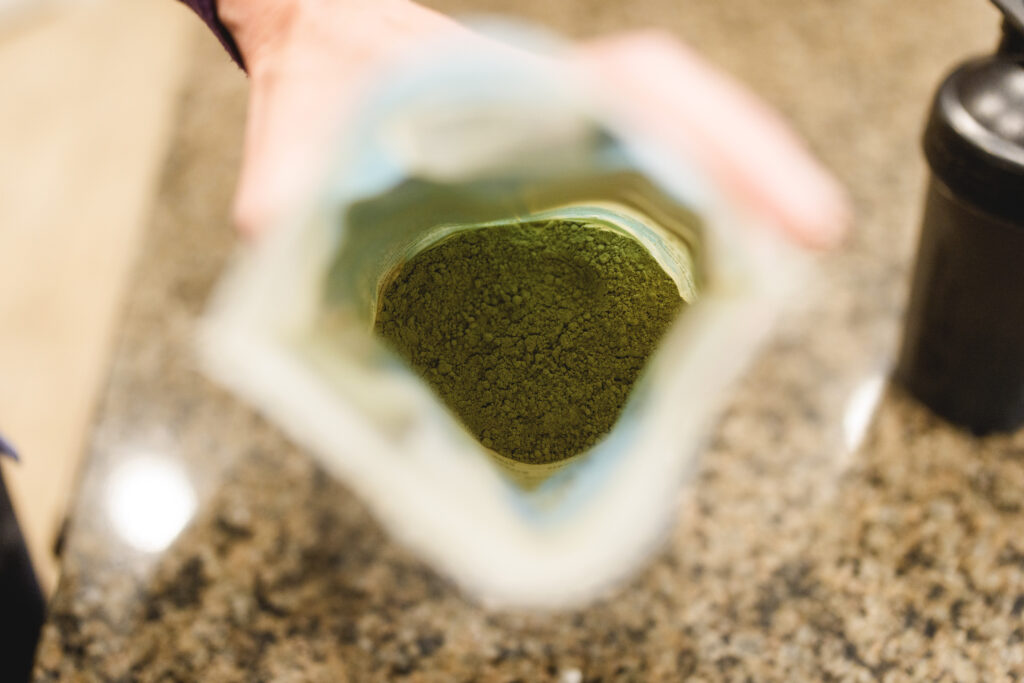

Lora Romney shows the contents of a bag of kratom at her home in Layton on Thursday, Feb. 5, 2026. Romney, 55, has atypical trigeminal neuralgia, which causes intense, burning, nerve pain in her face. Kratom, which the Utah legislature is considering banning, is the only non-opiate that she has found to alleviate the pain. (Photo by Spenser Heaps for Utah News Dispatch)
A complete ban of kratom products is off the table in Utah after lawmakers revised the most sweeping proposal the Legislature introduced this year. However, after this year, synthetic kratom products may go off the shelves of convenience stores and gas stations.
Senate Majority Assistant Whip Mike McKell, R-Spanish Fork, still believes a total ban of kratom, either natural or artificial, is appropriate. But, saying he needs to work with House representatives, he changed his bill on the Senate floor Wednesday to a more flexible proposal allowing only pure leaf kratom with more restrictions.
“This is going to be very narrow. This is going to eliminate, hopefully, 90% plus of our problems in the state of Utah, but we are going to allow pure leaf kratom to be sold in the state of Utah. That’s going to be done in specialty shops,” McKell told the Senate.
SUBSCRIBE: GET THE MORNING HEADLINES DELIVERED TO YOUR INBOX
The updated version of the bill passed the body unanimously and is now ready for the House’s consideration.
With that change the Legislature is advancing three bills with a common theme — they all aim to see artificially-enhanced kratom on its way out of the state, a product that experts say is as addictive as opioids like morphine. All would also ban large percentages of 7-hydroxymitragynine, or 7-OH, an alkaloid that occurs naturally in the kratom plant but only in a minor quantity.
Lawmakers and experts have supported further restrictions on kratom in the state citing high addiction rates, strong withdrawal issues, deceptive practices from the industry, and even fatal overdoses. However, kratom advocates say that’s true of adulterated kratom products, which often come in the form of tablets, gummies, drink mixes and shots.
Kratom has given and taken from chronic pain patients — will Utah ban it?
Pure products, like powders and pills, are dramatically different, consumers say, and in some cases have provided more relief than traditional medicine for chronic pain patients, who have reported using natural kratom products daily for years without experiencing negative health issues.
From July 2020 through 2025, the state counted 158 fatal overdoses involving kratom, which makes up from 4% to 6% of all fatal overdoses in the state, Megan Broekemeier, an overdose fatality examiner at the Utah Department of Health and Human Services told lawmakers during presentations of the bill. The majority of them involved at least one more substance, most commonly fentanyl, gabapentin, alcohol, methamphetamine or amphetamine.
Industry players and lawmakers often cite contradicting studies on potential damages coming from the pure herb. Some say overdose from natural kratom is unlikely, but there have been documented cases of deaths caused by mitragynine, the main chemical component of the plant. A Tampa Bay Times investigation found that out of 587 kratom-related overdoses in Florida, 46 were attributed to the herb by itself.
And Utah lawmakers agree that the plant by itself may still be dangerous for some.
“There’s a false dialogue that continues to be spread, that nobody dies from pure kratom. That’s not true. About 10% of the cases are pure kratom and the adulterated kratom, extracted kratom, the kratom that we’ve made more potent,” McKell said.
At the same time McKell presented his bill, a similar conversation was happening on the House floor, where Minority Whip Rep. Jennifer Dailey-Provost, D-Salt Lake City, introduced other kratom regulations she has been pursuing for two years.
Her bill, Dailey-Provost said, would ensure a unified regulatory framework for kratom processors and retailers. That would aim to improve product safety and compliance through dedicated funding and enforcement by the state’s administrative agencies.
“What we are lacking is a regulatory framework. It is a vacuum right now, without this bill, regardless of the legality we have given our regulatory agencies no tools to regulate kratom,” Dailey-Provost said.
The McKell and Dailey-Provost bills are similar. They both require kratom processors and retailers to register with the Utah Department of Agriculture and Food. They both ban kratom containing psychoactive stimulants or adulterants and kratom extracts. And they both set the same $5,000 administrative fine to kratom sellers who fail to register as a processor or retailer.
“She has a lot of regulatory structure that happens in vape shops. My preference is to see … the two bills dealing with the subject moving forward,” McKell told reporters on Wednesday.