Utah News Dispatch
With public safety update, ‘disappointed’ SLC mayor asks state to take city requests more seriously


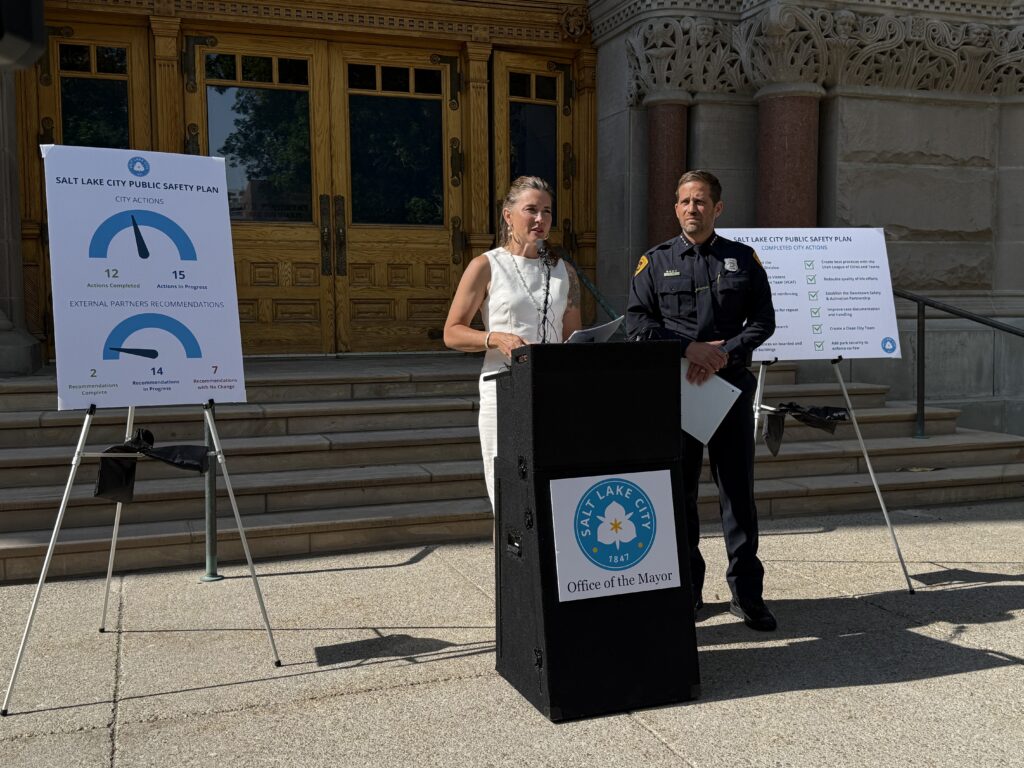


Salt Lake City Mayor Erin Mendenhall provides a public safety plan update at a news conference in front of City Hall on July 16, 2025. (Alixel Cabrera/Utah News Dispatch)
Six months after Salt Lake City Mayor Erin Mendenhall presented a public safety plan in response to demands from state leaders, she gave an update on the plan’s progress on Wednesday, saying crime has gone down and the city has implemented community-based approaches to improve safety.
But tensions between Utah’s capital and the state government remain, as Mendenhall says that the city’s requests for resources failed during the 2025 legislative session.
During the past six months, the city switched police chiefs and achieved 12 of the 27 proposed actions, Mendenhall said. June also ended up recording the lowest overall crime rates in eight years.
But, some of the plan’s recommendations for external partners have stalled. That includes allocating funding for services and housing, as well as considering policy changes to help tackle substance abuse and implementing a joint plan across state, county and city entities to improve public safety.
SUBSCRIBE: GET THE MORNING HEADLINES DELIVERED TO YOUR INBOX
“I’m disappointed, and I wish that more progress was made on those external recommendations. During this year’s legislative session the city advocated for several clear policy changes that would have better advanced this plan, but many of them failed to pass through the legislature,” Mendenhall said. “I urge lawmakers to give those measures more serious consideration moving forward.”
Mendenhall’s public safety plan came after Gov. Spencer Cox and Republican legislative leaders gave Mendenhall a firm deadline to draft a plan to “restore public confidence, security and safety,” warning the Legislature could step in if progress stalled.
This year Salt Lake City officials advocated for 42 bills that aligned with the plan’s goal. Of those, 28 of them passed, “representing significant progress,” according to the plan update.
Those that failed included the city’s request to dedicate an ongoing funding source for homeless services, increased funding for mental health treatment teams, and a requirement for more counties to provide residential behavioral health and substance abuse treatment.
When Mendenhall released her plan, she offered city-owned land for a temporary shelter campus if the state or philanthropic groups funded its operations. But now, the state has considered that site for a permanent facility, Mendenhall said.
‘Fed up’: SLC mayor answers Utah leaders’ call for plan to ‘restore public safety’
“Progress has now stalled,” she said. “The city has done everything in our power to support this effort. Now we need the state to act to fully fund development and ongoing operations for this state-owned campus.”
The city added 400 additional homeless shelter beds this year, extended its winter shelter into the summer months, and the Salt Lake City Council approved more youth beds. While Mendenhall acknowledged that systemic changes take a lot of time and work, she reiterated the city can’t keep doing this alone.
“This crisis demands sustainable, long-term funding from the state to meet the scale of this challenge in the fastest growing state in this nation,” she said.
The plan’s first six months
One of the first actions city officials took as part of the public safety plan was to deploy the Violent Crime Apprehension Team, or VCAT, which targets gang activity to disrupt drug and firearm trafficking, Mendenhall said.
Over the past six months the team helped seize thousands of fentanyl pills, over 20 pounds of narcotics and nearly 100 illegally-possessed firearms.
With a new Community Impact Division within the Salt Lake City Police Department, officers have also been assigned to patrol areas downtown, along the Jordan River Trail and in the Ballpark neighborhood. That team also works to connect unsheltered people with services, the mayor said.
“They’ve taken hundreds of criminals off the streets. They’ve tracked suspects, and they dismantled drug operations. At Cottonwood Park alone, (Community Impact Division) officers assigned to our bike units seized over 5,000 fentanyl pills and more than $11,000 in cash from a single dealer,” Mendenhall said.
Salt Lake City dedicated $4 million of this year’s budget for the new public safety initiatives, including added security across nine city parks and sections of the Jordan River Trail. City officials have also improved street lighting in high-traffic areas.
Officer proactivity is up nearly 10% every year, and the city is on track to end 2025 with over 1,000 more jail bookings than in 2024, Mendenhall said.
But the public safety plan is not just about the police since they aren’t equipped to solve every problem, Mendenhall said. She said a more holistic solution needs to come from a more community-based approach, with teams that work to keep the city clean and restore neglected spaces, and partnerships with businesses and residents in the downtown area to craft safety solutions.
The city is also eyeing a pilot program to bring free restrooms, showers and laundry facilities for those living on the streets, the mayor said.
To Salt Lake City Police Chief Brian Redd, the public safety plan has two themes; accountability for those who choose to victimize the community, and support for those in need, better aligning the criminal justice and social services systems. The city also created a system to connect the biggest repeat offenders in the criminal justice system in the city to housing, treatment and services.
Additionally, Redd said, the public safety approach includes investment in public safety technology, such as cameras and drones.
“Of course, as we utilize this type of technology, we’re going to be guided by principles of protecting privacy and civil liberties community involvement in those decisions,” Redd said.