Utah News Dispatch
What’s in Utah’s state budget? Here’s what lawmakers are prioritizing for 2026

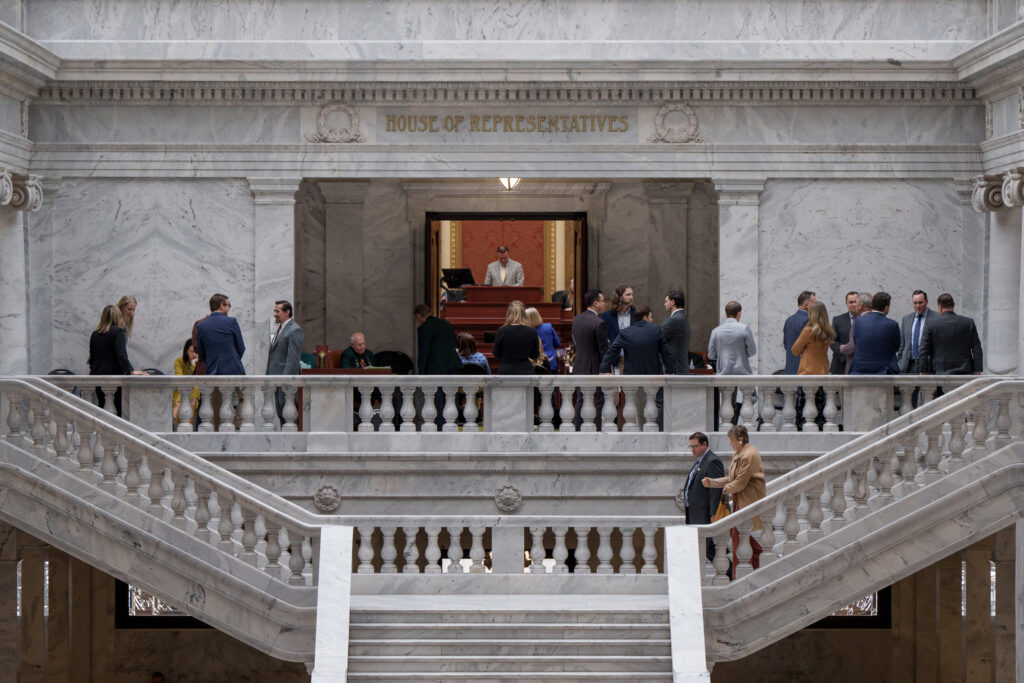

People congregate outside of the House Chamber at the Capitol in Salt Lake City on Thursday, Feb. 19, 2026. (Photo by Spenser Heaps for Utah News Dispatch)
With one week left in the Utah Legislature’s 2026 general session, Republican legislative leaders late Friday unveiled the long-awaited list of new budget recommendations for the 2026 fiscal year as they work to put finishing touches on the state’s more than $31 billion budget.
The Executive Appropriations Committee, the powerful budgetary body that decides how to spend the state’s money, released that list Friday night after appropriations subcommittees and legislative leaders spent weeks deciding what would get new money — and what wouldn’t.
In all, the committee came up with new recommendations on top of the more than $30 billion in base budgets that lawmakers had approved earlier in the session to fund existing programs and operations and other priorities the Executive Appropriations Committee had already approved.
SUBSCRIBE: GET THE MORNING HEADLINES DELIVERED TO YOUR INBOX
The budget process isn’t over. Lawmakers will spend the next week finalizing it before the session adjourns by midnight on March 6. But Friday’s list included most of what will get new money, and what was cut or reappropriated.
That includes $101 million for another income tax rate cut. But they also set aside about $17.6 million in valuable ongoing funding for homelessness. And they gave about $130 million to expand the state’s correctioanl facilities.
The committee’s recommendations also included funding for a 2.5% cost of living increase for state employees.
Legislative leaders had previously directed state agencies to contemplate the possibility of 5% budget reductions, tasking them each with generating a list of recommended cuts for lawmakers to consider.
Ultimately, the Executive Appropriations Committee accepted some of those proposed cuts — but not all. The cuts didn’t need to go as deep as expected after new revenue estimates released last week showed the state had millions more available to spend than previously forecasted.
But there were some cuts that disappointed Democrats. Sen. Kathleen Riebe, D-Cottonwood Heights, expressed concerns that more than $18.3 million had been cut from a digital training program for teachers.
“This is a teaching program that we train over 8,000 teachers every year to use the technology that we adopt,” Riebe said.
In response to Riebe’s concerns, Ball noted the cut was a recommendation that was made by the public education subcommittee after debating what to prioritize. He also noted that the public education subcommittee ended up seeing a 0.8% cut, the smallest reduction of all the subcommittees, “but this is the one sizeable item that will be reduced.”
Sen. Jennifer Dailey-Provost, D-Salt Lake City, said the budget process is “gut wrenching,” and she would have liked to see some of those programs, like the one Riebe pointed out, stay intact. But she said the cuts could have also been “so much worse.”
“Especially after going through the potential cuts in social services,” Dailey-Provost said, “I’m just so relieved.”
However, she said there are several priorities that Democrats had asked for that haven’t been funded, so “we’re going to keep fighting until the very, very end” next week.
Utah has more revenue than expected. Lawmakers still want leaner budgets, and a 6th income tax cut
Overall, the committee’s recommended reductions totaled around $274 million or 2.4% of the budget, according to legislative fiscal analyst Jonathan Ball. However, lawmakers added back that money in different ways and increased spending.
Even with some cuts and reappropriations, Senate President Stuart Adams, R-Layton, emphasized that the committee was recommending a more than 7% increase to the state’s overall budget. That totaled more than $934 million in additional spending, on top of the state’s already approved base budgets.
“I think we’ve spent too much,” Adams joked.
House Speaker Mike Schultz, R-Hooper, also emphasized that public education would be getting a more than 5% increase.
Homelessness
After reappropriating nearly $23 million in one-time money that Utah lawmakers set aside last year for “low-barrier” emergency shelter, the committee recommended lawmakers use that money to build programs meant to lay the groundwork for a future homeless campus — which didn’t get any money this session toward actually building it.
Senate Budget Chair Jerry Stevenson, R-Layton, said that project will likely take multiple years of investment, and lawmakers weren’t ready to set money aside for it yet.
Utah homeless leaders look to focus funding on ‘high utilizers’ while not ‘backing away’ from campus
“It’s a big item,” he said. “We can either take care of the problem we have (now) or we can look at building a campus that we may or may not need after we fully analyze what we’re doing.”
However, Nick Coleman, the state’s interim homeless coordinator, celebrated the Executive Appropriation’s committee’s recommendations as “fantastic,” especially because they set aside a significant chunk of ongoing money that “fully funded” the governor’s ongoing requests for homelessness.
That includes about:
- $2.5 million in ongoing funding and $9.4 million in one-time funding for emergency shelter and housing
- $4.6 million in ongoing funding and $2.7 million in one-time money for a program to address “high utilizers” of the criminal justice system
- $1.1 million in ongoing funding and $7.8 million in one-time money for mental and behavioral health
- $9.4 million in ongoing funding and $5 million in one-time for “phase two” investments as the state’s homeless leaders build future programs.
- $1 million in ongoing funding for expansion to The Other Side Village, a tiny home community in Salt Lake City for the chronically homeless.
Corrections
The budget recommendations included significant funding for an expansion to the state’s correctional facilities and other programs, including:
- $130 million in one-time money to expand correctional facilities, plus $3.5 million in ongoing money to open another building on the Utah State Correctional Facility campus, and nearly $3.2 million in one-time money for additional jail contracting beds
- $5 million in one-time money for the state’s corrections system to update its outdated offender management system
- $1.7 million for a “statewide financial crimes intelligence center” meant to investigate and prosecute financial crimes and create a central reporting center for banking and financial institutions
- $1.4 million in ongoing money for HB110, a bill to allow increased supervision for parolees
Courts
Lawmakers also funded their moves to expand the Utah Supreme Court and other courts, including:
- Nearly $4.7 million in ongoing funding and $1.8 million in one-time funding to expand the Utah Supreme Court from five justices to seven, and add five more lower court judges, including two Court of Appeals justices and three district court judges
- $545,500 in ongoing money and $88,100 in one-time money to fund the newly created “constitutional court” to hear legal challenges to state laws
- $500,000 in ongoing funding for HB540, a bill that would require the courts to make its proceedings and records more easily accessible to the public
Housing
Lawmakers also included some money for efforts to increase housing opportunities for Utahns, including:
- $10 million in one-time money to continue the state’s first-time homebuyer loan assistance program
- $450,000 in ongoing money for the state’s housing choice voucher program, which is meant to reduce financial risk for landlords and encourage them to open more rental units to tenants receiving Section 8 housing assistance
Water
The budget recommendations also include money for water conservation and some natural resources initiatives, including:
- $1 million in ongoing money for operational funding for the Colorado River Authority
- $4 million in one-time money for aquatic invasive species decontamination dip tanks
- $4 million in one-time money for the second phase of an effluent water reuse project in Cedar City, Enoch City and Iron County, meant to build a distribution system to deliver treated reclaimed water to secondary users
- $2.5 million in one-time money for a Great Salt Lake aquifer restoration project
- $2 million in ongoing money and $2 million in one-time money for a Great Salt Lake cloud seeding program
- $2 million in one-time money for SB130, a bill to help restore the Jordan River
- $4 million in one-time money for new water infrastructure in Tremonton
- $2.7 million in ongoing money for HB410, a bill creating a water leasing program for the Great Salt Lake
Education
Lawmakers also included more money for public education, including:
- $35 million in one-time money for Applied Professional Education Experience centers, formerly known as catalyst centers meant to align school curriculum with workforce needs
- $25 million ongoing funding for an increase in per-pupil spending for “at risk” students based on if they are economically disadvantaged or face English language challenges
- $12 million in one-time money for SB119, a bill that requires the Utah State Board of Education to develop “open educational resources” for students in kindergarten through eighth grade
- $17 million to restore funding to school districts that was promised to help with loss of school fees
- $5 million in one-time money for the Utah State Board of Education’s Grow Your Own Educator Grant, which provides scholarships for special educators
- $3.5 million in one-time money for HB393, a bill to create a pilot program to help students with dyslexia
- $2.5 million in one-time money for reduced-price school lunch
Correction: An earlier version reported the state’s proposed budget includes $130 million to expand the Utah State Correctional Facility in Salt Lake City. It is not publicly specified where the expansion would be funded.