
Utah News Dispatch
Utah State Bar ‘deeply alarmed’ by bills it says would ‘weaken’ the judiciary’s independence


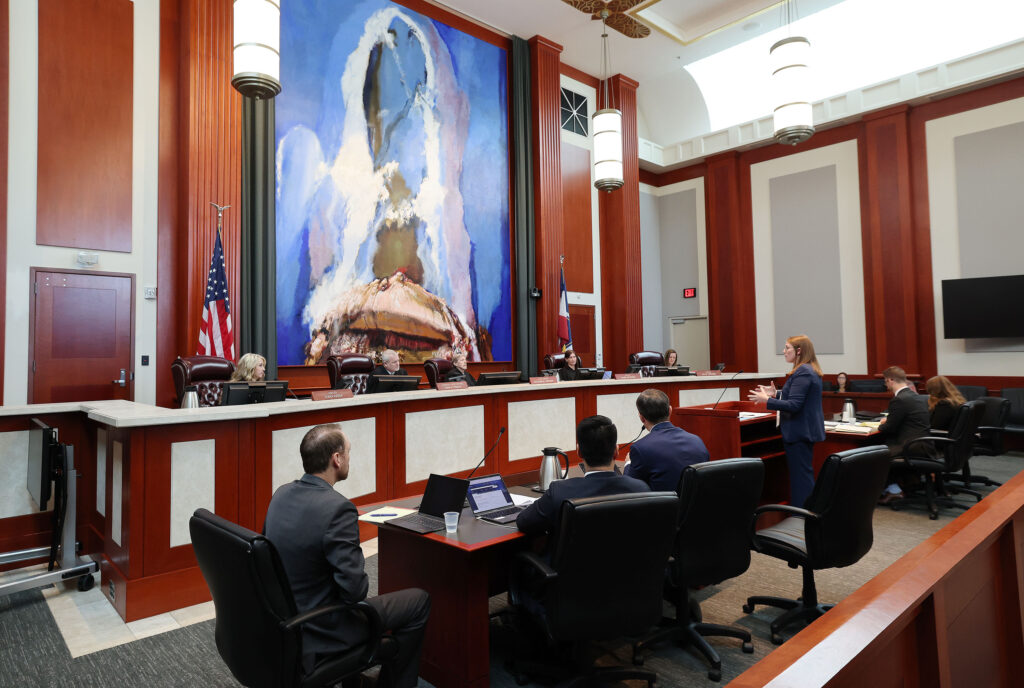


Attorney Taylor Meehan speaks to the court as Mormon Women for Ethical Government and The League of Women Voters oppose the Utah State Legislature during oral arguments at The Supreme Court of Utah in Salt Lake City on Wednesday, Sept. 25, 2024. (Pool photo by Jeffrey D. Allred/Deseret News)
Utah lawmakers on Wednesday advanced three bills impacting the courts despite objections from legal professionals concerned that legislators are moving rapidly to enact major structural changes that could “weaken” the courts’ independence while pumping millions toward changes the judiciary doesn’t support.
Among them was HB392, which would create a new, three-judge “constitutional court” with a price tag of more than $2.3 million.
The bill — which was approved by the Republican-majority House Law Enforcement and Criminal Justice Committee just one day after it became public — would completely restructure how constitutional challenges to Utah laws are heard by creating a new statewide trial court that would have “exclusive jurisdiction” over those types of lawsuits. The governor would appoint the three judges, subject to confirmation by the Senate.
The bill, sponsored by Rep. Matt MacPherson, R-West Valley City, would also limit the ability of individual judges or local courts to block potentially unconstitutional state laws through injunctions.
“We need these issues of statewide significance to not get bogged down by the court process. It leads to unintended consequences, which we have seen in recent cases,” MacPherson told the committee.
His bill comes as Republican Utah lawmakers remain frustrated with several recent court rulings that have checked the Legislature for overstepping its constitutional limits. A yearslong redistricting lawsuit recently led to a court-ordered congressional map to be used for the 2026 elections (to Republicans’ dismay) that included one Democratic district and three heavily GOP districts.
Utah judge faces impeachment threats after ordering congressional map with 1 Democratic seat
Additionally, in 2024, the Utah Supreme Court upheld an injunction that blocked enforcement of Utah’s trigger abortion ban after Planned Parenthood of Utah sued, alleging the ban was unconstitutional. That injunction remains in place today as litigation continues to play out in 3rd District Court. In the meantime, abortion remains legal in Utah for up to 18 weeks gestation under the state’s previous law.
MacPherson argued the aim is to streamline cases of statewide significance while relieving already overwhelmed district court judges that may not like the “pressure” of deciding heavy constitutional challenges.
“The ability to keep (constitutional challenges) centralized in this space will allow these cases to move much more quickly,” MacPherson said. “They won’t get bogged down by the fact that these district court judges already have an extremely high workload.”
But Michael Drexel, assistant state court administrator at the Administrative Office of the Courts, told lawmakers the judiciary opposes MacPherson’s bill in its current form because of how the judges for the “constitutional court” would be picked.
“Typically what happens is a case is filed and then that case gets assigned to judges, and the parties filing the case don’t know who their judge is going to be,” Drexel said. But under MacPherson’s bill, the governor and the Senate would be selecting the judges on the court, which would exclusively handle lawsuits against those state leaders.
“That’s not a way to establish a system that is seen as fair by all people,” Drexel said, though he welcomed more discussion on the bill, saying “I do think there’s a path forward, though, on this.”
Reforming or rigging the courts?
Attorneys including Kristy Kimball, of Salt Lake City, had much stronger words condemning MacPherson’s bill. She called it an “unprecedented attempt to control constitutional review itself.”
“When lawmakers are unhappy with constitutional rulings, this bill gives them a way to change the forum, redirect cases, and shape the process by which their own laws are reviewed and decided,” Kimball told the committee. “That is not separation of powers. That is power protecting itself.”
She argued that “constitutional rights mean nothing if the government can decide which courts hear a challenge, which judges decide it, and whether a case remains in the ordinary judicial system at all.”
“You are not reforming the courts,” she said. “You are attempting to rig them.”
Another attorney, Brandon Mark, said it would allow “forum shopping” by letting top state leaders decide who will hear any cases challenging their laws rather than those cases being randomly assigned to district court judges.


To those concerns, MacPherson argued the judges for the “constitutional court” would go through a similar nomination and confirmation process as other judges across the state. He also argued “there is an absolute need” for cases challenging laws to be sorted out “quickly and efficiently,” but also “done right.”
However, before the House committee voted 7-2, with only Democrats voting against, to advance his bill to the House floor, MacPherson said he was open to making changes to address concerns.
McPherson also argued the more than $2.3 million price tag of his bill would be “well invested.” But Kimball said the Legislature needs to listen to what the judiciary has said its actual needs are to address case backlogs and speed up decision-making.
“(Lawmakers) will not give the courts what they need. They’ve asked for more legal assistance, for more law clerks, for more legal secretaries,” she said, and yet “the Legislature keeps cutting what they say that they need, drastically, in some cases. So if you care about the courts and having them be more efficient, then give them what they’re asking for.”
Utah chief justice delivers letter to lawmakers to oppose bill threatening judicial independence
It’s true that the state’s judicial leaders, including Chief Justice Matthew Durrant, have said that the court system’s highest workload is on the district court level — which is why the judiciary has urged lawmakers to fund resources for those lower courts.
The judiciary, however, hasn’t asked for lawmakers to spend millions on creating an entirely new “constitutional court” — or to fund two additional justices on the Utah Supreme Court, which would happen under another bill, SB134, that also advanced out of Wednesday’s House committee. After clearing the Senate on Monday, it now heads to its final legislative hurdle, the House floor.
While SB134 would fund three additional district court judges and two more Court of Appeals justices, that’s only a fraction of what the state’s judiciary has requested to help the state’s overwhelmed district courts.
Utah State Bar bar opposes 7 bills it says will collectively ‘weaken’ judiciary’s independence
MacPherson’s bill and the part of SB134 that would expand the Utah Supreme Court was among a list of seven pieces of legislation proposed this year that the Utah State Bar has officially opposed.
The Bar issued a news release Wednesday saying it was “deeply alarmed by the fast-moving package of bills” being considered in the 2026 Utah Legislature’s session that began just last week.
Collectively, those bills would “fundamentally remake the state’s judicial system,” the Bar said, adding that the bills have been “coordinated to work in conjunction with each other to make it easier for lawmakers and the executive branch to remove judges, and just as quickly replace them, based on subjective political judgments rather than legal skill, experience, and demonstrated ability to be fair and impartial.”
“While each proposal is presented as a narrow change, together these bills operate as an overhaul to how judges are appointed, retained, and pressured while on the bench,” the Bar said. “The combined effect weakens long-standing safeguards that protect judges from political retribution and undermines the public’s right to a judiciary that upholds the rule of law without favor.”
In response to the Bar’s opposition on Wednesday, Senate President Stuart Adams, R-Layton, issued a prepared statement to Utah News Dispatch saying lawmakers are “committed to finding the best solutions for Utahns through a transparent and public legislative process.”
SUBSCRIBE: GET THE MORNING HEADLINES DELIVERED TO YOUR INBOX
“These proposals are being debated openly, include opportunities for public input, and reflect feedback from stakeholders across the state,” he said. “We encourage continued dialogue and thoughtful engagement as this work moves forward.”
Adams also argued that Utah’s “rapid growth has increased the demands placed on every level of the judicial system.”
“We are not only adding Supreme Court justices, we are also adding clerks, which will increase the Court’s capacity to hear cases. It is inconsistent to support our lower courts while opposing additional Supreme Court justices when the same workload pressures exist throughout the system,” Adams said. “Addressing these challenges requires a comprehensive, system-wide approach. Our priority remains on balancing efficiency while ensuring Utah’s courts have the capacity to serve the public effectively.”
The bills opposed by the Bar include:
- HB262, sponsored by Rep. Jason Kyle, R-Huntsville, which would increase the percentage of the vote required for a judge to win retention from 50% to 67%. “This would be the highest retention percentage in the nation,” the Bar said on its website. “We oppose this bill because it threatens the independence of the judiciary by creating greater opportunities for disgruntled litigants or political interest groups to impact judicial retention elections. This adversely impacts public trust and confidence in a judiciary system that can be so easily politicized.”
- HB274, sponsored by House Speaker Mike Schultz, R-Hooper, would change the makeup of the Utah Sentencing Commission by removing all defense lawyers from the commission and replacing them with more members from law enforcement. The Bar said it “strongly” opposes the bill because it “politicizes” the commission by restructuring it in a way that “favors law enforcement and partisan viewpoints.”
- HB366, sponsored by Rep. Jordan Teuscher, R-South Jordan, would change how district court cases involving cities are assigned and managed. The Bar said it opposes the bill “disrupts established court management practices, burdens district courts with justice court infractions and misdemeanors alongside serious felony cases and raises serious constitutional concerns regarding judicial independence.”
- HB392, MacPherson’s bill to create a “constitutional court.” The Bar said it “raises serious concerns about judicial independence by allowing the executive and legislative branches to appoint judges who may later hear cases involving those same branches, “while also diverting “taxpayer dollars and limited judicial resources to create a new court structure that is unnecessary and risks undermining public confidence in the judiciary.”
- HJR5, a proposed constitutional amendment sponsored by Kyle that would fundamentally change how judges are nominated in Utah. It would allow the governor to request a list of nominees from the Judicial Nominating Commission, but enable him to appoint any qualified candidate, even if they’re not on the commission’s list. “We strongly oppose this constitutional amendment because it fundamentally weakens Utah’s merit-based judicial selection system, which is heralded as a model for the nation,” the Bar said. “It undermines judicial independence by granting the governor unchecked authority to bypass nominating commissions and appoint judges of the executive’s choosing.”
- HJR13, a proposed constitutional amendment sponsored by Rep. Walt Brooks, R-St. George, which would allow the Legislature to initiate a “special retention election” for judges lawmakers determine are “unfit or incompetent.” The Bar said it opposes it because it “injects the Legislature directly into the judicial retention process, threatening the separation of powers.”
- SB134, sponsored by Senate Majority Whip Chris Wilson, R-Logan. While the Bar said it supports the provisions of the bill to add three more district court judges and two Court of Appeals justices, the Bar opposes the proposal to expand the Utah Supreme Court “given that the vast majority of cases involving everyday citizens are handled in lower courts.” The Bar also said the bill “does not adequately address the need for corresponding support staff, such as judicial assistants and law clerks, necessary to ensure that new judges can operate effectively and efficiently.”
Utah lawmaker proposes allowing Legislature to call ‘special retention elections’ for ‘unfit’ judges
In addition to advancing MacPherson’s “constitutional court” proposal and Wilson’s bill to expand the Utah Supreme Court on Wednesday, lawmakers on a separate panel, the House Judiciary Committee, also advanced a third bill on the Bar’s opposition list: HB274.
That bill, sponsored by the House’s most powerful Republican legislator, House Speaker Mike Schultz, met pushback from defense attorneys and other legal professionals arguing it would disrupt the delicate balance the Utah Sentencing Commission tries to strike while it sets sentencing guidelines.
During the at times emotional hearing, Schultz argued lawmakers have a duty to bring sentencing guidelines more in line with what victims want to see from their justice system.
As he has done repeatedly before, Schultz pointed to concerns he’s had with 7th District Judge Don Torgerson — who faced backlash for twice referring to a defendant’s “privilege” while deciding to not require him to serve any additional jail time or pay a fine for possessing and distributing multiple images of children being raped and sexually abused, KSL-TV reported.
“When I started to raise concerns around this, I got phone calls from defense attorneys, one after another, that told me that (Torgerson’s decision) was all in line with the sentencing commission’s recommendations,” Schultz said. “So I thought, ‘Well, that’s fine, I’m upset with the judge. And now I’m upset with the sentencing commission as well.’”
The speaker said it’s “extremely concerning” that the sentencing commission recommended “somebody with this egregious of an act zero days in jail.”
“I think they’re dead wrong,” he said, arguing his bill is meant to improve public safety in the state.
Before voting against the bill, Rep. Grant Miller, D-Salt Lake City, said he appreciated that “victims do need to have a meaningful presence on the commission,” but he questioned why not add more seats on the commission for victims “as opposed to removing defense attorneys.”
Schultz said he’s open to “continuing discussion” on his bill as it progresses through the legislative process.