Utah News Dispatch
Utah ranks No. 1 overall state for a 4th year in a row — but it was dinged for its air quality


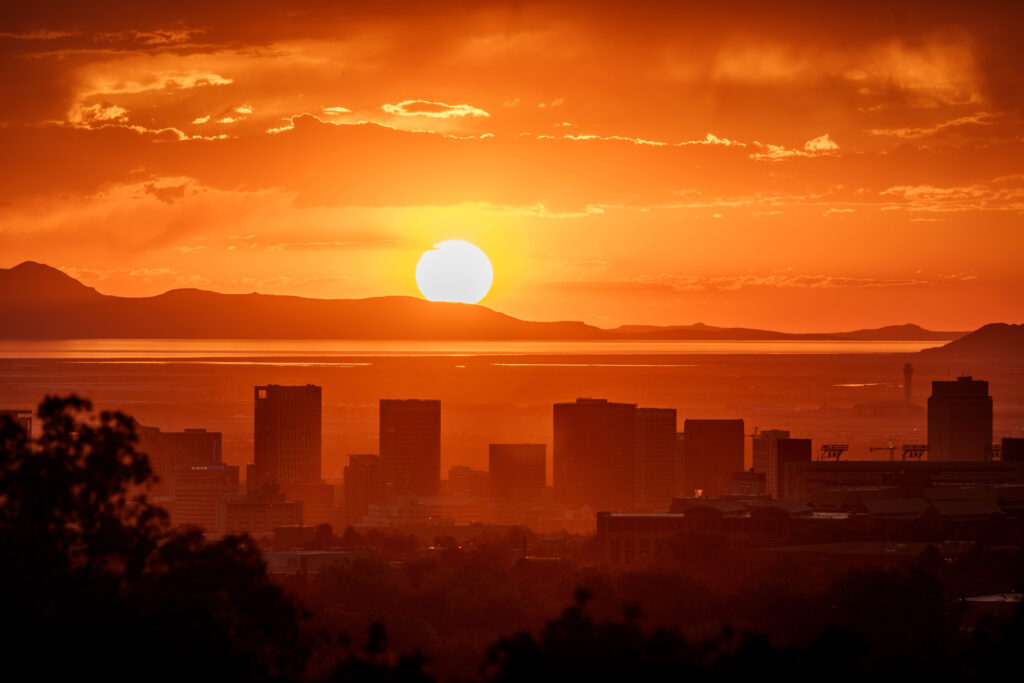


Downtown Salt Lake City is silhouetted as the sun sets over the Great Salt Lake on Wednesday, Aug. 20, 2025. (Photo by Spenser Heaps for Utah News Dispatch)
For a fourth year in a row, U.S. News & World Report has ranked Utah the No. 1 overall state in the nation, citing high performance in multiple categories including economy, fiscal stability and infrastructure.
However, Utah ranked low, No. 48, in one category — natural environment — due to air pollution and industrial toxin levels that exceed the national average.
The 2026 Best States analysis released Tuesday compared all 50 states on how they serve their citizens across a range of categories, including healthcare, education, economy, infrastructure, opportunity, fiscal stability, crime and corrections, and natural environment.
Utah Gov. Spencer Cox applauded the ranking in a prepared statement included in a news release issued by U.S. News & World Report.
“Being named the No. 1 state is an honor, but what matters most is what that ranking represents: hardworking people, strong families, and neighbors who look out for one another,” Cox said. “Utah’s success has never been about government. It comes from Utahns who serve, build, innovate, and invest in the future. I’m grateful to everyone who helps make our state the best place to live, work, and raise a family.”
SUBSCRIBE: GET THE MORNING HEADLINES DELIVERED TO YOUR INBOX.
Here’s how the top 10 states ranked overall:
- Utah
- South Dakota
- Minnesota
- North Dakota
- Nebraska
- New Hampshire
- Idaho
- Florida
- Washington
- Vermont
Diving deeper into the rankings
Utah ranked No. 2 for its economy, beat only by Texas, which leads the nation in job growth, GDP growth, net migration and youth population growth, according to U.S. News & World Report’s analysis. Idaho ranked close behind Utah as the No. 3 state for its economy.
In fiscal responsibility, Wyoming ranked No. 1 ahead of Utah, which took second place, and North Dakota took third. Wyoming jumped to the No. 1 position in fiscal responsibility after placing No. 30 last year, largely driven by improvements in budget balancing as measured by the ratio of total revenues to total expenses, according to the analysis.
Utah also ranked No. 4 for its infrastructure, beaten in that category by Nevada (No. 1), Oregon (No. 2) and Nebraska (No. 3). To evaluate infrastructure, the analysis looked at electricity prices, power grid reliability, renewable energy, internet access, and transportation metrics including bridge quality, commute time, public transit usage and road quality.
For its infrastructure, Utah was dinged for a 4.7% renewable energy use score compared to a national average of 8.8%, but earned points for an average commute time of about 23.2 minutes (compared to a national average of 27.2 minutes), and 17.5% of its roads rated to be in poor condition (compared to a national average of 18.9%).
Utah also ranked No. 7 for crime and corrections, with an incarceration rate of 186 per 100,000 residents (below a national average of 381), and a violent crime rate of about 230 per 100,000 residents (below a national average of 359).
For 19th year, Utah ranks No. 1 in nation for economic outlook
In education, Utah ranked No. 6, with a high school graduation rate of 88.3% (above the national average of 85.8%). It also has relatively low student debt and higher-than-the-national average math scores.
For healthcare, Utah ranked No. 18, with about 10.7% of its population lacking health insurance (compared to a national average of 11.3%), and an obesity rate of 31.2% (compared to a national average of 34.2%). It ranked No. 36 for healthcare access, No. 11 for healthcare quality and No. 14 for public health.
In the opportunity category, Utah ranked No. 24 in the nation, having lost points for affordability and equality issues due to housing costs and income, and employment disparities between men and women, people with disabilities and ethnic groups. However, Utah ranked higher for economic opportunity, with a median household income of $96,658 (compared to a national average of $81,604) and a poverty rate of 8.3% (compared to a national average of 12.1%).
For its low natural environment ranking, Utah was penalized for having 169 days a year with unhealthy air quality, above a national average of 152, and a measurement of 3,006 pounds per square mile of industrial toxins, compared to a national average of 930.
Policymakers react
The office of one of Utah’s top Republican legislative leaders, Senate President Stuart Adams, highlighted Utah’s longstanding ranking in a news release, which said it “reflects a strong foundation of economic growth, infrastructure, fiscal responsibility and opportunity that continues today.”
“Utah’s strength has always come from the people of Utah and their vision to look beyond today and build for tomorrow,” Adams said in a prepared statement. “Being recognized as the nation’s best state for a fourth consecutive year reflects our enduring values and the sound policies that have expanded opportunity, encouraged innovation and strengthened communities. We are proud of what Utahns have built together, and we remain committed to making our state the best place to live, work and raise a family.”
The Utah Senate’s top Democrat, however, issued a statement saying the ranking shows Utah has room for improvement, especially when it comes to affordability for working families and its air quality.
“Utah has a lot to be proud of, but the reality is that most working families are still struggling to make ends meet and can’t access basic necessities,” Escamilla said.
She also said the near-bottom ranking for Utah’s natural environment is “seriously concerning.”
“A state defined by having some of the most extraordinary landscapes and national parks in the world should also be a leader in protecting our public lands and the resources we depend on for survival,” she said.
Utah has long had poor air quality compared to the rest of the nation, largely due to its natural geography, with mountains that form a bowl around the Wasatch Front that can trap cold air in the winter, aggravating pollution levels. The shrinking Great Salt Lake also exposes dry lake bed, which exposes dust that can be blown into nearby communities.