Utah News Dispatch
Utah lawmakers consider English proficiency requirement for CDL applicants


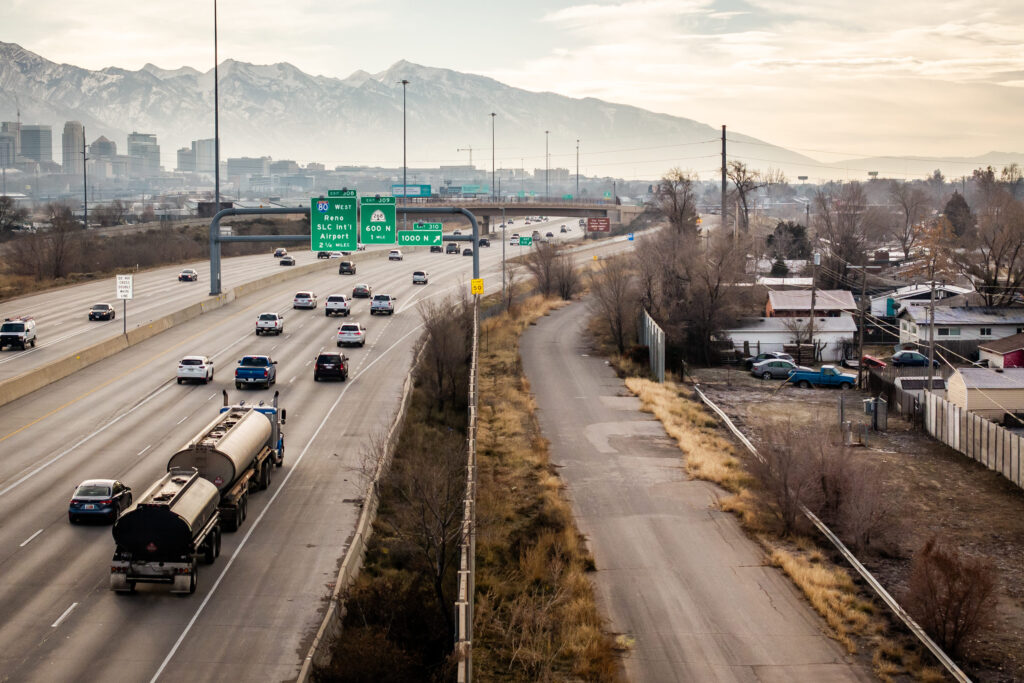


Traffic moves along I-15 near neighborhoods in the Rose Park neighborhood of Salt Lake City on Wednesday, Jan. 3, 2024. (Photo by Spenser Heaps for Utah News Dispatch)
Utah lawmakers are considering a bill that would require all applicants for a commercial driver’s license to attest they are proficient in English before training, building on existing federal law requiring English proficiency for all CDL drivers.
HB118 received a favorable recommendation from the House Transportation Committee in an 8-2 vote Monday. Bill sponsor Rep. Candice Pierucci, R-Herriman, told the committee the bill aims to increase safety on the roads and create additional oversight for CDL training schools. Pierucci said the bill will also help protect non-English-speaking applicants from undergoing expensive CDL training only to later be denied a license because of federal requirements.
The bill requires CDL applicants to sign a form attesting they can speak proficient English, with the sponsor saying it will increase safety on the road by requiring drivers “can converse with the general public, understand highway traffic, signs, signals, respond to official inquiries, etc.” It also requires CDL training schools to report applicant passage rates and data collection about which training school a CDL applicant used.
SUPPORT: YOU MAKE OUR WORK POSSIBLE
“I view (this) as a protection for the student because it’s unfair to require them to pay all that money, and then not be able to actually pass,” Pierucci said. “They may know the material, but not be able to articulate it in English.”
The U.S. Department of Transportation requires that all CDL drivers be proficient in English, and recent actions — including an executive order from President Donald Trump — aim to enforce the requirement.
Two Salt Lake City Democrats — Rep. Angela Romero and Rep. Rosalba Dominguez — voted no, with Romero citing worry “with our current political climate,” emphasizing “concerns on who’s going to determine who is English proficient.”
In response, Pierucci told the committee a counselor or supervisor at the training school would make the determination about an applicant’s language proficiency.
“The schools, if they’re operating in good faith, should have someone who is already doing that assessment, as it is federal guidelines now,” Pierucci added. “I would hope they’re flagging that already.”
Additional oversight
While speaking with Utah News Dispatch, Pierucci said that pursuing a CDL certification can cost thousands and is time intensive, emphasizing the bill’s oversight requirements would help protect applicants from being taken advantage of by “bad actor” CDL training schools.
“The oversight is actually having a physical piece of paper that they have to sign that is submitted to the driver’s license division,” she said. “That’s where that oversight component comes in, because right now, if you’re not tracking which school they come from, there’s no way to identify the bad actor.”
HB118 creates additional requirements for CDL training schools, requiring them to record which school an applicant used and report applicant passage rates.
I think it’ll help us maintain high quality, reputable training companies across the country as this becomes a more important issue.
– Rep. Candice Pierucci, R-Herriman
“(The bill) has a data collection component so the driver’s license division can monitor this and help us identify those schools that are underperforming, or maybe non-compliant in training programs,” she added. “I think it’ll help us maintain high quality, reputable training companies across the country as this becomes a more important issue.”
Rick Clasby, executive director of the Utah Trucking Association, spoke in support of HB118, telling the committee “there have been some very high-profile accidents across the country,” and “it’s become a real sensitive issue for trucking associations across the country.”
“We highly support this recommendation and appreciate that it does two things, that ensures safety and language proficiency, and it protects those students who might be taken advantage of by having to go to a school multiple times or not be able to pass the test at the conclusion of their training,” Clasby said.
SUBSCRIBE: GET THE MORNING HEADLINES DELIVERED TO YOUR INBOX