Utah News Dispatch
Utah governor vetoes 2 bills, including one to help put Wi-Fi on rural school buses

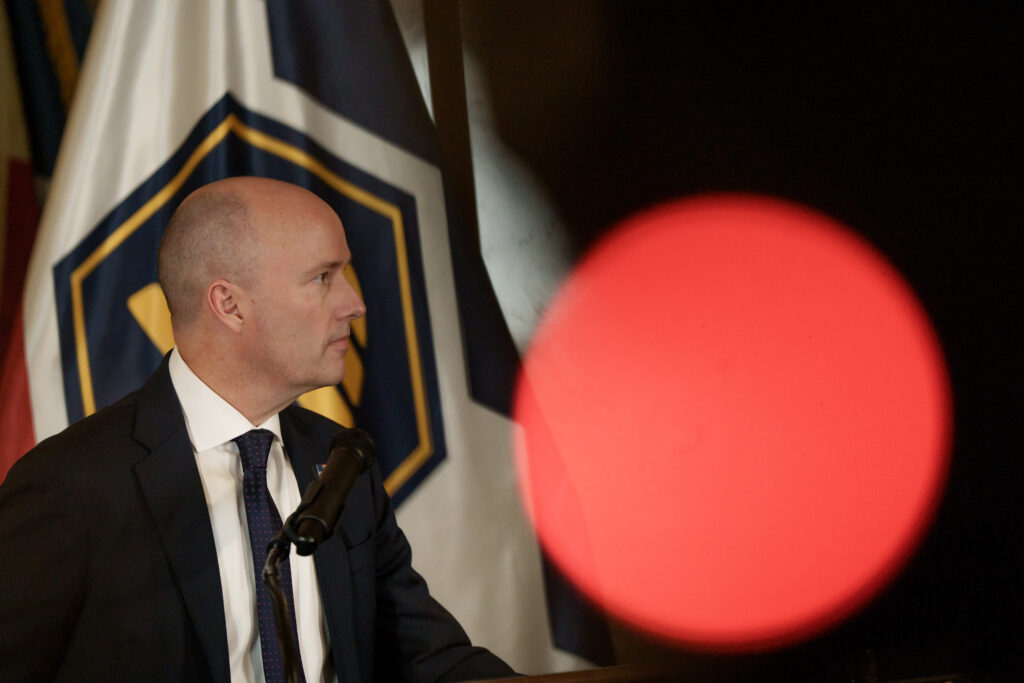

Gov. Spencer Cox speaks during a press conference at the Capitol in Salt Lake City on the final night of the legislative session, Friday, March 6, 2026. (Photo by Spenser Heaps for Utah News Dispatch)
Utah Gov. Spencer Cox on Thursday vetoed two bills that were passed by the 2026 Utah Legislature earlier this year.
They included:
- HB462, sponsored by Rep. Tiara Auxier, R-Morgan, which would have used about $325,000 to create a grant program for rural school districts to put Wi-Fi on school buses
- HB164, sponsored by Rep. Stephanie Gricius, R-Eagle Mountain, who sought to require health care providers and their employees to tell a patient how to file a complaint with Utah’s Division of Professional Licensing if the patient expresses concerns about a provider’s conduct. It would have also required disclosures to a patient before a doctor could enter into a settlement agreement that precludes a patient from filing a complaint with DOPL.
Cox explained his reasoning for the vetos in a letter to lawmakers.
In that letter, Cox said he vetoed Auxier’s bill because he’s concerned about “signaling to our students that we value more time spent on devices rather than more time interacting with one another face-to-face.”
Legislature approves bell-to-bell cellphone ban in Utah schools
As for Gricius’ bill, the governor said he vetoed it because it would have conflicted with provisions in another bill lawmakers also passed, SB117, which he said “better accomplishes the stated intent.”
Cox, in his letter, also explained his misgivings about a bill that the Legislature passed a second time after he vetoed an earlier version last year, but that he would allow it to become law without his signature because of legislators’ persistence.
That bill is HB195, sponsored by Rep. Ken Ivory, R-West Jordan, which allows the state to deal in “precious metals” like gold and silver and requires state leaders to create a precious metals-backed electronic payment system the state can use to pay vendors.
Cox says no to Wi-Fi on rural school buses
Of his two vetoes this year, Cox’s decision to stop HB462 from becoming law is the most controversial.
Cox acknowledged in his veto letter that the goal of the bill was to help students in rural school districts “do homework on school-issued computers during long bus rides for school sports or other activities.”
Cox, from Fairview, said he grew up as a student in a rural district and “I recognize the added challenge of longer bus rides for rural students.”
SUBSCRIBE: GET THE MORNING HEADLINES DELIVERED TO YOUR INBOX
“But I am very concerned about signaling to our students that we value more time spent on devices rather than more time interacting with one another face-to-face,” Cox wrote in his letter. “Our kids simply need less screen time and more human connection.”
Among the governor’s top priorities during the 2026 legislative session was a bill (which passed and he signed) requiring school districts to have a default “bell-to-bell” ban on cellphones. Cox has been a vocal critic of social media companies and their impacts on kids.
“I applaud the Legislature’s wise efforts this year to take a step back from devices and better balance students’ use of technology. I hope we continue to move in that direction,” Cox wrote.
He added that had Auxier’s bill “required schools to provide paper assignments to students in extracurricular activities to add greater flexibility for them accomplishing their work, I would have supported it.”
“But I don’t support creating infrastructure to facilitate more screen time,” Cox said. “For this reason, I have vetoed HB462.”
From phones, to school-issued laptops and AI, here’s how Utah schools are changing their rules
Auxier, in a lengthy statement defending her bill as a “practical, narrowly tailored solution to a real challenge facing rural Utah students,” expressed disappointment in the governor’s veto.
“Governor Cox has made student health a priority, which makes this veto especially disappointing, because this bill directly supported that goal in a thoughtful, limited way,” Auxier said. “Rural students shouldn’t have to choose between participating in school activities and getting enough sleep to succeed.”
Auxier argued that student athletes from rural school districts “often travel hours across the state, getting home as late as 11 p.m. and only then starting homework.
“That’s not sustainable, and it’s not healthy,” she said. “This bill was designed specifically to address that.”
She also noted that her bill would have only allowed school-issued laptops, not personal devices, to connect to the bus Wi-Fi, and it would have only “applied to a small number of buses serving the longest routes.”
“This aligns with the broader approach of other recently passed legislation, not banning technology, but promoting its responsible use to support student learning and well-being,” Auxier argued. “The reality is, students already have phones on these buses. Screen time isn’t the issue. The question is whether that time is wasted on scrolling or used productively to complete homework earlier.”
Conflicting bills
On his veto of Gricius’ bill, Cox said he’s preventing it from becoming law “for more technical reasons.”
“Representative Gricius undertook this bill to better protect patients and their ability to bring complaints to the Division of Professional Licensing (DOPL) in appropriate circumstances,” Cox wrote.
But he noted that while it was moving through the legislative process, another bill — SB117 — also progressed. Rather than allowing settlement agreements like HB164 would have, Cox noted that SB117 would make it unprofessional conduct for a provider to do anything that would keep a patient from filing a complaint with DOPL, including a settlement agreement that prohibited a patient from filing a complaint.”
Thus, he said the bills conflicted with each other.
“To address this conflict, and because I think the policy in SB117 better accomplishes the stated intent, I am vetoing HB164,” Cox wrote.
Gricius, in a prepared statement, said she appreciated Cox and his administration “for their strong partnership and thoughtful collaboration on this legislation.”
“I look forward to working together in the coming months to find the best path forward that better protects Utah’s patients,” Gricius said.
Allowing gold bill to become law without his signature
The governor picked one bill to become law without his signature: HB195, which allows the state to deal in “precious metals” like gold and silver.
It’s not the first time a version of that bill has landed on his desk. Last year, Cox vetoed an almost identical one, saying at the time that it posed “significant problems” that would have made it “operationally impracticable.”
Cox vetoes four more bills, rejecting a controversial tax policy and innovative gold legislation
Cox said he wrestled with this bill, saying that while he received messages in support of it, he also received “a significant number of messages in opposition.”
“Many are concerned that this will result in unwelcome government involvement in the gold market,” Cox wrote.
However, the governor noted that even though he vetoed last year’s bill, “the Legislature passed it again this year,” even though through the legislative process it hit several road blocks in a Senate committee and on the Senate floor.
“Though I signaled my concerns about this bill last year, the Legislature appears to be intent on passing the bill (this year with 65 Representatives and 22 Senators voting in favor),” Cox wrote. “And even though I heard from some Legislators who voted for the bill and hoped that I would veto it, I have decided to allow the bill to pass into law without signature this year.”
Read the governor’s full veto letter below: